Your bag is empty.
The rap legend and his co-creators Amy Chu and Larry Hama on their new mini-comic, chocolate chip cookies and why Bruce Lee is the blackest man in hip-hop

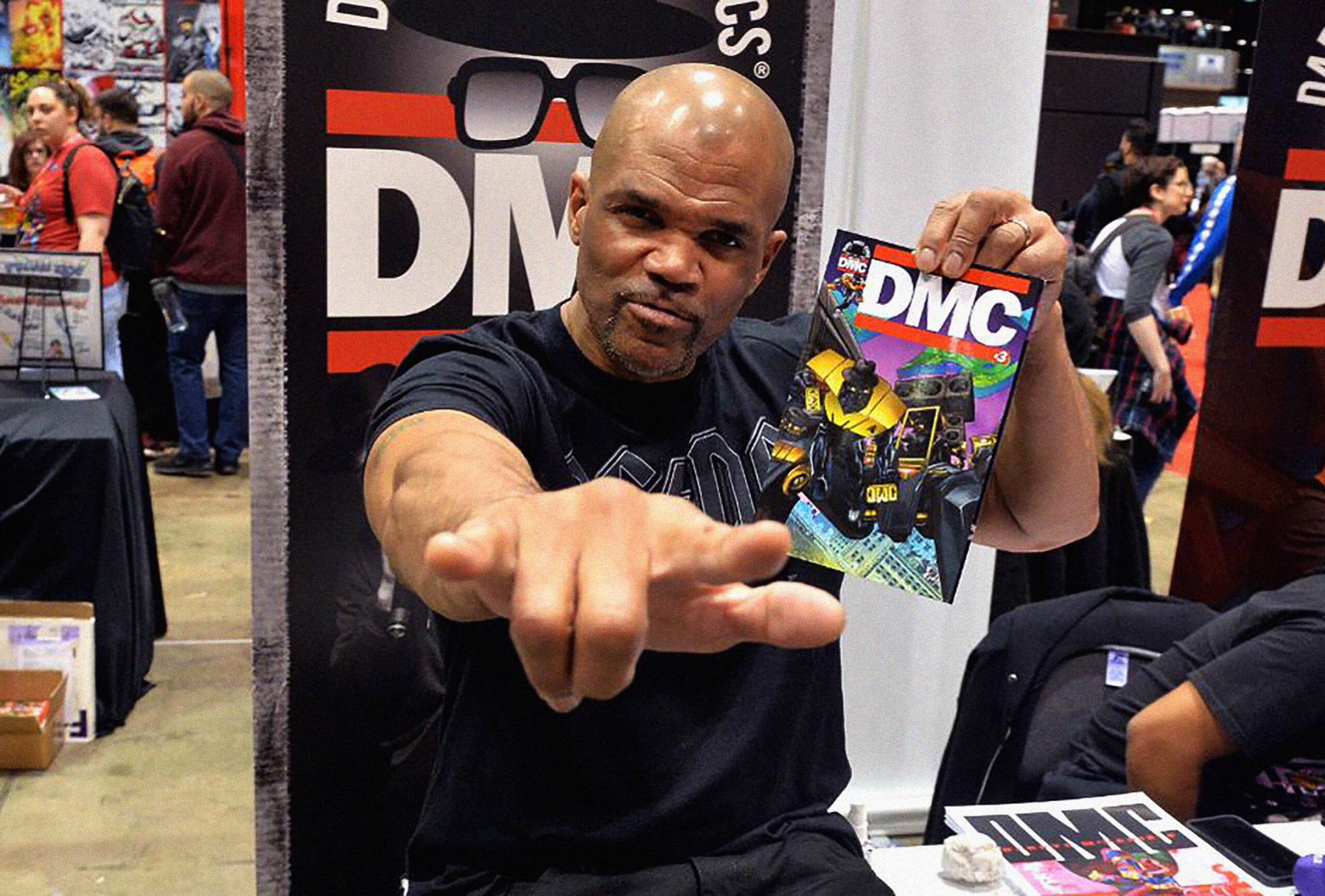
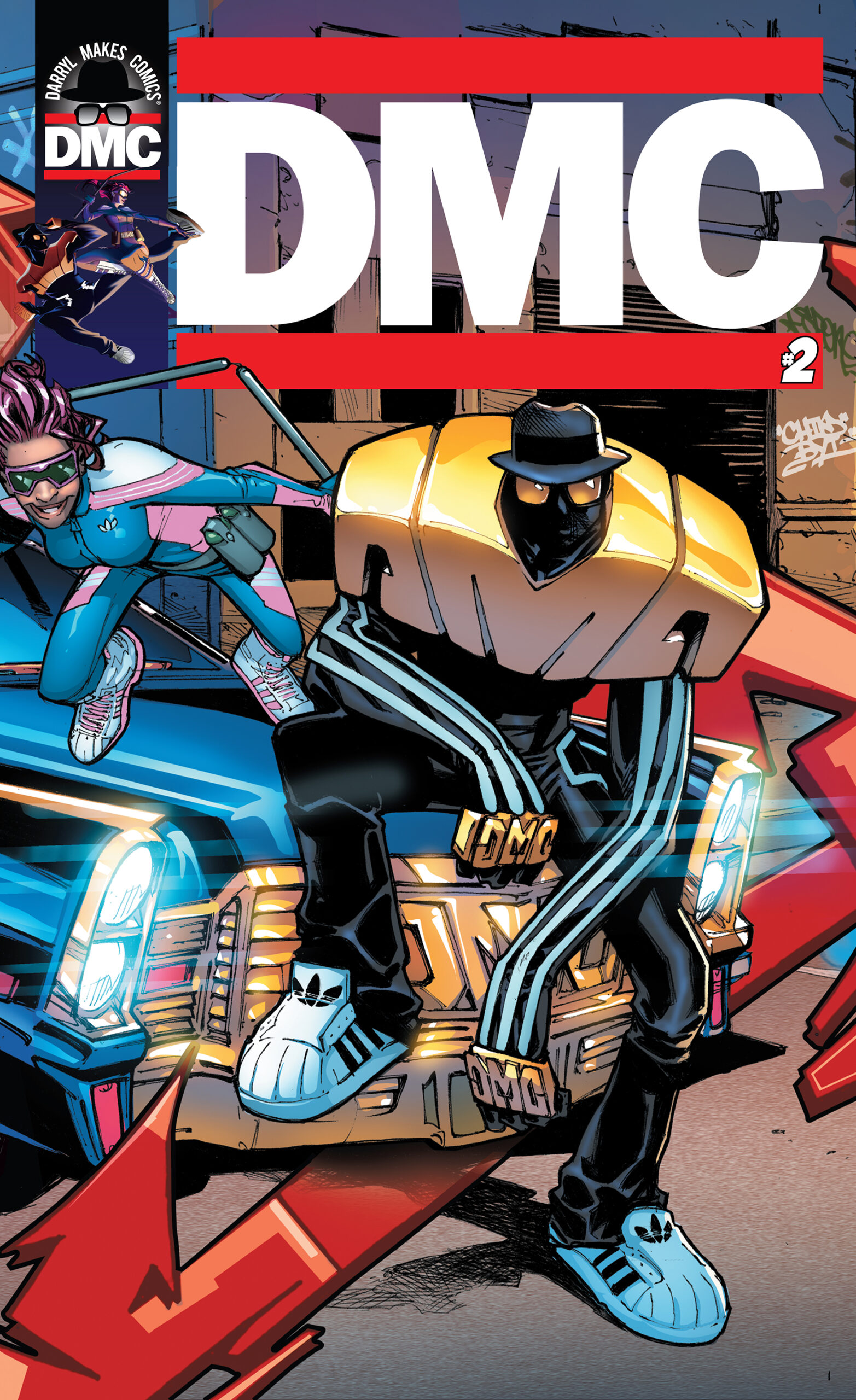
What do you get when rap music icon Darryl “DMC” McDaniels teams up with acclaimed comic book writer Amy Chu (Red Sonja, Poison Ivy) and legendary comics artist Larry Hama (G.I. Joe, Wolverine)? You get a powerhouse creative dream team responsible for “Outta This World,” a new mini-comic produced exclusively for Playboy. McDaniels, the self-proclaimed “King of Rock,” has been a superhero nerd since his elementary school days. In 2014 he directed that passion into founding his very own independent publishing house, Darryl Makes Comics, and introducing the world to DMC, a superhero alter ego that fights crime in 1985 while sporting a fedora, shades, tracksuit and Adidas sneakers. Much like the Marvel comics that inspired McDaniels as a kid, the DMC universe is set in New York City.
McDaniels’s comics enterprise eventually attracted the writing talent of Chu—who has penned stories for Marvel and DC and contributed to franchises such as Wonder Woman, Poison Ivy and Deadpool—and Hama, whose impressive résumé in the business stretches nearly 50 years. He has put his stamp on many eminent characters, including Wolverine, Venom and some dude you might’ve heard of named Batman, but he is perhaps best known for adding his golden touch and incorporating his own military experiences into G.I. Joe. Eisner Award–winning artist Rob Guillory also lent his considerable talents to the Playboy project (but was unavailable for interview).
McDaniels, Chu and Hama are set to participate in the first-ever fully virtual San Diego Comic-Con later this week, the traditional convention having been canceled due to coronavirus. In a wide-ranging conversation that took place over both Zoom and e-mail, we spoke about everything from Stan Lee to Bruce Lee and from diversity to authenticity.
PLAYBOY: How has the pandemic affected your lives?
DARRYL MCDANIELS: The first two days, it was all anxiety and fear. But on about the third day, I settled down. Even though I’m 56 years old, something made me feel like I was 12 again. When I was growing up, I had only my imagination, my comic books, my Godzilla movies, my Boris Karloff, Bela Lugosi, classic black-and-white Hollywood monster shows and just writing rhymes. By the third day I found myself sending out a lot of e-mails about DMC comics ideas. I also wrote about 50 new songs. It was just me and my imagination. It was just in the last two weeks when I finally started going out to record the new stuff.
PLAYBOY: You just put out a great track with Anthrax drummer Charlie Benante, “CB’s Run-DMC Jam.”
MCDANIELS: Thank you. That’s one of the things that came out of this pandemic. I also started a cookie company, Darryl Makes Cookies. I’m going to do oatmeal, chocolate chip and sugar cookies.
AMY CHU: Darryl Makes Cookies? I’m all for this! You know, it’s funny, the thing about being a writer is, it’s not a huge change. I work from home anyway.
Mild-mannered Darryl McDaniels became ‘the Mighty King of Rock’ because of comic books.
MCDANIELS: Are you going to help me with my cookies?
CHU: I can help you with your cookies. That’s what I’m supposed to be doing, not writing comics. When my friend said she wanted to start a comic book company, she’s like, “You’ve got to understand how comics are made.” So she dragged me to this writing class to understand comics. I wrote a story and people were like, “Oh, it’s really good.” And I’m like, “That’s ridiculous. I don’t write comics. I write business plans.” But I kept writing, and there weren’t a lot of women writing comics at that time. It was very much like, “Who’s this girl who doesn’t know anything about comics? Let’s see how long she lasts.” And that kind of pep always gets me where I’m like, “Oh, I’m going to show you. I’m going to get a Marvel or DC credit just to show you it can be done.” And obviously I overshot. I also do this because it’s all for that business school reunion. I get to go back like a hero. I’m like, “Yeah, I’m writing comics for Darryl McDaniels.” And they’re like, “Oh my God, what’s that like?” [laughs]
PLAYBOY: Darryl, how did people first react when you started getting into the comics business?
MCDANIELS: When I started going to conventions, the first reaction is, “What the hell are you doing here?” They would just start talking about the music. Then they would look down and see the comic books and I would explain, “Before I even wanted to be in music, all I did was read, collect and draw.” The attention-getter is me and what I’ve done as a musical artist, but then people get blown away by the comics.
PLAYBOY: What were your reactions when you found out Playboy wanted you to produce an original comic-book feature?
LARRY HAMA: I wasn’t all that surprised. Playboy has a long history of highlighting social causes, and I remember longtime cartoon editor Michelle Urry was known to every cartoonist I knew as a bastion of good taste with an impeccable eye.
PLAYBOY: Amy, you have a history with Larry. What’s the backstory there?
CHU: I actually met Larry before I got into comics; we were both involved in the Asian American arts and cultural scene. When I first started writing, it was very hard to break into comics. I pursued Larry to be my mentor. I wrote a short story set in a World War II Japanese internment camp, and he offered to draw it, which was very unusual because I was a nobody at that point. But his family had been interned in WWII. So he offered to draw it, and it was kind of a huge thing. He’s so knowledgeable on so many fronts. I’ve learned so much from him.
PLAYBOY: One thing all three of you have in common is that you started in other fields before getting into comics. Darryl was in music; Amy was in business, and Larry was doing trade illustrations.
HAMA: I was drawing shoes for Sears, Montgomery Ward and JC Penney catalogs, and doing underground strips for Gothic Blimp Works in the 1960s. Gothic Blimp Works was like the Sunday funnies for the East Village Other.
MCDANIELS: I grew up reading comic books. They were the only place I saw educated, awkward, clumsy people who were powerful. When I was growing up in Queens, New York, the people who were considered cool were the drug dealers, the gang bangers, the pimps and the pushers. When I first met Riggs Morales, he said, “You should do a comic book, D.” And then he told me, “You got a lot in common with these comic books because most of these comic book characters are adopted.” At the age of 35, I found out that I was adopted. Spider-Man, Bruce Wayne, Tony Stark, and Superman had all lost their parents. Subconsciously, I think I had a lot in common with them, which set me up to have my alter ego as the Mighty King of Rock and the Devastating Mic Controller. Now, I have this opportunity to tell stories that can educate, inspire and entertain people the same way Stan Lee did for me when I was a little kid. Stan Lee was brilliant because he put the superheroes in New York City. Gotham and Metropolis are cool, but they are fictional. If Spider-Man lives in Queens and all these superheroes are in New York City, then that make-believe world shows me that whatever you imagine is achievable. So mild-mannered Darryl McDaniels became “the Mighty King of Rock” because of comic books and because Stan Lee showed me that make-believe is real. So for me it’s the full-circle thing.
CHU: Oh, I have such a different story.
MCDANIELS: You were supposed to be in finance, right?
CHU: It’s totally crazy, right? I was happy in business. I didn’t grow up reading comics like Darryl. I was just trying to help a friend of mine. She sucked me into it, big time. You tell me you want to make art, I will help you figure out the financial part of it—business plan, marketing plan, strategy. I got into it and I was like, okay, I am the person who helps people achieve their dreams.
MCDANIELS: I’m going to be truthful, my first reaction was, “What kind of X-rated comic…” [laughs] You know what I’m saying? When I heard about the others that were in the magazine before me, I was scared I wouldn’t live up to expectations. I knew Playboy did interviews—the greatest writers, former presidents, actors—and I would always read those. When they interviewed Clint Eastwood, it showed me that this guy is much more than just Dirty Harry. If Playboy wants my comic book, it’s got to be badass, because when I see the roster that went before… It was me saying, “Man, I got a lot to live up to.” I was afraid I would fall short, and I don’t want the people to say, “See, DMC doesn’t really make comic books, he should stick to rapping.” I didn’t want that to happen.
PLAYBOY: Amy, you’re friends with Gail Simone, who wrote a Vampirella comic for us, so I imagine you were already aware that Playboy featured comic books?
CHU: I knew you had a long tradition of doing cool stuff with comics, illustrations, that kind of thing. I knew you did one with Hellboy too. You’ve had some good ones for sure.
MCDANIELS: Yeah, Hellboy scared me. Hellboy is a hard act to follow.
PLAYBOY: When you first started brainstorming for “Outta This World,” how quickly did it take shape?
MCDANIELS: It didn’t take long. We wanted it to be relatable to the established DMC universe, but we also wanted it to be exclusive and different. So we kept the DMC-universe characters, theme, hip-hop and purpose, but took it intergalactic. Now if we go intergalactic in future DMC-universe comic books, people will understand that the two are related; this mini-comic opened up that door for us. Now we got our foot in there.
I was a straight-A student because of my comic books.
CHU: That was probably the most successful brainstorming we had. Darryl was like, “If we go intergalactic, we need an alien.” I’m like, “Yeah, we need an alien. So, an alien comes down…” It was such a classic writers-room kind of thing that if it had been on reality TV, it would have been a perfect moment because we were like, “That totally makes sense.” And then we did this, and then this happened, and I’m like, “Oh my God, did we just break down the story?” And we wanted it to have a message. Because what’s the point in doing it without a message?
PLAYBOY: And the message is, “Don’t judge a book by its cover”?
MCDANIELS: Exactly. Each comic book should have an underlying theme. I love that.
PLAYBOY: Larry, what was your reaction to the story and overall message that Darryl and Amy came up with for “Outta This World”?
HAMA: I thought, “Hip-hop culture has come a long way.” I knew filmmaker Charlie Ahearn back in the day, and it was Charlie who introduced me to that culture. I was at an event at Danceteria with him when we first heard the new usage of “fresh.” We were both like, “This is going to be universal right quick.” Socially conscious superheroes from the hood is something that needs to happen.
PLAYBOY: What made you decide to base a character on real-life graffiti artist Lady Pink?
CHU: Our character Pinky also appears in DMC #1.5 and is inspired by Lady Pink, and Blue Boy is inspired by another artist, Sano. A lot of people think of street art and graffiti as vandalism. We don’t. We want to celebrate it as an art form. The least we can do is pay homage to the pioneers who did all that.
MCDANIELS: We always want to pay homage, celebrate, pay tribute to all creatives across the board. It’s like the Stan Lee thing, using New York City.
PLAYBOY: Let’s talk more about comic-book messages. What do you say to parents who won’t let their kids read comics?
MCDANIELS: Whether it’s race, women’s rights, civil rights, political rights or religious themes, comic books can start a dialogue about issues people are afraid to talk about. There’s a multitude of comic books that’ll help children understand bullying and people who don’t love and respect each other. I got a song, “Little kids, it’s not their fault/ Hate is a thing that must be taught.” Consider how to get through to the black kid who thinks all white people are evil. You can break through that wall of ignorance by saying, “Whoa, Captain America got a black dude called the Falcon who’s badass and that’s Steve’s boy.” Without those comic books, I wouldn’t have understood half the things going on in my real world.
I had teachers—Miss Regina, Miss Peterson, Miss Florentino, Sister Mary, Sister Patricia—who would take my comic books away but at the end of the day give them back. They were like, “This kid is a good student because he’s reading every day.” If kids are reading their comic books, they’ll be able to read their textbooks and workbooks too. I had the desire to read about science so I could understand what the hell Tony Stark and Reed Richards were talking about. Certain educators saw that connection. Other educators were too ignorant to even give it a chance. I was a straight-A student because of my comic books. So that’s what I would tell those parents. If you want to see your kids with a better attitude, you better let them read that comic book.
HAMA: I get hundreds of letters from readers who say that comics helped them deal with dyslexia or improved their vocabulary. I’ve made it a point for over four decades not to write down to kids. I’ve always maintained that the kids who spend their own money to buy something to read for pleasure are probably smarter than average. I’ve heard hundreds of fans say that reading Captain America, Superman and G.I. Joe had a direct impact on developing their moral centers.
People don’t know, but there’s nobody in the history of hip-hop blacker than Bruce Lee.
CHU: I feel the same and I talk as a parent. I did get some really expensive degrees—MIT, Harvard and Wellesley—and I have two kids who grew up on comic books because that’s what Mommy’s doing. I’m making them read comic books, actually. My oldest son is like Darryl—a straight-A honors student who literally read comic books for the majority of his life. I think he turned out just fine.
PLAYBOY: Comics have long been diverse and can now be a springboard to mainstream movies—Black Panther became a household name; Shang-Chi is getting his own Marvel movie soon. You’ve all helped bring diverse, complex characters to life in the DMC universe and elsewhere; DMC’s sidekick LAK6 is a Puerto Rican girl.
MCDANIELS: Except for Jase, all DMC’s right-hand people are women. It’s not like we’re sitting there saying, “We’re going to make all the powerful DMC sidekicks women.” When we create these mystical characters, they pop out organically.
What I don’t like about the diversity issue is when we vocalize our concerns as people of all communities and colors to Hollywood, and then they do it just because “We need to throw a black guy up in there to get people to like us.” No, throw the black guy up in there because he’s really a powerful character. Throw a lady up in there because she’s really a powerful character. Don’t showcase diversity and inclusion just because people are bitching about it. Tell a powerful story. I understand why they do it, but it’s like, don’t make Thor a lady. Make a lady with her own name who’s more powerful than Thor, who busts Thor’s ass and you have to fall in love with her.
CHU: But Thor sells, you know?
MCDANIELS: Exactly. But I would prefer if they introduced a female thunder god named…Thorsilla. [laughs] She busts Thor’s ass and you don’t even care about Thor anymore. That’s what I mean.
People don’t know, but there’s nobody in the history of hip-hop blacker than Bruce Lee. When I was growing up in the 1970s, Bruce Lee was a god to us. Perfect example is Wu-Tang Clan. People might not have liked hip-hop, but when Wu-Tang started talking about kung-fu movies, people who didn’t care about hip-hop were able to bond as people with Wu-Tang for the love of those kung-fu movies. That’s the beauty of diversity. We didn’t make “Walk This Way” with Aerosmith to get white people to like us. We made “Walk This Way” with Aerosmith because they were white guys who made some badass music that these black dudes fell in love with. And once we get together, whether it’s in a studio or on the pages of a comic book, people can see the similarities through all of their differences. That’s the thing that brings us together.
There are more Black, Asian and Latinx creators than ever. We are entrenched, and the detractors are not going to shove us out.
CHU: Authenticity is super important now with consumers. We can tell when it’s a joke, when it’s tokenization. This is coming from our experiences, our collective. Our characters come out of our collaborative process. It’s not just because, “Oh, we need a Latina.” We’re going for interesting multi-layered characters. It’s not like we can have all these characters with the same old tropes and traumas and whatnot.
HAMA: I think there have been tremendous strides in diversifying comics, amidst some fierce opposition from people whose reading comprehension I have serious doubts about—did they not understand what was going down in X-Men or in Denny O’Neil and Neal Adams’s take on Green Lantern/Green Arrow? But comics have been diverse and socially conscious for some time now. Working in comics was an immigrant dream. When I first entered the biz, it was mostly Jewish, Italian and Irish. Now, there are more Black, Asian and Latinx creators than ever. We are entrenched, and the detractors are not going to shove us out.
PLAYBOY: Would you like to see your DMC characters hop into the movies?
MCDANIELS: Yes, that’s what we’re working toward. That’s why we’re in a stage of establishing relatable characters that we can take on continuous journeys throughout generations. I want the DMC universe to be relevant 500 years from now. We’re starting to get bites.
CHU: Our first and foremost love, as you can tell, is comics. If it was just comics, we’d be happy, but in the current world you need to bring the story to different platforms. My cynical MBA twin is like, “What are you talking about? You’re exploiting the IP!” But we don’t do it that way.
MCDANIELS: When we do exploit the IP we want to do it with integrity. I had people approach me already for the movie thing. But I didn’t want people to rush into it. I don’t want to just sign a movie deal because Black Panther was successful. When we come out, we’re going to blow Black Panther away.