Your bag is empty.

Experts weigh in on the new “love drug” nasal spray.
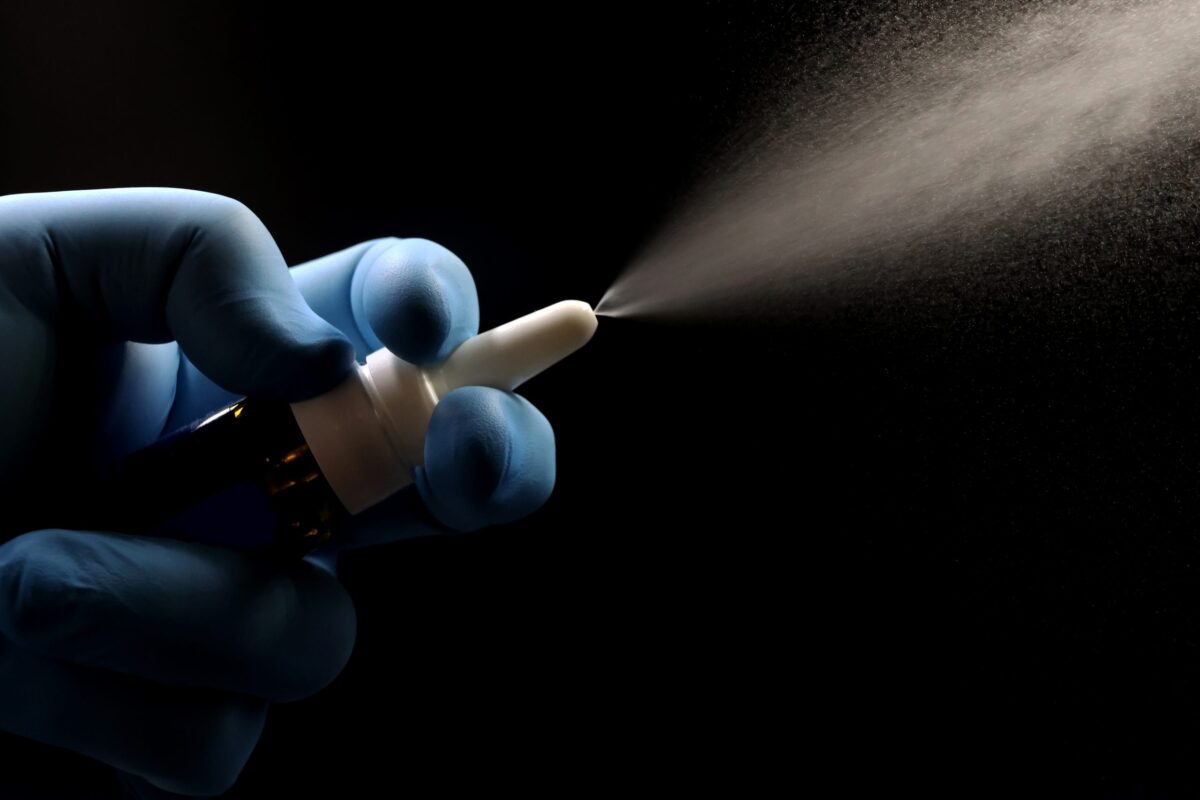
In our limp cultural imagination, we’ve sold oxytocin short. Most colloquial renderings of the nanopeptide, a fancy term for nine linked amino acids, diminish its rather awesome list of functions to a romanticized “cuddle hormone,” something our brain spurts out while we’re nuzzled up with a partner. But it’s more than just a byproduct of human intimacy.
Versions of the hormone have been found in almost every living species from newborn babies to lizards and beetles. In humans, it helps to manage stress, regulates sleep and relaxes our pesky score-keeping bodies. During birth, oxytocin drives contractions to the uterus to help push out the fetus. And, because a brand new baby doesn’t have the motor strength to suck milk, oxytocin causes mammary tissue to contract and squirt milk into a newborn’s mouth to ensure its delivery. To put it lightly, you can thank it for furthering the human race.
But never mind all that. According to some telehealth companies offering the hormone via sniff, oxytocin is little more than a “love drug.”
“There’s kind of no such thing as a love drug,” Robert Froemke, the Skirball Professor of Genetics at NYU Grossman School of Medicine, told Playboy. “Like, is a margarita a love drug?”
Intranasal oxytocin, a spray that some telehealth companies are hocking as a potential cure-all for sexual frustration, has been popping up more frequently on internet ads, with some touting its reputation as the “love drug” or the “cuddle hormone” as a solution to any bedroom frustrations, along with positive benefits for those with social anxiety. One company’s ads even labeled it “Ozempic for sex,” — whatever that means — in hopes of spurring you to shell out upwards of $100 for the peptide spritz.
Because of the multiple jobs oxytocin can perform in the body, these outlets have touted it as the solution to multiple different problems. Healthspan, one such telehealth company, emphasizes its ability to counteract cortisol, a hormone released by the body during times of stress, while Joi + Blokes, another, underscore its ability to help in fostering emotional connections, calling it “better than Netflix and chill.” Either way, the idea is that the presence of oxytocin in the body would act as a fast-track to the warm feelings considered its widely known for.
One telehealth company offering oxytocin spray, Ready, specifically hits the gas on oxytocin as a potential problem solver for people who are taking any GLP-1 agonist, such as Ozempic or Wegovy, and may be experiencing sexual side effects. That claim at least works from a solid foundation: Ozempic has been shown to have side effects that could affect a person’s sex drive, though researchers are not exactly certain why.
In a study published in the medical journal Obesity Pillars in November, researchers concluded that, by affecting the amount of serotonin produced in the brain, GLP-1 agonists “may indeed be associated with a decrease in sexual desire and behavior,” which had backed up earlier findings in mice published in the Journal of Sexual Medicine. Though these particular medicines may diminish sexual desire, their effects may also enhance a person’s sexual desire overall by offering the user an improved body image, better glycemic control and an increase in overall testosterone, alongside more physical activity, improved sleep and a better overall mood.
Dr. Melissa Loseke, a medical advisor at the telehealth company Joi + Blokes, added that, though oxytocin might help with desire and arousal, the science is less clear as to whether it can address erectile dysfunction, which can be both vascular and hormonal, calling it “rarely a stand-alone answer” to trouble getting or staying hard, but one part of a “thoughtful protocol” that looks at testosterone, vascular health as well as the “psychological-relational layer.”
While Ozempic could contribute to lower libido overall, what’s still unclear is how well oxytocin works as a supplement, especially delivered intranasally, and whether delivery of oxytocin can have the effect that the user sets out for it to have.
That’s because, Froemke continues, research, as well as its results, are context dependent. For instance, just because people giving birth are given oxytocin to induce labor, doesn’t mean they suddenly become overamorous.
“People aren’t bonding with their doctor, right?” he said. “They’re not bonding with their IV oxytocin delivery machine. The context absolutely matters.”
Ultimately, Froemke said, although the molecule itself is highly researched, he’s hesitant to say that a nasal spray can have the effect that some telehealth companies promote it for.
“There’s not a ton of really, really good data on whether we can deliver it to people in a really innocuous way, like through a nasal spray, and get certain effects we want out of it,” Froemke said.
Much of the literature backs up Froemke here.
“While a number of studies had indicated that the intranasal route could be effective in delivering drugs or peptides directly to the brain via the olfactory and trigeminal nerves, there has been considerable controversy concerning whether this is the route whereby oxytocin or vasopressin produce their observed functional effects,” researchers wrote in Pharmaceutics in 2022.
To be fair, the literature is not all down on intranasal oxytocin, but rather mixed or unclear. A 2020 review in Nature certainly said the results seemed promising, but still called for further study.
“Recent critiques of human intranasal oxytocin have been a much-needed wake-up call for behavioral oxytocin research,” researchers wrote. “The intranasal administration of oxytocin remains a worthwhile approach to better understand the neurobiology of our thoughts, feelings, and behaviors.”
While Oxytocin is FDA-approved as an injection to be used before, during or after labor, it is not approved for many of the uses for which it is touted across the internet, including addressing low libido or high anxiety. (Both Froemke and Loseke emphasized that people who are pregnant should not take oxytocin at all, given that it is used to induce labor.) The kind that is accessible to people — and has been touted on several telehealth sites — usually has to be made custom in settings known as compounded pharmacies, which allow a physician to formulate dosages, delivery and concentration for each patient.
Each expert who spoke to Playboy seemed hesitant to recommend it as a first-line therapy for the vast array of problems some telehealth sites seem to hope it can solve.
Though Froemke is clear that he is not a physician and just a researcher, he did say that, if asked, he would steer people down the behavioral route to address any oxytocin shortfalls rather than resorting directly to pharmaceuticals. That means maybe some good old-fashioned counseling or therapy before resorting straight to pumping something up your nose.
“You don’t want to just take an off-brand medicine or buy something on Amazon and do your own self-experimentation, unless that’s like, literally your jam,” he said.
As a counselor who regularly works with people to raise their oxytocin levels, Dr. Katie Schubert, Florida-based certified sex therapist and relationship coach also says she’d be reticent about replacing other methods with an intranasal mist.
“The research is pretty mixed,” she says. “I’d hesitate to recommend it to clients. If someone was thinking of trying it to help with intimacy, I’d point them in the direction of couple’s counseling.” She added, “I feel like the spray would simply be a band-aid.”
In her practice, Schubert helps couples build oxytocin through “homework” assignments, including prolonged eye contact, non-sexual touch — cuddling, hugging, playing with each others’ hair or massage — slow, mindful kissing and planning date nights with another.
“Sex also helps, but I focus on non-sexual activities first,” she added. “These activities help shift couples from performance-based intimacy to connection-based intimacy, which helps release oxytocin and enhance their connection.”
Even Loseke, who is a medical advisor for a telehealth company, said that she “always starts” with other ways to regulate oxytocin, including some of the ways that Schubert mentioned, alongside time with pets, singing, group movement, as well as addressing some of the issues that might be leading people to seek oxytocin therapy — sleep, boundaries, nervous-system regulation — at their root.
“You can’t sustainably raise oxytocin while cortisol stays high,” she said. “In patients whose stress physiology is severely dysregulated, the spray alone won’t do the work, meaning oxytocin use needs to sit inside a broader plan.”
Reviews for intranasal oxytocin seem to be mixed among those who use them online; most Reddit threads among people who use them for libido or social anxiety seem to underscore the mixed results that researchers and experts who spoke to Playboy pointed to.
At least one group of people who does seem to consistently get a good use from this particular modality is people with autism, who have pretty overwhelmingly positive things to say about its ability to enhance social connection. While Froemke seemed unmoved by oxytocin for other applications, he did say the research on use in autistic people “remains promising.” (At least one 2022 study still said that using the hormone to address social connection in children with autism had “limited benefit.”)
One person who spoke with Playboy, Louisiana-based Carrie Tracy Pizzalato said that, upon first sniffing her oxytocin nasal spray, she did feel her anxiety lower, and that she became “more sexual and cuddly.” While she said it did make a difference in her life, she added that she was “expecting to feel more feelings from it to be honest. However, she blamed it on her own biology; Pizzalato says she had taken a test that had shown reduced receptors for the hormone.
However, her particular case is not unique to the way that oxytocin can affect people. In fact, individual biology and psychology have much to do with how much people might tolerate oxytocin, enjoy it or find it useful.
“What makes humans so wonderful is that we’re all so different from each other,” Froemke said. “There’s no one true path for all of us.”
Complicating whether or not oxytocin works intranasally, as well, is the placebo effect, which Froemke says we shouldn’t discount when it comes to people who are already seeking out something such as intranasal oxytocin to work out their problems. And, he added, placebo effects are real.
Its mixed reviews are one reason that uptake for the compounded drug might still be low, as well as awareness in general. Reddit threads dedicated to oxytocin are populated with users who have never heard of being able to pump the cuddle hormone up your nostril — not to mention the fact that some people are mistaking it for oxycodone.
But for those who are finding benefit in the delivery, Froemke says that’s nothing to sneeze at.
“At the end of the day, it’s outcomes,” he said. “If someone’s saying they’re taking oxytocin at clinically reasonable levels and it’s helping them sleep better or manage their anxiety, I’m all for it.”