Your bag is empty.
Playboy asked soldiers and their partners about how the war was impacting their love lives—and the power of desire as a survival mechanism.
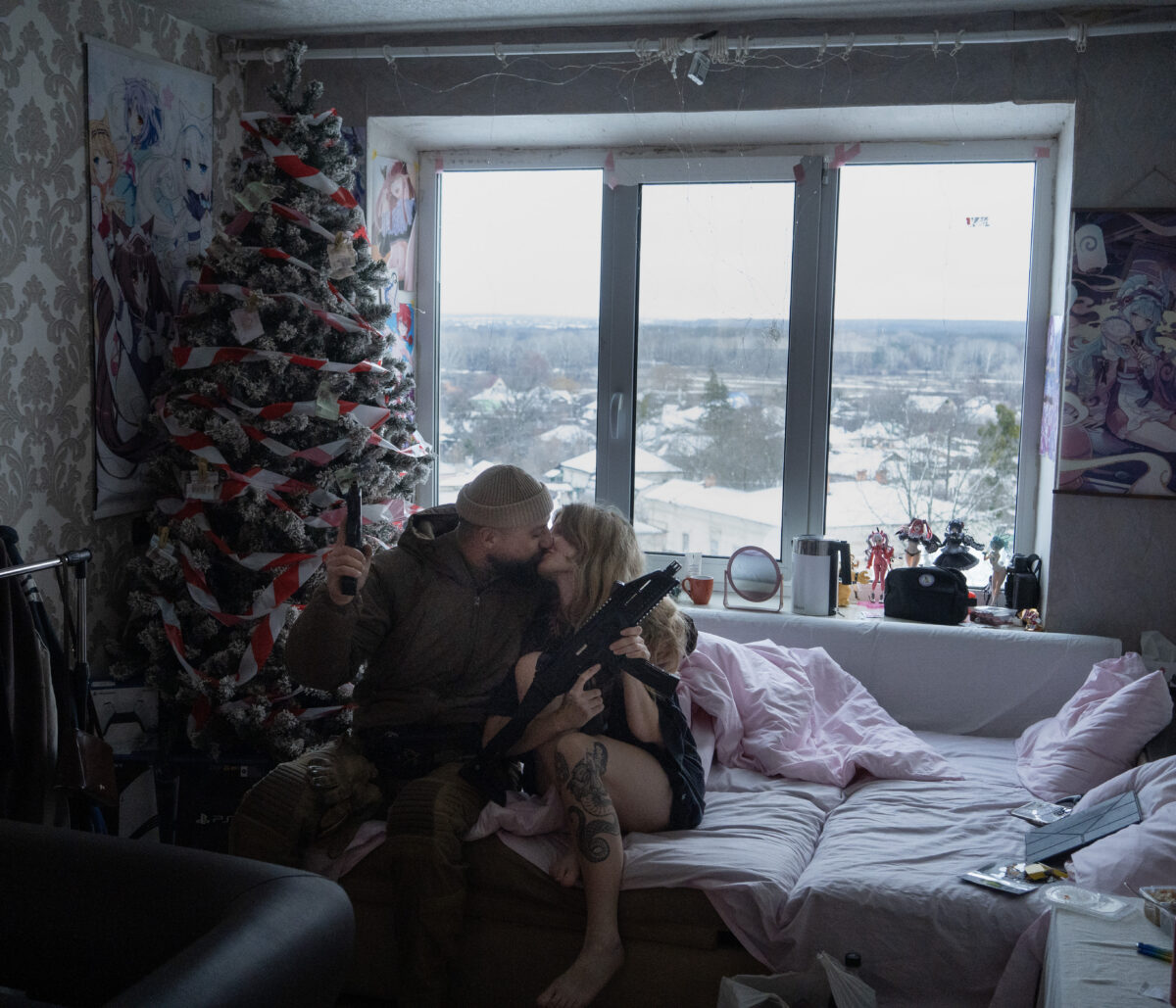
War has a way of sharpening the appetite for anything that proves you’re still here — alive, and not dead. According to Freud, sexual desire is part of our “life instinct,” the driving force behind human behavior and survival. So what happens to that instinct when faced with the prospect of death?
Amorous exploits have always been an indispensable part of war: soldiers penning feverish letters from the front, falling in love, marrying, or paying for sex. Conflict has always intensified the desire of humans just as much as it has extinguished it. If war forces you to confront death, sex becomes a way to reaffirm life. In the Great War of 1914, the rampant desire of troops was serviced by a sex economy comprised of brothels flashing blue lights for officers, red for lower ranks — often accompanied by large queues of men, especially in the days before major offensives. They wanted as much life as they could get.
The nature of warfare has fundamentally changed, driven by technological advances. Drones, cyberattacks, and electronic warfare have shifted frontlines, and with them the ways that people build and sustain intimacy. Encrypted messages, dating apps, and remote-controlled sex toys have become part of the emotional infrastructure of wartime lovers. The separation that war demands still remains, but the experience of it has evolved.


The Digital Frontier
Diana logs onto the call from a garage somewhere in Donbas — around ten kilometers from the frontline — where she flies First-Person View (FPV) drones. Before flying, she was a combat medic. The signal is inconsistent, the lighting is low, and she warns me that she might need to end the call abruptly for obvious reasons. Ordinarily, she works 10 days on, 10 days off; I’m speaking to her on day nine, just before she begins her final night shift of the rotation. Tomorrow, she’s scheduled to return to Kyiv where she’ll see her partner for the first time in two months — he’s also serving in the military. Spending long periods separated is just part of their relationship, the stretch of time is punctuated by exchanging nudes and sexts about what they’ll do to each other. For them, it’s the way things are: “it’s just this crazy war and crazy world which separates people.”
Another woman I spoke to requested anonymity. I’ll call her Maria. When Russia launched its full-scale invasion on Ukraine in February 2022, Maria returned to the US where she grew up as a first generation immigrant. Four years passed before she felt ready to return. In the meantime, her partner had joined Ukraine’s 3rd Assault Brigade, one of the country’s most elite, battle-hardened fighting units. “When you part ways, you understand you’re alone in this journey again. You’re doing life on your own. You have a partner, but you don’t really have a partnership, or a military relationship.”
The first months were marked by a specific kind of grief: mourning the life they had imagined while learning the rules of a relationship amidst war. Then something shifted, and the distance gave way to a heightened sexuality. Long stints of separation meant months of foreplay. “When you have such a distance, you can almost hide behind a screen. You really get to understand the other person from a perspective that you perhaps would be missing if you lived together. You can be a little riskier with words, images, even ideas.” The fantasies became bolder, and so did the route to sexual satisfaction; she described a vibrator that connected to an app, allowing him to control her pleasure from wherever he was positioned. She recalls his first mission in Avdiivka, “I remember him calming me by saying, ‘get the photos ready, I’ll be home soon.’”
Lovers adapt to their new dynamic, or they don’t. Mary Keeling, PhD, research leader at RAND Europe, has dedicated her career to understanding the social and psychological impact of military service on personnel, veterans, and families. She points to the work of relationship researchers Julie and John Gottman, who suggest that healthy relationships are built through many small moments they term “bids for connection.” These bids can be comments, touch, a question, or a glance that says, “I’m here, connect with me.” When acknowledged and reciprocated, these bids reinforce the emotional bond between two people, but when they are ignored or rejected, the relationship begins to deteriorate. War creates the perfect opportunity for this.
“When we make decisions on whether we want to be in a relationship we’re weighing and balancing different factors. One of those is the presence of our current partner, and one of them is the availability of alternatives,” Keeling says. “So maybe in this moment, if your partner is deployed, if you’re having relationship problems, satisfaction is low, and the availability of alternatives is high, you could potentially see there could be a risk of infidelity.”
But these conditions can also drive couples closer. Feeling chosen, despite everything, fuels desire for Maria. “It’s an incredible turn-on that he’s so busy with life, dealing with war, and yet he’s taking the time to actually connect and build intimacy,” she says. “He’s going through hell, but he’s still turned on.”
It’s common for women to visit their partners serving in frontline locations. In cities like Kharkiv there are hotels, but smaller towns like Izium or Kramatorsk don’t have that luxury, so families often rent out their apartments for a nightly rate. Mykhaylo, a former seaman from Odessa who spent four years in active combat before taking a lower-risk position to heal his mind and body, explains that high demand drives prices up: “Everyone wants to make love.” Asya, a marketing consultant from a town in Kyiv Oblast, was initially attracted to her partner because of what his position in the military told her about his experiences and the values he lives by. She recently made the dangerous journey to visit him in Zaporizhzhia where they rented an apartment for a few days. The region is constantly targeted because of its nuclear power plant, but Asya felt safer with him, “I wasn’t alone, and being with my partner gave me a strong sense of safety, even though the situation around us was objectively more dangerous.”
Soldiers without partners often seek out intimacy elsewhere. Dating apps can become an infrastructure for intimacy, offering conversation and a temporary escape from the isolation of life on the frontline. But they also opened up a new front, “The enemy understands that they can use this weakness,” says Mykhaylo. “A soldier is away from women for a long time and his desire becomes so strong, he becomes weak, so the enemy makes fake applications.” In 2026, the Ukrainian Ministry of Defence shared official guidance on the Russian recruitment strategy that saw fake female profiles used to gather information before blackmailing targets to act on Russia’s behalf. This tactic was then co-opted by the Ukrainians, and both countries have since introduced warnings in a bid to control this phenomenon known as honey-trapping.

The Closeness of Death
For some soldiers libido disappears in the face of active combat, crowded out by exhaustion and the immediate demands of survival. It’s only when the danger has passed that desire comes back with rushing force, serving as one way of metabolizing the stress. Diana describes a spike in sexuality after a near-death experience. “There was a crazy situation between life and death, and I realized I had to do something about it, so I called a friend,” she says. Diana’s reaction is less contradictory than it first appears. The closer death seems, the more intently the body grasps for life. “When death and our mortality become a central focus in our world, it really can wake us up,” says sex therapist Kat Kova. “When we say we’re aroused, we say we’re turned on…there’s something inherent in life being under threat that can awaken our life force.” Another civilian woman told me that sex offered a form of control when nothing felt controllable.
War, and the proximity to death, can become a catalyst for self-expansion. Stripped of the certainties of peacetime, people are forced to confront who they are and what they want. When I spoke to Mykhaylo, he appeared on screen alongside his partner, Lera, his broad frame contrasting with her striking femininity. She tells me the war forced her to grow up, accelerating the formation of her identity. It has also changed her taste in men, something she said many of her friends have experienced too. “Now the perfect man for the average woman is a guy with muscles and beard, and better that he is from the military,” she says, “a tough guy.” Before Mykhaylo, Lera preferred to keep a friend close by for sexual gratification, but also because his presence made her feel safer during the persistent shelling.
Asya describes war as a constant reminder of how fragile life is, “It made me more honest with my emotions and desires.” This contributed to the evolution of her sexuality, “I realized I wanted to experience my partner’s physical strength more. I’d always been curious about exploring a more physically intense side of intimacy, but I’d never felt safe enough to bring it up.”
When soldiers join a military unit they’re given a call sign — a name or sequence of letters — marking a separation between who they are, and who they were. Maria witnessed this happening to her long-term partner. “There’s a certain amount of time they spend assuming that new identity. They are no longer the man that you know, they’re now the pseudonym they chose, which means a different way of responding to things, maybe a different way of communicating.” She was introduced to an entirely new character, and recognized that this new identity had become part of his appeal. His call sign became part of her sexual imagination, “I like to think that this man came from serving, essentially, to be with me.”
Amid all the talk of lust and desire, what emerged consistently was a hunger for tenderness. To love, and be loved, to be held, and to be cared for. Maria only truly understood the meaning of ‘making love’ in the context of war, “Sometimes it’s more about intimacy,” she told me. “I genuinely want to sit there and just be in your arms, and have you in mine.”
Tenderness, however, takes many forms. Mykhaylo and Lera’s old bedroom in Izium looked directly towards the frontline, its window framing the flash of explosions. “She immediately switches from the playful state of mind to the survival state of mind,” Mykhaylo explains. In an instant, sexual desire gives way to protection, and he becomes less a lover than a guardian. It seems that war broadens the self, demanding a constant movement between different roles, to protect yourself, and the people you love.