Your bag is empty.

Comparing Playboy's first-ever Sex Survey from 1983 to our current results, it's clear that your mom and dad were getting it on constantly.

On September 22, Playboy launched our Gen Z Sex Survey, a comprehensive look at the sex lives of young people. In partnership with The Kinsey Institute and the reproductive health brand Julie, we polled 2,373 people ages 18 to 29 to see what’s really happening in their bedrooms. Our research confirmed that the sex recession is real. That was never more clear than when we compared our new data to the results of our first-ever sex survey from 1983.
The Playboy Sex Survey kicked off in 1983, with results from a sprawling poll of more than 100,000 Playboy readers. It probed sexual frequency, number of partners, sexual acts, extramarital affairs, and so much more. It was much different from our current survey in scope and methodology—the 1983 survey results were derived from a self-selecting sample of people of many ages who saw the questionnaire in the magazine and decided to respond. For today’s survey, researchers recruited a representative and diverse sample meant to embody Gen Z specifically. But that ’83 survey kicked off a long legacy of Playboy polling people about their sex lives—and it provides an important historical reference, one that is pretty shocking in comparison to our current sexual landscape.
In the early ’80s, Playboy Sex Survey respondents were getting it on with wild abandon. In fact, they put our 2026 respondents to shame in the bedroom. The questions asked in the ’80s were different than the ones we asked today, but if we compare a few similar data points, there are some clear shifts—like how much sex people were having and with whom.
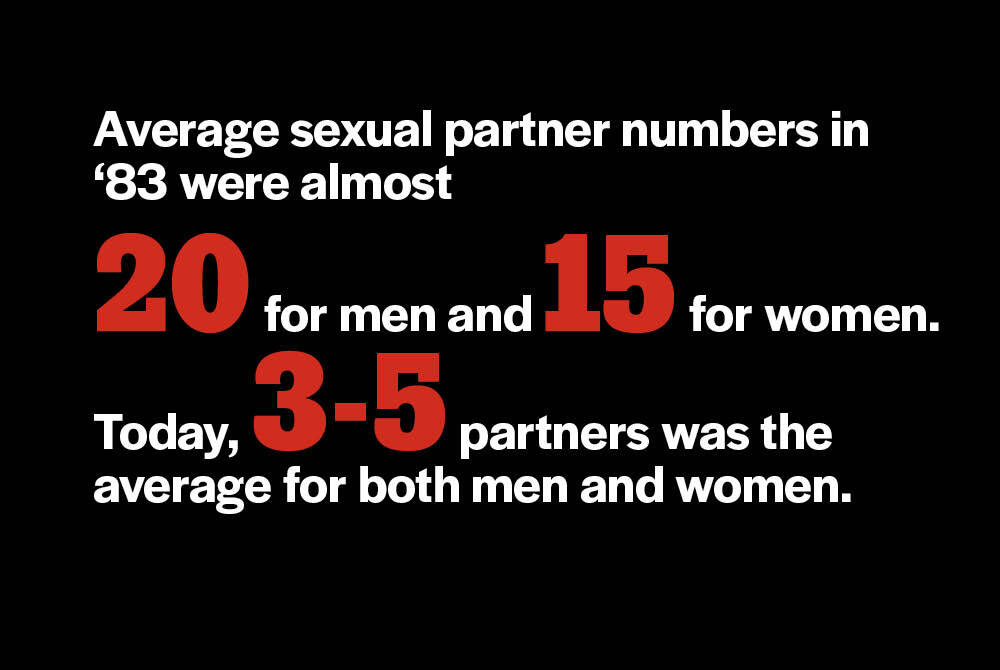
According to the 1983 survey, respondents reported having an average of 15 lifetime sexual partners for women, and 20 for men. In our 2026 survey, both men and women reported an average of three to five lifetime sexual partners. In other words, Playboy readers in the ’80s were having four to five times more sexual partners than young people today. Here’s what Playboy had to say about those 1983 numbers:
Question 57 asked, “How many sexual partners have you had?” There are two useful ways to present the answers-by the mean (average) and the median. The mean, in this case, represents the number of partners divided by the number of respondents. But that figure can be distorted by extreme responses from a small number of individuals the relative few who have done a lot to many, so to speak. The median can be a more useful figure. It represents the middle point among the respondents-half the people score higher, half score lower. The mean number of partners for the men in our survey is 19.8, with a median of 16.3. The mean number of partners for the women is 16.1; the median is 7.8.
Does promiscuity lead to disillusionment or despair? The evidence suggests not. For both men and women, experience contributes to a good self-image. The more partners you’ve had, the more likely you are to say that you are a good lover. We also discovered an interesting discrepancy between the sexes. The more partners a man has, the more likely he is to say that he gets enough intercourse. The more partners a woman has, the more likely she is to say that she wants more intercourse.
Much to consider!
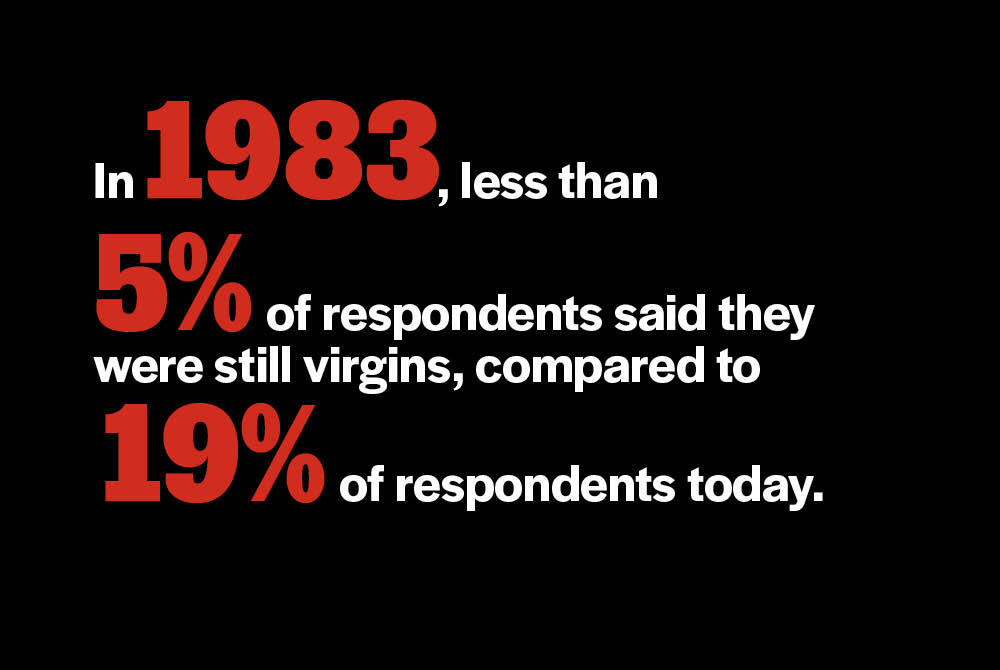
Another big difference? Virginity rates. In our 1983 survey, less than five percent of respondents reported never having had sex before, compared to almost 20% of our current survey respondents. We wrote a whole article about the prevalence of virginity among our respondents, but in 1983, virginity wasn’t a factor in the survey results at all—only a focus on losing it.
In our questionnaire, we asked readers when and how they lost their virginity. The answers are startling. To put the figures into perspective, let’s review earlier studies. In the Forties, Kinsey’s researchers found that 71 percent of the males and 33 percent of the females had lost their virginity by the age of 25. By 1972, the time of [Morton] Hunt’s survey [the author of the PLAYBOY series Sexual Behavior in the 1970s] 97 percent of the males and more than 66 percent of the females had experienced sex by the age of 25. A decade later, the 25-year mark belongs on the trash heap of sexual history. Ninety-six percent of the males and 98 percent of the females in our survey lost their virginity by the age of 25. When we look at our statistics, we discover how profound the change is. Kinsey shocked a nation by suggesting that three percent of the women he studied had engaged in intercourse by the time they were 16. Thirty percent of our female respondents report that they lost their virginity before they were 16. (Only 26 percent of the male respondents engaged in sex by that age.) The average age for sexual initiation among the PLAYBOY generation is 17.8 for men and 17.5 for women.
There are plenty of explanations for these shifts, ones we explored in depth in our current survey. But its clear that our respondents can’t hold a candle to our freaky readers of the 1980s.