Your bag is empty.
It's Gavin Newsom's seat to lose, but the Republican party will learn a lot from John Cox
It’s easy to forget that California’s status as the bluest blue state of all is a relatively recent identity flip. Ronald Reagan and Richard Nixon both started their Alpine climbs to the presidency from there. Reagan was a sunny two-term governor. Nixon was a surly Orange County congressman turned sulky U.S. Senator. The state (re-) elected its last Republican governor as recently as 2006.
Arnold Schwarzenegger’s only tepidly Republican star quality partly accounts for that. But even Los Angeles had a GOP mayor—centrist businessman Richard Riordan—as the 21st century dawned. So far as we know, there is no truth to the rumor that Riordan is now preserved in the L.A. Zoo for incredulous schoolchildren to gape at.
Statewide, Republican voters make up around a quarter of the total electorate these days. You can imagine what a disgruntled crew they are. The 14 GOP representatives in California’s huge 53-member delegation, the largest in the country, are an even smaller minority. Nonetheless, before Tuesday’s primary, those diehard (or are they?) Republican districts were sucking up all of the available media oxygen. Flipping some or even all of the seven whose constituents favored Hillary Clinton in 2016 is key to the Democrats’ hopes of recapturing the House. Ironically, since his district wasn’t one of them, Trump stooge Devin Nunes’s seat is probably safe. But retiring Republican Rep. Darrell Issa’s isn’t.
On the Democratic side, the big complication was California’s ”jungle primary” system. Itself a pretty recent innovation—devised to increase voter turnout, and partisan affiliations be damned—it advances the two top primary vote-getters to face off against each other in November, regardless of party. Emboldened by Trump’s unpopularity, an unprecedented flock of liberal challengers signed up to run in newly competitive Republican districts. That got Establishment Democrats all agitated that the upstarts would cancel each other out and leave two GOP candidates topping the heap. With its usual palooka-footed, Sanders-phobic clumsiness, the Democratic National Committee stepped in earlier this spring to winnow the field by bullying contenders deemed too marginal, too Bernie-ist, or both to step aside. That attempt largely failed, partly because every self-respecting leftist hates the DNC anyway. Getting out of the way to let them run the show has all the appeal of watching the Hindenburg lead off the Macy’s Thanksgiving Day parade.
Yet the party’s worst-case scenario didn’t come to pass, either. Reliable Dem challengers either did or seem likely to finish second in every primary contest where there’s a reasonable chance of tipping a red district blue. California elections always look like they’re going to be crazier and more unconventional than they turn out to be at crunch time. Even so, what got virtually overlooked in all the kerfuffle over congressional seats was how close California’s Republican voters came to having nobody at all to vote for in the race to succeed term-limited Governor Jerry Brown.
Sure, the jungle-primary system got the DNC hysterical (to the tune of 7 million dollars of hysteria) over those unmanageable House outcomes. But those were individual tempests in relatively discrete teapots. On the other hand, the idea that Californians—for the first time ever—might have ended up getting to “choose” between which of two liberal Democrats to send to Sacramento should have provoked nonpartisan dismay across the board. Our GOP friends here in the Golden State grumble enough about one-party rule as it is. Not only would a gubernatorial election without a Republican on the ballot have turned their grumbles into a roar, but we’d have joined right in with them.
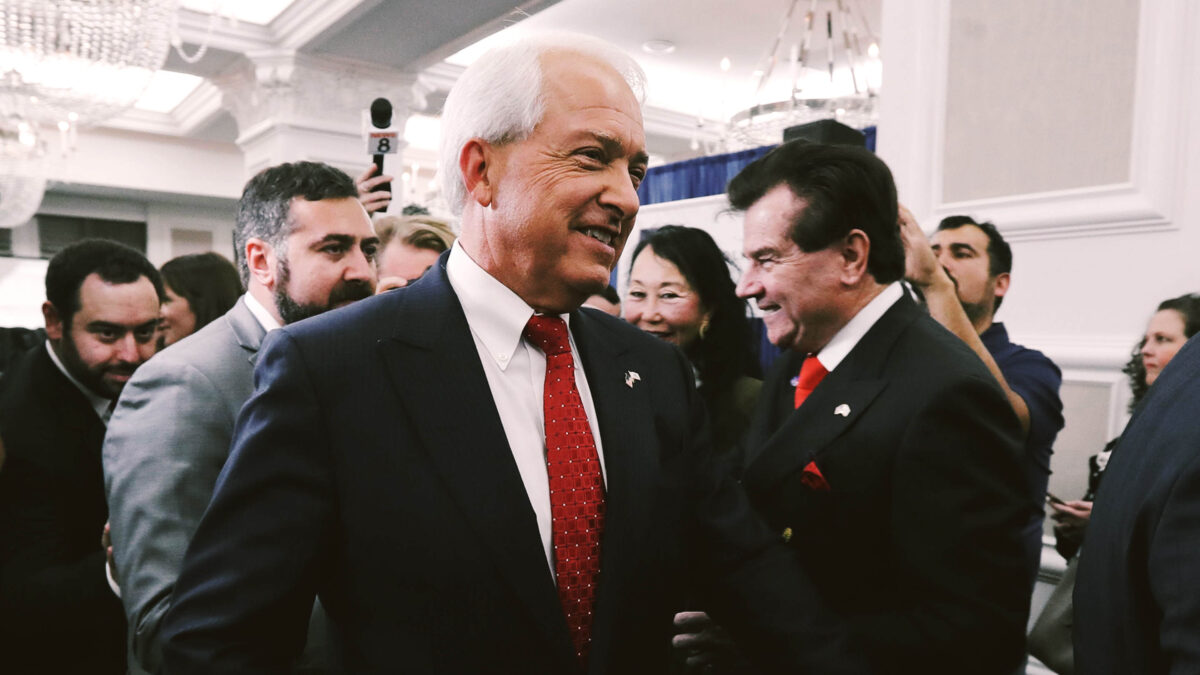
As it happens, that’s exactly the situation they’re facing in this year’s Senate race. Incumbent Dianne Feinstein will most likely easily prevail against her fellow Democrat Kevin de Leon in November. But California hasn’t elected a Republican senator in 30 years, so the sting is at least tempered by familiarity. Besides being literally closer to home, the governorship has also stayed at least notionally in contention between the two parties in modern times, even when Jerry Brown cruised to victory against Republican Neel Kashkari in his 2014 re-election campaign. Even Californians who bleed blue ought to breathe a sigh of relief that millionaire businessman John Cox will be on the ballot as the GOP candidate after coming in second to front-runner Gavin Newsom.
Currently lieutenant governor, Newsom is the former San Francisco mayor who drew nationwide notice when he okayed same-sex marriage licenses in S.F. in 2004 before the state’s Supreme Court annulled them, and he doesn’t just bleed blue. He breathes blue. He takes blue out for regular rides in his Tesla. (Okay, so we don’t know whether Newsom owns a Tesla, but you get the idea.) If you believe in democracy at all, the state’s nearly 5 million registered Republicans deserve an alternative they can tolerate punching a ballot for. And, presumably, go down in flames with five months from now—but screw it, democracy never promised them a rose garden.Until relatively late in the campaign, though, the conventional wisdom was that Newsom’s November opponent would be former Los Angeles mayor Anthony Villaraigosa, despite the fact that Villaraigosa has all the magnetism of a saddle sore. If he was less liberal than Newsom, that’s like saying Miley Cyrus is no Lady Gaga. But Villaraigosa couldn’t energize either his Los Angeles base or his Latino one. Spotting an opportunity, Newsom started airing ads depicting Cox as his main opponent, attacking him for “standing with Donald Trump and the NRA,” for instance. This had the double effect of a) getting complacent Democrats wrought up about The Enemy and b) making Republican voters more likely to decide Cox was their guy, giving Newsom exactly the challenger he wanted. The proof the jiujitsu worked was that Villaraigosa was swiftly reduced to both denouncing Newsom for helping Trump and imitating his idea by attacking (that is, boosting) Cox’s main GOP rival, state assemblyman Travis Allen. (Allen finished fourth.)
Then Trump himself, not realizing he was making Newsom very happy by doing so, tweeted his support for Cox and tweeted again to congratulate him on his second-place finish. In reply, Newsom took to Twitter to let the cat out of the bag: “Please come campaign for him as much as possible.”
Cox comes across in many ways as a standard Chamber of Commerce-style Republican trying to adapt to the Trump era while remaining an at least semi-viable candidate in the bluest of blue states.
Cox seems relatively blameless in this game. Naturally, after trying to keep his distance from Trump early on, he felt blessed by POTUS’s endorsement, since it helped propel him to that second-place finish. But he’s not especially Trumpian. He’s even admitted he didn’t vote for El Jefe in 2016, going with Libertarian Gary Johnson instead. It says a lot about the California GOP’s shortage of available talent that he’s never held political office and only became a full-time state resident in 2011. Cox reportedly donated more than 4 million dollars to his own campaign to turn himself into a contender.
He’s not quite a political novice, however, if running for multiple offices in his native Illinois and failing to win any counts. That included a short-lived bid for the 2008 Republican presidential nomination, which suggests a certain eccentricity. So does the one innovative political proposal he’s tried and failed four times to amass enough signatures to put on the California ballot, which was to expand the state legislature to 12,000 members who wouldn’t have to rely on special-interest money to win office in their tiny fiefdoms. He’s also called for requiring legislators to wear the logos of their top corporate donors, NASCAR-style.
Such quixoticism aside, however, Cox comes across in many ways as a standard Chamber of Commerce-style Republican trying to adapt to the Trump era while remaining an at least semi-viable candidate in the bluest of blue states. He supports Trump’s border wall and disdains sanctuary laws, but he also wants the Dreamers protected. Like any businessman, he sees excessive—that is, any—government regulation as the root of all economic woes, and wants California’s Environmental Quality Act repealed to, so he says, alleviate the state’s affordable-housing crisis. He’s big on Second Amendment rights, but opposed to the death penalty. And so on.
Because he’s still a cipher to most Californians, it’s anyone’s guess whether Cox’s conventional side or his quirky streak will get the upper hand in defining his identity between now and November. From one perspective, which one ends up dominant won’t matter, because Newsom would practically have to be caught on video barbecuing kittens for his kids in order to lose this election. But at least the state’s Republicans won’t be deprived of having a choice, not an echo, this fall. Call us old-fashioned for saying so, but we think that’s good news.