Your bag is empty.
Our White House correspondent puts into plain English what the administration’s press secretary is really saying—and not saying
If there’s one thing both sides of the political spectrum can agree on about Donald Trump, it is that his administration seems to be in constant motion.
Some say it’s chaos. Some say it’s inspired brilliance. But whatever you label the media vortex, until recently it did not include daily briefings by the White House press secretary.
Trump’s previous press secretary, Stephanie Grisham, did not hold a single press briefing, although her predecessors, Sarah Huckabee Sanders and Sean Spicer, often did (with much spin). Those close to the president say he finally got to a point where he liked being his own press secretary and thought he could do it better than anyone else.
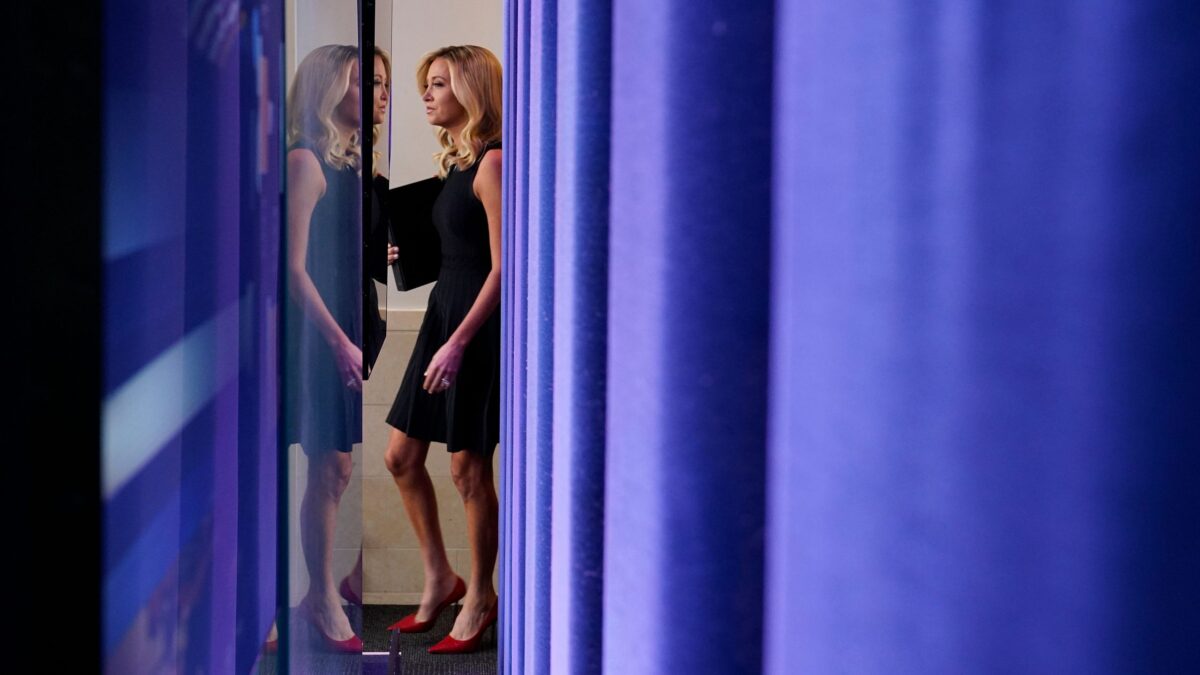
Enter press secretary Kayleigh McEnany, who stepped up to the plate and reintroduced the daily briefing. On five occasions she and the president have even briefed on the same day—quite a difference from Trump’s other press secretaries. Both Spicer and Sanders said they wouldn’t brief on the same day the president spoke because they didn’t want to step on his message.
With McEnany it has been different. Insiders say the president is more than willing to share the spotlight with her because she is so adept at backing him without stepping on his message. Others think Trump just enjoys having someone agree with him, since so many these days do not.
To some, McEnany is smooth and professional, the best the country has seen under the Trump administration. Her appearance coincided with the disappearance of Kellyanne Conway and others who used to hold gaggles in the Brady Briefing Room and out on Pebble Beach. But those other mouthpieces have famously bungled. So far McEnany has avoided being arrogantly combative. She smiles and pushes back against the press. She scolds. But she neither sneers nor claims the “alternative facts” narrative that destroyed Conway’s credibility.
McEnany’s press briefings are nothing more than theater.
The truth is, McEnany is about the same as Spicer and Sanders, though she does carry a briefing book so she can remain constant with her spin.
Her press briefings break down to an opening statement of five to 10 minutes, followed by 10 minutes of questions. No more than 14 reporters can be seated, thanks to the pandemic, versus the 75 to 100 who routinely pounced on both Spicer and Sanders. McEnany appears lucid and in control. At the end she often calls on the 15th reporter, who is from OANN and isn’t technically allowed into the room but sits behind a line marked “for guests.” McEnany then issues a closing statement, often disparaging the very reporters who’ve just asked her a question. Then she’ll drop the mike and leave. Her briefings routinely last 25 to 30 minutes. She doesn’t linger.
McEnany obviously learned from Spicer and Sanders, who often got into trouble the longer their briefings lasted. Obama’s last spokesman, Josh Earnest, held briefings for up to 90 minutes, leaving reporters to wonder when he would tire of his marathons. At least in his case, as with Spicer and Sanders, real information was exchanged on occasion.
McEnany’s press briefings are nothing more than theater. The reporters are props. The event is nothing more than a mini-campaign rally—or the administration’s equivalent of a high school pep rally. Little news is made. Few facts are given. Most of the major networks, including, occasionally, Fox News, have stopped broadcasting these disasters live.
The reporters who cover the briefings as part of their job are often left with glazed eyes and dyspepsia. Some of the audio and video technicians who’ve been covering presidential administrations since Reagan are left shaking their heads.
More than once I’ve heard a variation of, “You need an interpreter to understand what the hell she’s saying.” So as a public service, I am doing what I once did with Sanders: providing handy translations of her favorite briefing-room expressions, all in the interest of better understanding.
When Press Secretary Kayleigh McEnany says, “Can’t get ahead of the president on that,” she means:
“We literally don’t know what the hell the president is going to say, and, further, whatever we say, he’s likely to later contradict us, so we aren’t saying shit.” An early favorite from the Sean Spicer days.
“The Democrats are fundamentally unserious.”
The Democrats have proposed something the president doesn’t like.
“I’ll get back to you on that.”
She will never get back to you on that.
“Mail-in voting will lead to fraud…”
…unless it’s in Florida; then it’s okay because the president lives there.
“It was extensive, good reporting…”
The reporting favors the president.
“There is ample evidence of [fill in the blank].”
There is absolutely no evidence, but the president wishes there were.
“We’re tracking it closely.”
They have no idea what’s going on and this is probably the first time they’ve heard about it.
“The mainstream media has failed to report on…”
The president saw something he likes in the news and wants to see more of it.
“I won’t engage in hypotheticals.”
When followed by “but,” this means she will engage in hypotheticals—but only if she can spin it to support the president. Otherwise she doesn’t want to answer the question.
“No one has worked harder than this president on [fill in the blank].”
The president has done little or nothing but wants to get credit for mentioning the issue in a way that makes him look good to his base.
“Many people are saying…”
No one is saying it. A favorite of the president and his press office when they want people to think someone other than the president is saying something.
“Polls show the president has a 96 percent approval rating among the GOP.”
A favorite, even of the president himself. The joke is everyone in the West Wing was polled, and Trump still couldn’t hit 100 percent approval among his staff. The truth is there have been no official polls that back this claim.
“The president is ready to act on this…”
Not unless it’s done by praising him first. Then someone will have to tell him what action to take.
“The president moves at a very rapid pace…”
…when he has the television remote in his hand. This statement is often used to defend a lack of action by the administration on an issue.
“No one has done more to protect the American people from [fill in the blank].”
Whether it’s Russia, China, North Korea, violence, the failing economy or something else, this is a tip-off that the president has done very little. Take, for example, the coronavirus: The president has failed at everything he’s done, first calling it a hoax, then saying it would be gone by Easter, claiming that testing causes more cases and saying ingesting or injecting disinfectants will cure people.
“The president is hard at work…”
…when he’s not on the back nine at his favorite golf club. He has spent more than 250 days of his administration golfing. The Marine guard, usually stationed at the West Wing door to indicate the president is in, rarely appears these days.
“I certainly will inquire about that and follow up with you and find out what the status is.”
You will never hear from her, and she hopes you’ll eventually forget about it so she won’t have to answer. This is an alternative to “I’ll get back to you” but is meant to address weightier issues the president and the administration wish to ignore—like the Russian bounty story.
“I would refer to our experts.”
“We acknowledge the question needs an answer, but we know we’ll screw it up and can’t hide from the question forever, so ask someone else so we don’t have to come back and tell another lie to cover the first one.”
“The tweet speaks for itself.”
Another oldie but goodie, a remnant from the Spicer era, that means there’s no way to answer your question about the tweet without seeming like a racist, idiot or misogynist—or, more important, without making the speaker criminally liable. So, moving on.…
“I haven’t spoken to the president about that specific fact scenario…”
Here the press secretary hopes you won’t notice that she has no idea what the issue is, what to say about it or how to spin it, so she’s spitting out nonsense to hopefully confuse you so she can move on.
There are of course many, many more misleading and empty phrases. The president and his staff have told thousands of lies since Day One, when Sean Spicer walked into the briefing room and told us Trump’s inauguration set attendance records.