Your bag is empty.

It's Instagram's sexiest new destination, but its history with gender and freedom goes just a tad further back than social media may lead you to think
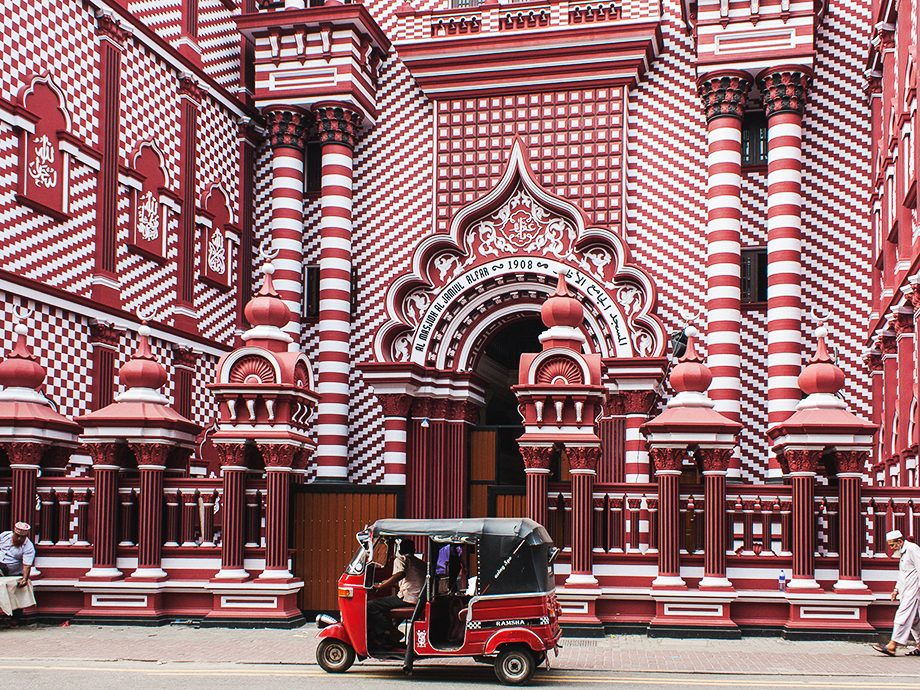
It’s only 7:30 AM and we’ve already climbed about 50 flights of stairs at Sri Lanka’s Sigiriya, also called Lion Rock. There are stray dogs and monkeys everywhere, and the sun, despite the early hour, is unrelenting. It’s a welcome respite when our group of seven travelers takes the final steps into a large cave, carved out of the side of the rock. In this cut out are fresco paintings from the 5th century, still remarkably well preserved in bright shades of orange, reds, and yellows. They’d be notable for their skill and vivid color, if it weren’t for one other very noticeable aspect: breasts. Everywhere. In fact, some women have three.
“It was so distracting, the monks couldn’t meditate,” laughs Ajith Fonseka, the personable and enthusiastic local guide of the REI-branded trip we’re on. “They said to the king, ‘Hey, you have to paint over these!” He gestures to the voluptuous-bordering-on-otherworldly women. “I mean, you can see why!”
This interaction exemplifies Sri Lanka’s complicated relationship with gender and its accompanying contrasts. The site we’re in is of undeniable historical value to the world, having served as a Buddhist monastery in the 3rd century BCE before being commandeered by Sri Lankan royalty in the 5th century C.E. It was given back to Buddhist monks sometime around the 6th century, at which point the aforementioned issue arose. It’s a sight steeped in history and also a humorous snapshot of how the country views gender: roles are traditional, but there doesn’t seem to be any taboo against breaking them or taking them with a grain of salt.
Sri Lanka, a small island country off the southeastern coast of India, was engaged in a 40-year civil war between the minority Tamil people, who came to Sri Lanka from India to work on tea plantations, and the Singhalese people, who are native to Sri Lanka. Conflicts between the two groups escalated during British rule when the country was known as Ceylon. Though Ceylon gained independence in 1948, the 1940s and 1950s saw a series of laws passed oppressing Tamils, and by 1983, the conflicts had escalated to a full-blown civil war. It ended in 2009.
Over the next decade, Sri Lanka went from wartorn to welcoming, quickly becoming a hot destination for young travelers, beach enthusiasts, and–of course–Instagram influencers. Both Conde Nast Traveler and Fodors Travel Guide named it as a top travel destination on recent annual lists and REI Adventures introduced their first Sri Lankan trip in spring 2019; a second Under-35 trip is slated to debut in December. For travelers with an endless budget, National Geographic offers an island-hopping excursion for a cool $93,000 per person that includes a luxurious three-day stay (hosted by Titanic discoverer Bob Ballard, no less).
On social media, a search for Sri Lanka on any online platform brings up the most quintessentially sexy travel photos imaginable: bikini-clad women strolling through waterfalls, blonde 20-somethings majestically staring out onto herds of elephants. Somehow, Sri Lanka has gone from full-blown civil war to the number one spot on many a sexy Millennial’s travel bucket list in a decade, which is something no other country can claim. But maybe it shouldn’t be surprising, given the country’s complicated history related to gender.
Living together is a big ‘no-no,’ even in Colombo.
Sri Lanka was the first country in the world to elect a female prime minister (Sirima Ratwatte Dias Bandaranaike, who served three terms beginning in 1960) and was one of the first countries in Asia to give women the right to vote in 1931. But on the flip side, men and women still have separate roles in society, jobs, and culture through it’s quickly changing.
“When it comes to jobs like tea plucking, cashiering, working in garment factories, et cetera, women are given preference since these are considered soft jobs,” says Hashanthi Madugalle, a native Sri Lankan who runs the travel company REI contracted with on their new adventure. Madugalle is in her late 20s and grew up living on tea plantations throughout the country as her father worked in the tea business (tea and spices represent nearly 10 percent of Sri Lanka’s export economy). In Sri Lanka, women are often considered more gentle and delicate, making them better suited for jobs like plucking tea leaves or handling fabrics.
And in areas beyond Colombo, the country’s capital, Madugalle says gender roles are still very traditional. “In Colombo, there is an understanding that women are also allowed to work and earn,” she says “whereas in a rural family, the mother is usually expected to stay back at home and take care of the washing and cleaning.” However, she agrees that’s changing, especially since both male and female children are given equal access to education (at least in towns and cities.) That’s possible because of Sri Lanka’s successful efforts to meet the United Nations Millennium Development Goal in 2015 of ensuring that every child in the country, male or female, has access to a full primary education; it’s the only South Asian country to have done so.
And when it comes to careers, Hashanthi says in her years of working in Sri Lanka, she’s seen larger companies making strides to change the pattern of most senior leadership roles going to men with programs aimed to support women and parents with families—something that’s seen significant traction in developed countries like Norway, but has proved challenging to get off the ground on a national level in the U.S. Yet in Sri Lanka, the country is working hand-in-hand with international organizations like the World Bank to increase female representation on corporate boards of directors. It’s an interesting dichotomy: in rural areas, many people think “delicate” jobs should be left to women, but at a national level the government is a primary cheerleader for women’s professional empowerment.
While in Galle—Sri Lanka’s former Dutch colony that now serves as a popular destination for young expats and bloggers—there was a common sight along the rocky nooks and shady trees that dot the coastline: young people huddled together under umbrellas and sheets. Despite having beaches crawling with sexy young travelers, many of Sri Lanka’s young locals still live by very traditional gender roles when it comes to navigating the dating scene. “Living together is a big ‘no-no,’ even in Colombo,” says Madugalle. Arranged marriages are still common in rural areas, she adds, noting that the early 20s is still considered the best time for a woman to get married outside of major cities. To spend time with a potential partner, young Sri Lankans need to do so in public or under the eye of chaperoning parents–unless you can find an umbrella to huddle under at the beach, that is.
Despite this traditionalism, Sri Lanka continues to be a top destination for young, single travelers. The new REI ‘under 35’ trip will have guests staying at Talalla Surf & Yoga Resort, boasting open-air rooms, retreats on “Tonic Masculinity” and “The Alchemy of Self-Retreat,” and an average guest age that can’t be a day over 25. And the Honey Beach Club in Galle looks like it belongs in South Beach with the reputation for dating and hooking up to match. And don’t forget about CoCo Bay resort, whose oversized beach-view jacuzzis in each room earned it a spot as a host hotel on the same REI Adventure that brought us past Sirigala’s busty rock paintings.
When it comes to jobs like tea plucking, cashiering, working in garment factories, et cetera, women are given preference since these are considered soft jobs
Jeff Stivers, who creates REI’s Asia adventures, says that it’s this slightly exotic, unconventional mentality that is leading adventurous American travelers to the cSri Lountry. “It feels like Thailand 20 years ago,” he says. “It’s been growing in popularity with international tourists, however; it’s still rather new to U.S. travelers.”
For western travelers, Sri Lanka oozes travel opportunity, from the unspoiled beaches praised by Fodors to the through-the-mountains train route that seems to be a must-see location for anyone with a camera. Tourism has become a driving industry for the small island, more than doubling from 447,890 tourists in 2009 (the last year of the Sri Lankan civil war) to 1,005,605 in 2012. By 2016, the country cracked the 2 million mark, and numbers continue to grow, especially with continued accolades from mainstream travel publications; Lonely Planet chose it as 2019’s top travel destination.
The Sri Lankan government played a major role in that extraordinary growth, establishing a national tourist training program in 2009. According to Fonseka, the program was quite competitive and challenging. Guides need to be able to knowledgeably speak on any one of more than 300 sites of national touristic value within the country at any given time to pass. The program falls within Sri Lanka’s National Institute of Tourism and Hotel Management, established in the 1960s as a way for both men and women to acquire skills to develop the tourism industry.
While there are still more men than women in the tourism industry, the state is attempting to change that trend. The largest local newspaper in Sri Lanka has written about the positive economic impact of employing more women in tourism as it’s currently the country’s fastest-growing industry. Interestingly, a 2015 research study from the Uva Wellassa University of Sri Lanka found that women were still underrepresented in senior positions in the travel and tourism industry for reasons that may sound familiar to western readers: salary inequality, an old-boy network, a lack of female role models, gender harassment, and attitudes of existing management were all listed as reasons why it’s difficult for women to advance. As a country, the response has been extremely progressive and arguably far more progressive than other more “developed” countries; the aforementioned partnership with the World Bank began in 2018 and the country has made significant strides on the World Economic Forum’s Global Gender Gap Report.
In 2018, it was ranked 100 out of 150 on the list of overall rankings by country, making it the second-highest rated country in southeast Asia for gender equality, just behind Bangladesh (the U.S. ranked 51.) However, despite receiving high marks for closing the gender gap in health and survival (a category in which it has the highest rating possible; the U.S. has a piddly score of 71), Sri Lanka’s overall score has actually dropped from 39, in 2012. The report attributes most of that to a cause that mirrors the U.S. situation but may be surprising in the country that elected a female in the 1950s: a lack of female representation in government. In Sri Lanka, women hold just six percent of parliamentary seats (the U.S. is closer to 20 percent,) ranking it as one of the lowest in the world. The record holder is, interestingly, Rwanda, at 61 percent female.
Sri Lanka is a land of gender contrasts, but what makes it particularly interesting is that the government seems to be both acknowledging the current levels of inequality and genuinely trying to address its issues. While traveling through the country, our group of female travelers never encountered any restrictions, save for being asked to cover our shoulders and knees when visiting monasteries (a rule applied equally to both genders.)
Perhaps it’s the welcoming and progressive attitude that attracts western travelers, who see it as (forgive the colonialism) a new, “unexplored” country, where friendly people and tropical beaches make travelers feel safe and welcomed. That creates an environment that fosters personal expression and body acceptance, two things which lead to skimpier bikinis and an influx of young expats. While there are different viewpoints through the country, usually divided by traditional versus urban lines, the tolerance for differing viewpoints seems to ensure that all can co-exist. Fonseka told us that neighbors celebrate their neighbors’ religious holidays, even if they aren’t their own; a statement that summarizes the openness with which the average Sri Lankan seems to embrace alternate ideas.
As with any country, it’s unfair to say that Sri Lanka isn’t without its domestic issues, though the U.S. State Department did recently bump it’s travel advisory rating back down to a “level two” following the “level three” status given after the April 2019 bombings. But if you’re looking for a welcoming, beachy, and downright sexy place to kill some time with your fellow hashtag-wanderlust travelers, consider bumping the country a notch or two higher on your travel bucket list.