Your bag is empty.

With psilocybin once again in the running to become a legitimate treatment for anxiety, we sent a writer deep into the Mexican jungle to face her fears. Did she find inner peace?
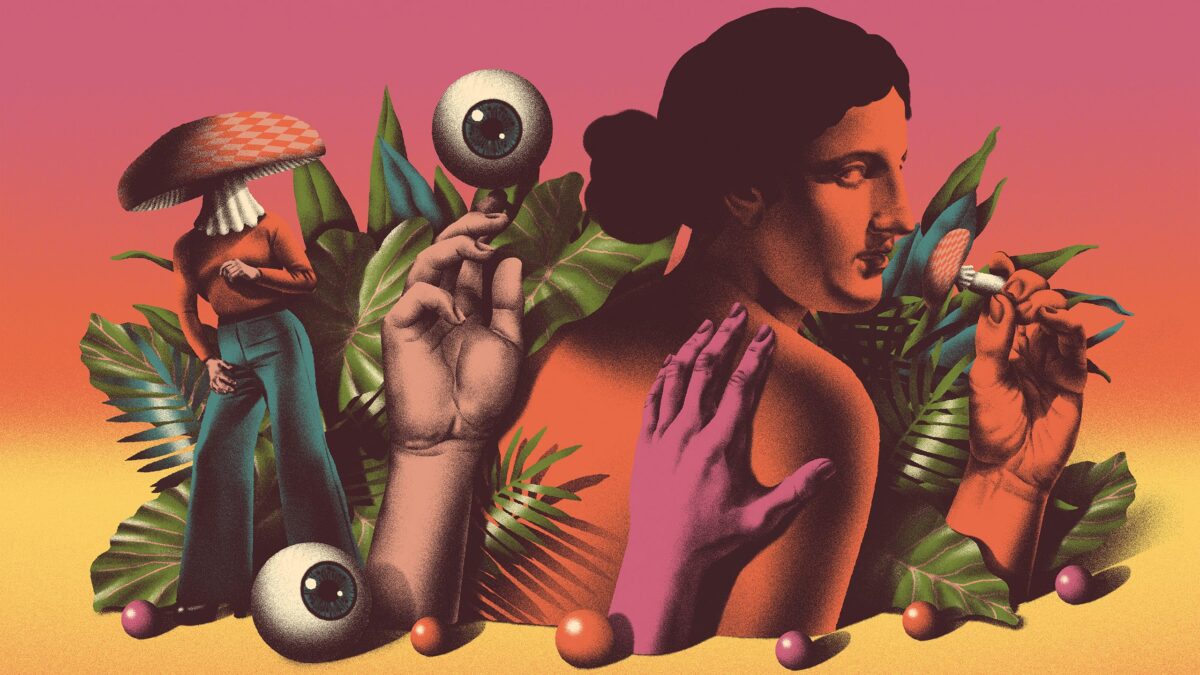
I arrive in a van with six other Americans after traveling on a long, stomach-turning dirt road to the heart of the jungle outside Playa del Carmen, Mexico. The resort is a maze of wooden boardwalks, but the foliage still creeps through and grazes my limbs. We are led, one by one, down overgrown paths that open into large event spaces, including the appropriately dubbed Buddha Hall, where three days of transformative psilocybin ceremonies will take place.
We’re a total of 20 participants. We eat dinner together in a decadent, palace-like setting and play Two Truths and a Lie to break the ice before heading to bed. It’s still early. I lie in my room—a private, nearly square enclosure with wall-length windows overlooking dense greenery—while I patiently wait for daylight.
The next morning is a blur. There’s dosing information, contracts to sign and the group activity of “intentions setting”—a discussion during which almost everyone cries, myself included. I reveal my experiences with drug abuse and depression, the story of a friend’s death and my recovery afterward. It comes out easily because everyone around me is emotional; they have their own reasons for being here.
First-person research for my upcoming book, Your Psilocybin Mushroom Companion, is what has led me to the Buena Vida Psilocybin Retreat in the Yucatán Peninsula’s tropical wonderland. The tag line of this roving retreat is “Embark on a journey of a lifetime with the help of magical fungi.”
For the 19 others, their journeys to this moment may not have started with a simple Google search as mine did, but I suspect they’re here because of the hard-to-ignore attention psilocybin has received of late—in particular, the reports that this psychoactive compound, found in more than 100 species of mushroom of the genus Psilocybe, may assist in treating several mental health issues and disorders. Having paid $3,000 for the week-long experience, they’re here to begin healing from personal traumas I can’t begin to understand.
Although psychedelic drugs are most closely associated with the hippie culture of the 1960s, interest in them has remained consistent over the years. In 2016, the Journal of Psychopharmacology published two studies that determined that doses of psilocybin, which alters perception, eased cancer patients’ distress. In 2017, the Global Drug Survey named mushrooms the safest drug on the planet. New York University and Johns Hopkins University recently conducted clinical trials, the results of which lend credence to the argument that psilocybin could work as a therapy for otherwise treatment-resistant depression, addiction and anxiety. While the Drug Enforcement Administration still lists the mushroom compound as a Schedule I substance, the U.S. Food and Drug Administration has designated it a “breakthrough therapy,” opening the door for expedited clinical trials to be conducted by Compass Pathways, a mental health research firm. Why wouldn’t we, with the proper guidance from this retreat’s shamans, see positive results?
The Buena Vida retreat—founded in 2015 by Amanda Schendel, a “psychedelic expert” whose previous careers include positions in sales and comedy—maintains that its goal is “to provide safe access to healing plant medicines within the context of ritual and ceremony.” Thus, before the first of the three mushroom ceremonies commences, we’re encouraged to light a candle on an altar—a small stage adorned with objects of significance and offerings to the spirits and elements of the earth—and write down our intentions. I scribble a laundry list of emotional goals I would like to achieve over the next six hours, which is my first mistake, and wait for my name to be called. When it is, I’m given a fragrant spray of agua de florida to purify my spirit. The shaman proceeds to sit me down. I get chills as my doubt about her power fades with the smoke from the sacred tobacco she’s wafting. I’m given a clay mug of mushroom tea. The serving is one and a half grams.
The aroma of palo santo (“holy wood”) burning with sage engulfs me. My tea is steeping and my mind races as I ready myself on my yoga mat. The 20 of us drink our tea in unison. Most of the group then lie down and close their eyes, surrendering to the medicine. I remain sitting up, partly to watch people’s reactions and partly because I find myself enchanted by the shaman’s echoing voice.
Even though I know the lighting is dim, it suddenly feels unbearably bright. My limbs start to become limp, exhausted. I chuckle at the feeling, lie back and close my eyes. But instead of finding peace or feeling blissed out, my mind is chaotic and my thoughts are negative. Why do people do this, again? I feel nauseated as the drug rumbles through my insides. The shaman’s voice turns haunting, vibrating through the pavilion. I’m struggling to let go, hesitant to allow the mushrooms to do their work.
The anxiety I’ve felt leading up to this trip—anxiety specifically tied to writing my book—grows vicious. I worry that I’m not qualified to write a mushroom guide. I’m worthless. I’m stupid. I try sitting up and opening my eyes, but the thoughts continue, and I start to cry. There are no trippy visuals to distract me. I want to get out, to be alone, but I signed a waiver promising I would stay in the ceremony space. A facilitator brings me tissues and sits with me.
I try again to go back inward. I lie down and close my eyes, but the overriding voice in my head screams at me to kill myself. I have to sit up. I can’t handle it.
These drugs are dangerous, I think, and I feel the weight of everyone who may read my book and take my advice. It’s too much pressure. I keep bawling. A mountain of soggy tissues grows beside me. I’m a fraud.
It’s another four hours before my negative thoughts dry up. Facilitators bring around a tray of fruit, signaling the end of the ceremony. I leave as a shell of myself, brewing a crying-induced headache. I wonder if other people went through the same thing, but everyone else seems effervescent at dinner time. We eat in a space that resembles a spooky, overgrown Chinese restaurant. Some of my favorite foods are on the table—falafel, pita, hummus—but eating seems foreign. I listen to others talk about their relaxing experiences, their crazy visions. Am I broken?
The next morning I’m raw, and Advil can’t touch my headache. I sleep through yoga and rush to get changed so I don’t miss breakfast. Surviving today will require coffee. Immediately after breakfast, we have an “integration meeting” on the rooftop terrace, which glitters with Indian teahouse–style decorations. I strain to get comfortable as I absorb everyone’s journeys. Most describe good trips. When it’s my turn, I start crying again. I suggest I need to talk to a facilitator one-on-one. People are understanding. The group moves on.
I continue to feel exposed; tears flood at the simplest thoughts. When I try talking to others I feel a bit better, less alone. In the afternoon I swim with some people in a cenote (a limestone swimming hole) at the center of the grounds, though I still feel distant. After dinner I join everyone for what they’re calling an “ecstatic dance party.” We spread glow sticks on the floor, and I start to move around, pushing out my heavy energy with the music’s beat. Tears again rush down my face.
I feel lighter by the day of the second ceremony. I make it to yoga class but bail halfway through meditation to take a walk in the woods with a woman around my age from the Midwest and a man at the other end of his 30s from Denver. It feels good to connect with them. I am at ease.
I usually dread the thought of touch, but the warmth is sweet.
Our second mushroom ceremony kicks off while the sun is still out, around three p.m. I ditch the pre-ceremony acupuncture and sound bath to form my own ritual: swimming in the cenote with some new friends, a social worker in his 50s and a scientist in his 30s. I take a shower and call my partner before skipping off to the ceremony with the scientist. We set up our yoga mats near a Wall Street guy with whom I’ve bonded over our shared New Jersey roots. I’m feeling more comfortable and less anxious this time. I go to the altar before the ceremony and jot down my intention—simply “I love you.” Then I wait, much more calmly than yesterday, to collect my mushroom tea. This round, I drink two and a half grams.
A nature walk is offered during this ceremony, and an hour or so into the experience I feel ready to explore. My wanderlust is partially brought on by the scientist, who seems to be having a negative reaction. The shaman sings over him and facilitators hold him down as he thrashes in distress. I’m worried, but I’m also sure he’ll be okay.
With a small group and a facilitator, I stroll down rickety wooden planks through the jungle. We hold on to one another as we stop to examine trees and discuss their personalities like kids playing make-believe. The sun beams through the foliage the way it does just before dusk, hues of gold sparkling off the tropical leaves. At some point we run into another group of nature walkers, and together we venture to admire the cenote. We’re told swimming is forbidden. We lament, because it’s hot and humid.
The banker from New Jersey finds me.
“It’s so good to see you!” he says enthusiastically.
He reports that he just came back from losing his ego and relates how terrifying it was.
“I feel like I’ll never be depressed again,” he exclaims. “It all feels so irrelevant now.”
We head up a path of mosaic chakras to a wild and bright pavilion. Every inch is covered in hand-painted images of Buddhism. Lying on the cool stone ground, we watch with compassion, randomly chuckling, as ants skitter. The laughter echoes around me, fills my belly and makes me feel connected to these strangers in a way I’ve always struggled with. We’re not that different, a voice inside me says. I don’t have to be an outsider.
We return to the ceremony space to find the scientist coming out of hell. He’s still scared, and I struggle to comfort him.
“If that’s what it’s like to die, I’m even more afraid,” he tells me. I look at him deeply but don’t know what to say. He’s contradicting everything I’ve learned about the death of one’s ego. Wasn’t it supposed to be mystical?
We’re politely asked to be quiet. We go back to our separate spots and lie down for the remainder of the ceremony. I feel great waves of self-acceptance and love—emotions I couldn’t even fathom during the first ceremony. As the session ends, I’m more content and confident. At dinner, I consume more guava than is healthy to eat.
I wake up the next morning feeling elated, enlightened even. We’re scheduled to take a break from tripping and go on an excursion outside the dense jungle. We’re chauffeured to cenotes and beach clubs. I somehow feel comfortable and connected to everything around me.
The following day, I feel invincible ahead of our final ceremony. Opening up during the group session for the first time without tears, I talk to fellow participants without self-doubt. My mind clears all anxiety to make room for the present. I do yoga and meditate. The ceremony begins in the afternoon, and the familiar space is set up for us to sit in a circle, facing one another. I settle between two women I find admirable and ask to take four grams (the maximum offer is five). The facilitators have us stand and pass along the agua de florida, followed by a massive collective embrace. I usually dread the thought of touch, but the warmth is sweet. I set my intentions.
Teach me, I’m listening.
I’m determined to go inward—to resist resistance—so I secure my headphones queued with spiritual sounds and put my sunglasses on after finishing the tea. I focus on breathing with the hope of being taken on a vision quest, but all I see is the black inside of my eyelids. Just before longing and disappointment set in, the mushrooms transport me to a place where hardship and anxiety feel silly. I don’t see Technicolor swirls or splashes of neon, just a pure white light. I transcend my identity as a neurotic writer (with crippling impostor syndrome) and laugh out loud at my foolish problems. The white light has always been here.
When my mind wanders to my book, it’s no longer burdened by stress. Anything I don’t know, I can learn. The only thing holding me back is me! My book takes the shape of an epic tree that’s so tall the top isn’t visible to me. I’m in awe of it, as I would be of a giant ancient redwood. I see my life clearly—that I’ve created something beautiful. Its beauty should be cherished.
I open my eyes and survey my surroundings. I smile, recognizing all the people here with me doing their human thing, trying to comfort one another and themselves. I understand life’s beauty, even if it also seems futile while I explore another plane of reality. Some people begin to huddle. I want to be close to them, but I’m not quite ready. First, I’m granted permission to sit alone with some trees behind the altar. I’m connected to the jungle. I thank the jungle out loud, cross-legged and staring into the darkness.
When I emerge from the trees, the others welcome me back. I snuggle under a blanket with the scientist and a model from New York; it’s the closest I’ve felt to friends since I was in college almost a decade ago. We giggle and sigh. We invite others to join. I feel the light even after the visual fades.
This is why people do this.