

Your bag is empty.
Sports & Gaming
He’s Attempting Mission Impossible: Sailing Around the Arctic The Arctic ice is melting, so Matt Rutherford is heading into the storm.
The classic Eddie Murphy comedy has never felt more relevant, in light of 'Black Panther's' success
Even if you’ve never seen the classic Eddie Murphy comedy Coming to America, odds are you’ve heard it referenced—in hip-hop music videos, celebrity weddings and costume parties, even in cosmetic products. The 1988 film, about a fictional African prince named Akeem (played by Murphy) traveling to Queens, N.Y., with his best friend (an up-and-coming Arsenio Hall) in search of true love, was not the best-reviewed or most commercially successful film from Murphy’s ‘80s heyday. And yet it has arguably had the most enduring cultural impact of all his movies.
As the film turns 30 on June 29, its relevance has been reaffirmed once again because of the unprecedented popularity of another film about an affluent black royal family hailing from a fictional African nation—Black Panther. Both films, in part because of their aspirational nature and unapologetic Afrocentrism, have become touchstones for black audiences in particular.
“I don’t know of any black-cast film that is more referenced, quoted and beloved than Coming to America,” Racquel Gates, a professor of media studies at the College of Staten Island, tells Playboy. “[It] demonstrated that you don’t have to sacrifice cultural specificity for mainstream appeal.”
Gates has devoted an entire chapter of her upcoming book, Double Negative: The Black Image in Popular Culture, to Coming to America in part because she believes its significance as a groundbreaking genre movie has been widely understated. She vividly remembers seeing it for the first time on the big screen alongside her mother as a child on the South Side of Chicago, and watching the audience rolling in the aisles throughout—especially during the iconic barbershop scenes, which feature surreal boasts about Frank Sinatra and Martin Luther King Jr.; and the Black Awareness Rally, where a fictional Jheri-curled crooner named Randy Watson (Murphy again) delivers a hilarious, ill-fated version of “The Greatest Love of All” in front of his backing band called Sexual Chocolate. Both uproarious moments are oft-imitated and meme’d to this day.
“I think Coming to America was the first [Eddie Murphy] film you could watch comfortably with your kids,” veteran stand-up comedian and fellow Saturday Night Live alum Dean Edwards tells Playboy, adding that the comedy of those scenes—in which both Murphy and Hall play multiple characters—is uniquely relatable. “I don’t care who you are—black, white, Asian, Latino—you go to get your hair cut. [And] we’ve been someplace where you thought you were killing, and you just didn’t connect with the audience.”
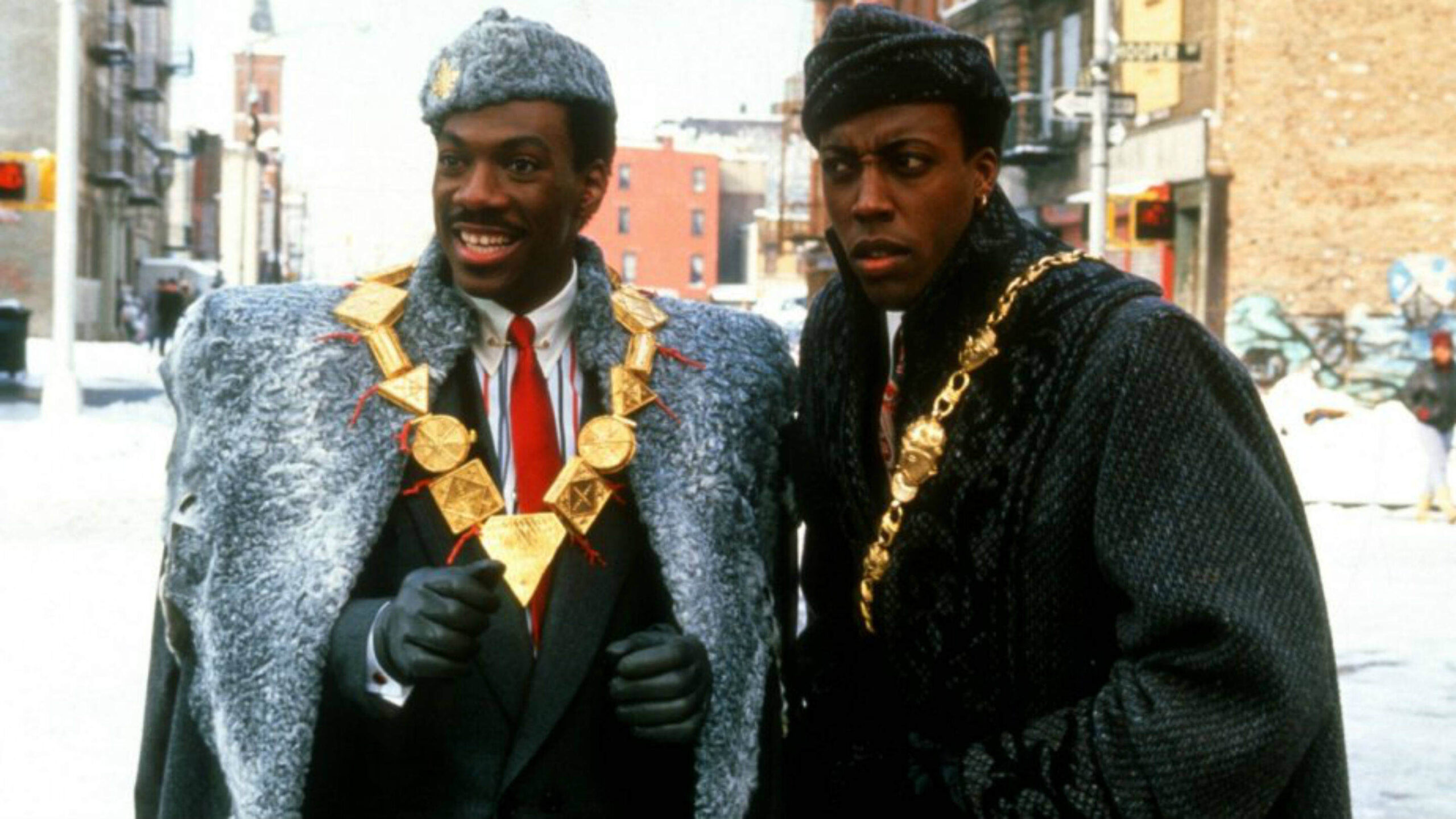
What may come as a surprise to many longtime fans of the film is that those scenes—including a heavily made-up, unrecognizable Murphy as a cantankerous, elderly Jewish man—were largely scripted, according to the film’s producer and editor, George Folsey Jr. “There was almost no question that we were going to pull it off—the combination of the writing, makeup and Eddie’s ability to play different characters,” Folsey, who first worked with Murphy on 1983’s Trading Places, tells Playboy. “I think Coming to America was pretty much the highlight of his career.”
During the contentious making of the film, its success was anything but certain. The film’s director, John Landis, was operating under the cloud of a tragic, accidental death on prior production Twilight Zone: The Movie, and frequently clashed with his star, who had become the biggest box-office draw in the world in the five years since their last collaboration. “I think he and Landis had a little bit of friction,” says Folsey. ”Eddie felt that John was treating him the way he did on Trading Places and not giving him the respect he had clearly earned.”
Meanwhile, the studio pushed up the film’s release to the summer, forcing an extremely tight editing window for an elaborate production which had just wrapped that spring. Folsey Jr.—who has edited and produced such popular comedic hits as Animal House, Three Amigos, The Blues Brothers and Spies Like Us—adhered to a simple strategy to make sure the laughs landed: “Just get out of the way of the comedy.”
Of course, not everyone embraced Coming to America out of the gate. “When John and I were making movies, none of them were well-received,” concedes Folsey Jr. Although one of the biggest box-office hits of 1988, the movie was hit with lawsuits over its parody of McDonald’s and credit for its original story, while others called out its farcical portrayal of Africa and some elements perceived as misogynistic.
“There was almost no question that we were going to pull it off—the combination of the writing, makeup and Eddie’s ability to play different characters.”
Irin Carmon, a writer who been covering gender for years (and the co-author of the book Notorious RBG) has long been aware of the movie’s “problematic moments,” like when Murphy’s Prince Akeem instructs a would-be suitor to “bark like a dog.” But as an Israeli immigrant coming to the U.S. for the first time, and Queens, N.Y., to be exact, “It was a road map into black American cultural touch points.” Carmon tells Playboy, “The movie was a fairy tale, but the princess was valued for being smart and independent as well as beautiful, which was a little better than most of its peers. Also, it was hilarious, and the costumes were—and are—amazing.”
“The criticisms tend to overlook how much of the film is not meant to be taken straightforward,” adds Gates. “The film is poking fun at the convention of that type of romantic comedy.”
Some of the film’s wackier experiments are among its most indelible elements. Murphy’s character breaks the fourth wall during the aforementioned “dog” scene, as does the villain later in the film. Meanwhile, Akeem has not only a live orchestra playing in his bedroom, but a pet elephant named Babar to boot. And there’s even some Murphy movie-universe building, where the villains of Trading Places (played again by Ralph Bellamy and Don Ameche) return in a cameo appearance that Folsey helped persuade Landis to include.
Hijinks like these, and an eclectic cast which includes Louie Anderson (the film’s sole, significant white speaking role) and a then-unknown Samuel L. Jackson as a would-be robber, are in stark contrast with the more serious-minded, politically charged attempts at multicultural representation present in a movie like Black Panther, even though, according to Gates, “every single fan was making [the] connection” by noticing the two films’ similar themes.
Even SN**L got into the act, when Black Panther star Chadwick Boseman hosted the show this season and reprised his T’Challa character in a “Black Jeopardy” sketch. In a meta moment, and in a nod to fans of Murphy’s movie, Boseman channeled Coming to America’s Akeem and his naive, incongruous “yes, in the face!” exclamation.
What both movies proved is that there is a wide, crossover audience that can enjoy powerful black people on screen, as long as it’s entertaining. And with Eddie Murphy arguably at the peak of his popularity and comedic powers, the combination was perfect with Coming to America, which has a sequel in the works. “For a generation of comics like myself, Eddie made stand-up palatable,” says Edwards. “When [he] popped, it was something refreshing—this was a cat looked at as the next Pryor, but he was younger and more matter-of-fact.”
Despite its R-rated language, Gates views Coming to America as Murphy’s “pivot” film, and indeed, the actor would later stretch into more romantic films and eventually settle into a series of successful family vehicles (including the blockbuster animated Shrek films) in the years that followed. His big-screen star presence has dimmed a lot recently, as his only film appearance in the last six years was the little-seen, poorly reviewed drama Mr. Church. And fans of his wisecracking, raunchier 1980s persona have been lamenting his turn to lighter fare for years.
Still, fans will likely always have Coming to America to revisit during its ubiquitous reruns on cable and streaming services. According to Gates, “I think Coming to America continues to reverberate in black popular culture, and will indefinitely.” Or, to borrow a choice quote from the film, “Sexual Chocolate!” … forever.