Your bag is empty.
If you somehow forgot to chew up two hours of your weekend checking out Michael Moore’s latest drive-by documentary at the multiplex, you’ve got lots of company. According to Variety, no movie of his has crapped out so badly at the box office since Fahrenheit 9/11 turned him from a muckraking left-wing cult figure into a blue-state folk hero 14 years ago.
Released just months before George W. Bush’s 2004 reelection, which it was supposed to help prevent, Moore’s Dubya-bashing splatterfest made $23 million right out of the gate in its opening weekend. Fahrenheit 9/11’s eventual $222 million worldwide gross (Moore insists it was more like twice that) means it’s still unbeaten as the most commercially successful documentary of all time. By comparison, its Trump-era sequel, cutely titled Fahrenheit 11/9—as in, the morning after Election Day 2016—only dredged up an anemic $3 million in ticket sales this weekend, despite opening on almost twice as many screens nationwide.
Because we’re the dutiful type, we dragged ourselves off to see it Sunday afternoon, and trust us: We could have heard a pin drop. If we’d turned around in time, we might even have guessed which of the other two people in the theater had dropped it. And bear in mind, this was in an upscale, more-chic-than-thou neighborhood in ultra-blue Calif. The dazed trio we were part of probably looked like a raucous mob compared to the business Fahrenheit 11/9 was doing elsewhere.
Let’s get to the burning question, though. Other than that, Mrs. Lincoln, how was the movie? Oh, well. As the Hail Mary implied by the title’s echo of Moore’s best-known film should tell you, Fahrenheit 11/9 is, first and foremost, the work of a man desperately struggling—and, judging by those pitiful box-office numbers, failing—to delay his pop-culture sell-by date. All the same, a lot of it isn’t bad at all, at least if you aren’t sick to death of his scattershot but preening style.
For better or worse, assuming you’re curious, bashing our 45th president works more like audience bait than an honest-to-gosh theme. Trump pretty much vanishes from the screen between a pointless early montage that plays up the creepy incest vibe in his relationship with Ivanka, and an over-the-top finale—one of several finales, actually—that uses vintage newsreel footage of Nazi Germany to share Moore’s discovery that Trump is really … just … like … Hitler. The nuts and bolts of Trump’s particular awfulness, which can look pretty scary even without adding a swastika hood ornament to POTUS’ gold-plated limo, don’t seem to interest Moore much at all.
His problem is that he was hoping the Trump era would make his inflammatory approach newly relevant, and it has paradoxically made him virtually redundant instead.
What does interest him, above all, is the water crisis that left thousands of mostly African-American people afflicted with lead poisoning in Flint, Mich., from 2014 on. Moore’s excuse for highlighting the scandal is that the cynical, greedy and racist destruction of the city’s water supply for profit and privilege’s sake was a “preview” of life in Trumplandia, which is a bit on the makeshift side as justifications go. But Flint is his hometown, and he’s usually on solid ground there. These unsparing, indignant sequences are by far the best stuff in the movie, and would have made a top-notch 45-minute documentary all by themselves. It’s too bad Moore would always rather cast a wide net than a taut one.
So he visits Bernie Sanders to relitigate the 2016 Democratic primaries yet again. He trots down to Florida to hang out with the Parkland kids, who are predictably photogenic and articulate. He meets up with progressive candidates running for Congress in this year’s midterms: Alexandria Ocasio-Cortez, naturally, but also Rashida Tlaib in Mich. and Richard Ojeda in W.Va. An ex-Army officer with eyes like happy shivs and a cement-mixer voice, the awesomely blunt Ojeda gives the movie a jolt of pure energy whenever he shows up.
Moore spends a lot of time blasting the gutless Democratic Establishment, whose prevarications madden him more than Trump or the GOP’s wickedness: Bill and Hillary Clinton, the Democratic National Committee, Nancy Pelosi. Even Barack Obama doesn’t escape unscathed, since his own visit to Flint was a stunt disguised as empathy that Moore can’t forgive. His argument is that centrist, Wall Street-friendly Democrats helped make Trump’s rowdy advent possible, and he’s not totally wrong.
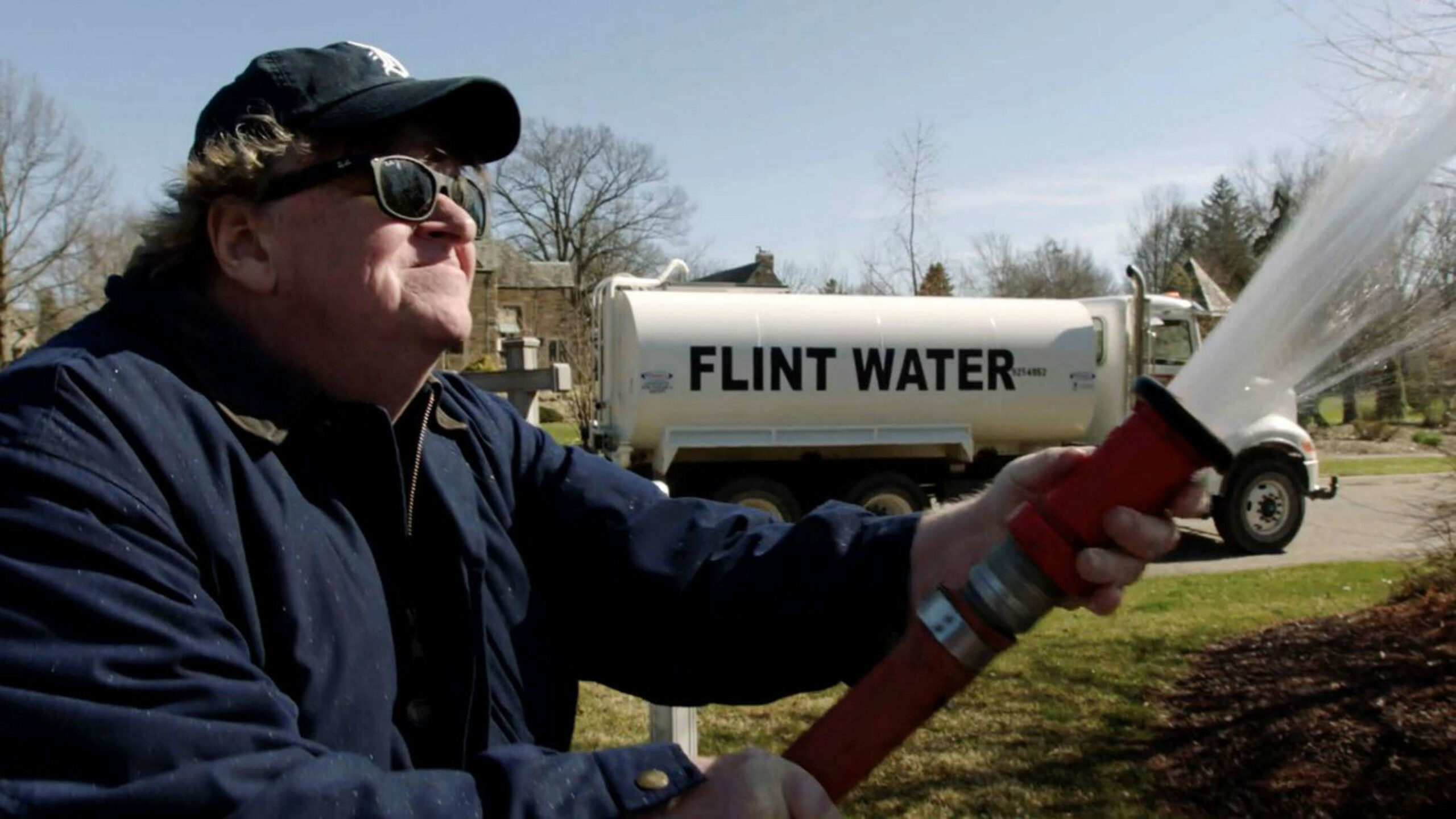
That kind of intransigence was bound to alienate the hefty chunk of Moore’s audience that persists in thinking he’s a good liberal like themselves, not an insurgent bomb-thrower. It would have alienated them, anyway, if they’d bothered to show up in sizable numbers on the movie’s opening weekend—but they didn’t. Neither did the kids who’d have been a lot more sympathetic to his scorn for business-as-usual Democratic Party politics.
In other words, at least so far as we can tell, Moore’s attitudes weren’t to blame for Fahrenheit 11/9’s dud opening weekend. His problem is that he was hoping the Trump era would make his inflammatory approach newly relevant, and it has paradoxically made him virtually redundant instead. Moore’s big advantage in the George W. Bush years was that he was pretty much alone out there as a high-profile, marquee-name dissident, but that’s hardly the case today.
As Owen Gleiberman pointed out in Variety, Moore’s longtime fans aren’t getting any younger. Even with Emma Gonzalez and David Hogg adding “Hello, Young Lovers” (or Death in Venice) youth appeal, he’s plainly at a loss for how to attract new ones. Why should they, or anyone, shell out for movie tickets, parking and dinner to watch cranky, overly familiar Michael Moore go after Trump, when they can saturate themselves in—often cleverer, often more pointed and cogent—versions of the “resistance” 24/7 just by opening their laptops?
At Moore’s most unappealing, the years have turned him into a downright eerie, left-wing parody of Trump himself, which is one inconvenient truth he’ll never cop to.
On top of that, at Moore’s most unappealing, the years have turned him into a downright eerie, left-wing parody of Trump himself, which is one inconvenient truth you know he’ll never cop to. It’s not just that they’re a couple of lardbutts who dress like bozos, right down to the stupid ball caps both men favor. Like Trump, Moore confuses his own stardom with the causes he’s supposedly advocating for. If he’s not in POTUS’ league when it comes to flagrant mendacity—because nobody is—he’s nonetheless fond of specious arguments, opportunistic end runs and baffling changes of subject that substitute rhetorical gamesmanship for coherence. He even hates the New York Times as much as Trump does, and comes perilously close in Fahrenheit 11/9 to calling the mainstream media “fake news.” No huge defense of the First Amendment is on view.
No less than Trump, Moore thrives on rally-style public appearances that let him bask in uncritical adoration, turning his ostensible job into a pretext rather than the point. Like Trump, he’s even notorious for stiffing contractors and leaving trails of unpaid bills behind him. Beyond that, though, what’s uncanny is how similar they sound when they treat “compromise” as the ultimate political dirty word and thrill their partisans with visions of turning the system into so much rubble. Should we even mention that they probably agree that Hillary Clinton ought to be locked up, and not even for wholly dissimilar reasons?
Ultimately, despite their shared pretensions to populism, they also both speak the same language, which is the language of celebrity. That’s why the single most fascinating bit in Fahrenheit 9/11 is Moore’s sheepish acknowledgment early on that he once played patty-cake with Trump on Roseanne Barr’s short-lived talk show, and was even buddy-buddy with Jared Kushner. The clip of Moore and Trump awkwardly joshing each other as a grinning Barr mediates looks like the beginning of a promising movie about fame, doppelgangers, shared privilege and so on, but it’s a movie someone else will have to make. Say, does anyone out there have David (Dead Ringers) Cronenberg’s phone number? He could probably use the work these days.