Bennett Rhodes was scrolling through Instagram early last year when he came across a young woman named Andi Galland. Twenty years old, she posed on beaches and at music festivals; she displayed an impressive command of yoga. To Bennett she epitomized the perfect bikini-clad California girl.
From his Hollywood apartment, Bennett slid into her DMs. To his delight she quickly hit him back. She liked what she saw as well: Only 18, he was a good-looking if unlikely white trap rapper with a burgeoning Instagram following. They got to chatting. Despite his hardcore raps he came from a well-to-do family in San Diego—and so did she, it turned out. She still lived there. Bennett put his cards on the table.
“I’ll bet you won’t come up and see me in Hollywood,” he said.
“I’ll bet I will,” she replied.
Bennett didn’t believe her until she arrived on his doorstep that same day. He was immediately charmed. She was funny, kind and down to do absolutely anything. She, likewise, was won over by his energy and charisma. He carried himself like the star he wanted to be.
Andi stayed with Bennett the entire weekend, joining him and his friends at parties and restaurants. She’d brought Xanax pills with her, and the pair indulged, helping fuel an immediate infatuation. “It became recurring; she ended up visiting us for weeks at a time,” says Bennett’s then-roommate, Daniel “Gibby” Gibb.
Bennett wasn’t a stranger to Xanax. He sometimes rapped about it: “Them Xanies on the yellow / Bitch don’t get so mellow / Your legs looking like Jell-O.” But as their romance blossomed, he learned that Andi was secretly hooked on an even more dangerous drug.
Unknown to most people until a few years ago, fentanyl is 50 times stronger than heroin, an opioid that leaves users feeling like they’re floating on a cloud. Incredibly cheap to produce, fentanyl is cut into other drugs—particularly heroin and prescription pills—as a cost-saving measure by drug dealers. Synthetic opioids, of which fentanyl is among the most common, now kill more than 30,000 Americans per year, making them the deadliest drugs in U.S. history.
Gibby sensed the severity of Andi’s problem when she would go into the bathroom “and just throw up like crazy,” he says. “It was this overwhelming smell.” Severe nausea is a common side effect of fentanyl.
One time Bennett and Gibby picked her up in San Diego. She was planning to visit a dealer.
The red-light district of hookup sites and the anarchic bazaars of the dark web add to a digital world that can be lethally alluring.
Brushing off her concerns, Bennett began taking fentanyl with her. He knew the risks but was so obsessed with Andi that he didn’t care; he wanted to feel what she was feeling. The euphoria was otherworldly, and sharing it with the person he suddenly loved more than anyone heightened the experience.
When they took fentanyl together, time stopped and their love was eternal, even as the drug overtook them and upended everything.
To Bennett’s mother Liz Rhodes, their fate was Shakespearean. “They’re like a Romeo and Juliet couple,” she says.
During Bennett’s childhood his father had a thriving international banking career and his nanny resembled Mary Poppins. Bennett was a martial arts prodigy and a surfer with infectious enthusiasm. “He could have done anything,” says Liz. We’re at her home just outside San Diego; the views are breathtaking. She’s immaculately put together and quite accomplished herself, a corporate education specialist, former law school assistant dean and author.
At different points in his life Bennett was borderline-ADD and diagnosed with anxiety. In high school his parents divorced. He associated with a gang of violent La Jolla High School surfer kids known as the Groms. In 2016, just before his 16th birthday, a terrible car accident left him with a brain bleed. His girlfriend at the time helped him recover, and he became consumed by their relationship. When they broke up he left her a suicide note, and then drove to the Coronado Bridge, though he didn’t jump.
More than a cry for help, it was a cry for love, a reflection of the instability in his life. “Bennett didn’t have anyone asking him about his feelings for most of his life,” says Gibby. “I don’t really think he got a lot of constant love, and so when he got it finally, he was really obsessed with it.”
Andi was the next girl to consume him. Born Andrea Galland, she lived in San Diego’s inland Tierrasanta neighborhood and attended the experimental High Tech High charter school system, where she wrote fiction and dreamed of becoming a surgeon. The school could be lenient, and she was sharp enough to “skate by without doing much,” says her friend Gabriel Jacobs. He and another friend said she was troubled by a particularly traumatic childhood event she preferred not to discuss.
Andi Galland in a photo from her Instagram.
Her sophomore year boyfriend Zion Maly saw her become increasingly preoccupied with drugs and drinking. “I would get random Snapchats of her, like, knocked out at parties, or with people snorting cocaine off her,” he says. “I cheated on Andi, and then it went all downhill. She started drinking more, partying more, doing more drugs. I felt like I was responsible.”
After high school she worked restaurant jobs and hung out with her best friend Jane. (Jane’s name has been changed; she declined to be interviewed.) They grew as close as two young, starry-eyed people can be, residing together in San Diego and even sharing a bed. Vacationing in exotic locations, they posted swimsuit photos to Instagram; Jane was equally stunning, and a number of brands attempted to recruit them. Like many millennials, Andi also had a “Finsta,” a private “fake Instagram” page showcasing the sillier and more inebriated side of her life.
According to two people who knew them well, Andi and Jane patronized the website Seeking Arrangement, where “sugar babies,” often young women, are paired with “sugar daddies,” usually successful older men. Being young and beautiful on the internet gave them access to fawning men, free clothes and wild parties.
They, along with Bennett, were poster children for the Instagram age, where young people seek fame and fulfillment online, and likes and new followers supply the dopamine kicks. Instagram has changed the way young people present themselves. In Romeo and Juliet, ballrooms were where the kids found each other, picked fights and fell in love. Today’s ballroom is Instagram, and it’s always open. Meanwhile, the red-light district of hookup sites and the anarchic bazaars of the dark web, where just about any drug is a few clicks away, add to a digital world that can be lethally alluring to kids who, like Bennett and Andi, are struggling with addiction and trauma.
As Andi descended into fentanyl abuse, she found herself associating with dubiously motivated guys with access to drugs. Smart, ambitious and seemingly headed for big things, her potential began to erode.
Synthetic opioids already kill more people annually than any drugs in American history, but having wreaked havoc on the East Coast fentanyl is only now arriving in California. In the San Diego region, fentanyl deaths jumped by 68 percent between 2018 and 2019.
Because of dealers’ propensity to secretly cut fentanyl into other drugs, today’s black-market pills and powders are especially dangerous for experimentation-minded young people. Fentanyl has been particularly deadly in hip-hop, killing rappers Lil Peep, Mac Miller and Lexii Alijai, as well as music legends Prince and Tom Petty.
Perc love helped them be with each other, and it helped them be with themselves.
Though rap artists including Bennett, who rapped under the name Beanie, glorify popping pills and drinking lean, virtually no rappers brag about doing hard drugs like fentanyl. But since fentanyl is increasingly cut into black-market pills that look exactly like Xanax or Percocet, it’s often essentially the same thing.
Andi and Bennett snorted crushed-up tablets called Percocet 30s. These weren’t pharmaceutical-grade pills containing acetaminophen and oxycodone; in fact, actual Percocet doesn’t come in 30 milligram doses. These were counterfeit blue pills, made with fentanyl. Andi and Bennett knew this, but it didn’t slow them down. In fact, it made their love feel more real. Bennett called the phenomenon “Perc love.”
“It was the most magical high I ever felt. Literally I found true love in a person and in a drug,” says Bennett’s brother Mark Rhodes, who experienced Perc love himself while taking the pills with Jane, noting that it dulls one’s libido even while it ignites one’s infatuation. (He says he soon came to his senses, quit fentanyl and broke things off with her.)
For Bennett and Andi, this euphoria was wrapped up in their happiness with each other. They stayed up all night in his room, watching Gossip Girl in a haze or just kissing and cuddling. Perc love was easy to confuse with actual love.
They chased fantasies: gritty rap star and carefree traveler. The social media identities they fashioned for themselves papered over pain from their upbringings, and fentanyl served to smooth out the rough edges. When they snorted the powder, they had all the love in the world they needed; Perc love helped them be with each other, and it helped them be with themselves. But when the opioids wore off, their self-confidence plummeted, and reality set in.
As they grew closer, Andi shared her drug contact. She received the Percocet 30s from a man named Andrew, she told Bennett. Andrew was another man apparently auditioning to be her sugar daddy, but he wasn’t an investment banker or wealthy financier. He was a fentanyl trafficker, with an operation stretching across the border.
Daren Andrew Lee goes by his middle name. Born in 1983, he grew up in Mormon country, living for a time in Salt Lake City and studying organic chemistry at Brigham Young University, Hawaii. With a white-collar résumé atypical for a dealer of street drugs, he arrived in San Diego to begin work with a biopharma company in early 2013.
But Andrew suffered personal setbacks, including becoming estranged from his young son and getting involved with heroin. In 2015, he received probation after selling heroin to undercover cops; according to court records, he “told officers he…frequently crossed into Mexico to bring drugs back over the border to sell.” In 2017, he was charged with misdemeanor possession of controlled substances including heroin, and he successfully completed a drug treatment program. (For all the well-deserved bluster against the war on drugs, drug sentences have actually been reduced quite a bit in recent years.)
Somehow, he maintained steady work in the pharmaceutical industry. According to his LinkedIn profile, he started as a clinical operations consultant in May 2018 for Acadia Pharmaceuticals, a San Diego-based company making medications for disorders including Parkinson’s disease. He was hired temporarily through employment agency Suna Solutions, his page notes, and under his areas of experience he lists “Opioid Induced Constipation.” “This is by FAR the best job I have had in the industry in over 10 years!” he wrote.
Life was good. He bought a BMW and moved into a luxury apartment overlooking the Padres’ baseball stadium. He displayed his amateur photography work on his Instagram page—beaches at sunset and dazzling downtown cityscapes.
It’s unclear when Andrew began trafficking fentanyl pills from Mexico or how he began his courtship of Andi and Jane, but the two events overlapped. He sought to impress them by offering gifts like shoes and watches, says Gibby, who grew close to both women. “He was creepy and weird,” Gibby goes on, adding Andi and Jane were only “using” him for his fentanyl access. “They could do it because they were very attractive, and they had this addiction.”
In the fall of 2019, he posted a picture of the three of them in his elevator. For the photo, Andrew donned sunglasses and attempted to look suave. Jane and Andi wear short skirts, their arms draped over him. Apparently attempting to be funny, Andrew wrote: “Can’t believe what progress [Jane and Andi] have made since I met them panhandling, I’d say they clean up nice… #futurehousemates.”
Bennett’s father David—a large guy whose face, like his son’s, radiates curiosity and kindness—says that, in the last week of November, Bennett detailed to his parents conversations he and Andi had with Andrew. David listened carefully as Bennett laid out Andrew’s attempts to recruit Andi and Jane to move into his apartment and help him expand his fentanyl business.
He used an app to discover her phone’s location. It was in the DEA’s office in San Diego.
According to Bennett’s parents, Andrew explained his smuggling operation and told Bennett and Andi his position with Acadia helped insulate him. “Lee bragged about using his pharma company’s credentials to get easily back and forth across the Mexican border,” David says. (Andrew did not respond to requests for comment; nor did Acadia Pharmaceuticals.)
In the spring of 2019 Bennett’s parents caught wind of his fentanyl habit, and his mother Liz rushed him off to Hawaii for a week, to sober up. He swam in the ocean and played ukulele, an instrument he learned from the now-deceased Chargers great Junior Seau, a family friend. Liz expressed her concern about Bennett’s drug-centered relationship with Andi. Bennett pledged to stay clean; he hoped to help Andi beat fentanyl too.
“He was going to save Andi, then save himself, and then they would live a clean life together,” says Liz.
That summer Bennett moved into a new apartment in Hollywood, just off Sunset Boulevard, with his brother Mark. It was a young hip-hopper’s Shangri-La, a crash pad filled with bongs, top-line recording equipment and rolls of fake $100 bills for music videos. Mark is a driven rap producer and singer-songwriter known as MTStreets, and he and Bennett attended the Los Angeles Recording School. They called their music together “Hollywood trap”—a melding of the glossy and the grimy. Mark is most in his element when blasting his music between pulls from the water pipe, rapping along with Bennett’s best tracks.
Those who knew their backgrounds might blanche at their images as gritty hip-hop artists—Bennett once wrote in an Instagram post, “Hard to believe we came from nothing”—considering their upbringing in tony La Jolla, and that their mother leased the Hollywood apartment. Still, hip-hop has always been about remaking oneself, and the two brothers’ obvious love for the trap genre helped them pull it off.
Having worked up a business plan for his music career with his dad, Bennett was now preparing his debut mixtape, Never Comfortable, spending down his five-figure settlement from his high school car accident on well-known collaborators—including associates of his hero, Gucci Mane, a rapper who glamorizes Percocet in his music.
“We had dreams of winning Grammys, of being millionaires,” Mark says. Bennett built up an Instagram following of nearly 10,000, posing with gold chains, vape pens and stacks of cash.
Mark and Bennett drew into their orbit local performers and impresarios, including co-workers from restaurants where they worked. Paul Fleming, a Los Angeles rapper known as Cloud, was shocked when Bennett announced his sudden resignation from Jersey Mike’s, tossing aside his hat and apron mid-shift and walking out. “We have a higher calling,” Bennett had said.
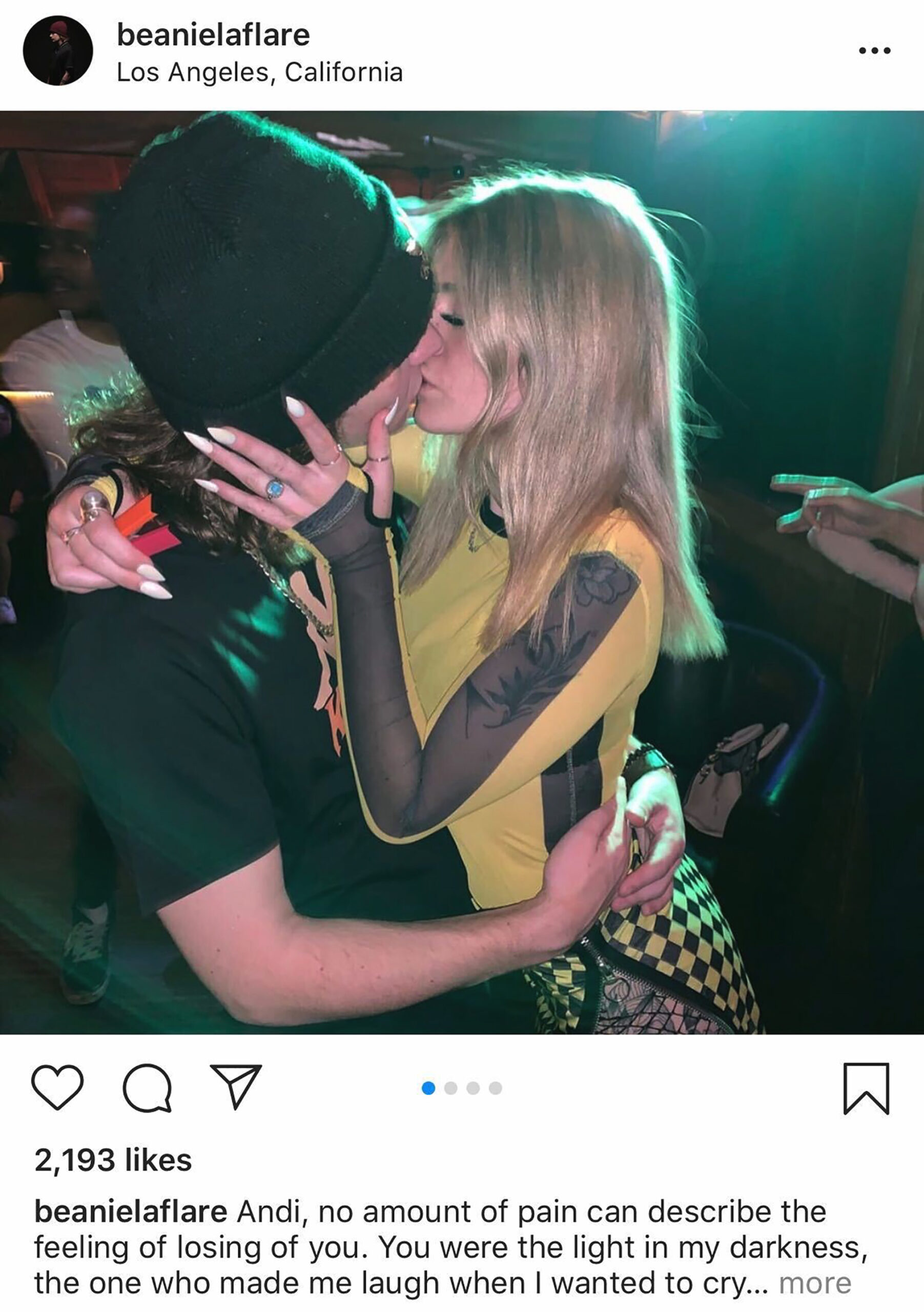
Bennett’s tribute to Andi, from his Instagram account.
This impressed Cloud, who also welcomed Andi and her glamorous energy into his social circle. “She was like Marilyn Monroe,” he says. “They were next.”
But behind the scenes fentanyl was back in Andi and Bennett’s lives. While high everything was great, but when they crashed they were miserable, and the only balm was more fentanyl. Andi began to withdraw. While she maintained admiration and even love for Bennett, her commitment to the relationship waned. “But Bennett was not letting it go,” Gibby says. “Like a puzzle piece that doesn’t fit.”
His addiction out of control, Bennett agreed to check into Passages Malibu, an elite treatment center known for its steep price (as much as $100,000 a month for a private room) and for not adhering to a 12-step recovery model. There he experienced the agony of detox—“It was like skin was being ripped off of his body,” remembers his father—only to find even greater agony on the other side.
On Sunday, November 24, after being unable to reach Andi by text message, he used an app to discover her phone’s location. It was in the DEA’s office in San Diego.
His mind raced. Why was it at the DEA’s office? He called Andi’s mother, who told him what he feared most in the world—that Andi had passed.
The details are unclear, but according to the San Diego County Medical Examiner’s Office she died from fentanyl, alcohol and alprazolam, the drug in Xanax.
“He immediately FaceTimed me. He was on his knees,” says David Rhodes. “He just shattered right there.”
In the immediate aftermath, Bennett was caught between conflicting desires: to numb his pain into oblivion and to inflict payback on Andrew, the man he believed responsible for Andi’s demise. He took to social media to express his sorrow. “You made my heart beat when it didn’t want to,” Bennett wrote to Andi in an Instagram tribute. “You were my reason to breathe.”
At Passages Malibu, Bennett was placed on suicide watch, with someone assigned to check on him every 15 minutes, says Liz. But soon there was a new development. According to his parents, Bennett was discharged early, on November 29, 2019, because the family changed health insurance policies. This was only five days after Andi’s death. (Passages Malibu did not respond to requests for comment.)
“He was released too early,” says his mother. “It was not right for a person who was so fragile and had just suffered the single worst trauma of his life.”
She adds that, shortly after discharge, he had a strange question for her: “What are some of our best family memories?” he asked.
His mother was perplexed. “Bennett, you have a lifetime of amazing stuff,” she said. “At home I’ll pull out every photo album and we’ll reconnect you to your wonderful childhood.”
Bennett spent his first night out of rehab at home, with Mark keeping close tabs on him. The next day, November 30, they boarded a train to San Diego.
They planned to celebrate a late Thanksgiving with the family, but when Liz picked up the boys at the train station, Bennett wasn’t himself. He seemed “unhinged” and “drugged,” she said—but not on fentanyl. He had apparently taken lorazepam, an anti-anxiety medicine best known as Ativan, that Liz believes he received from Passages. Like Xanax, Ativan is a benzodiazepine. It’s a downer that, when combined with fentanyl, another downer, is particularly lethal.
An argument broke out. Bennett, reeling, made nasty accusations against his mother, and she told him to get his act together. Bennett and Mark eventually decided to spend the night at the Carlsbad apartment of their friends William and Hannah. First, Bennett visited Andi’s parents to offer his condolences. They took him in like a son, and each consoled the other. At some point that day he also made his way downtown. Near Andrew’s apartment, he met a dealer and purchased six or seven Percocet 30s.
Back in Carlsbad he acted like nothing had happened. He said goodnight to his brother and friends. “He gave us all a hug; he thanked us for letting him crash,” says William. “I felt that everything would be okay. It was a safe place.” Bennett went into William’s bedroom and closed the door.
In the morning, Mark checked on his brother. The door was locked; he picked it. He found Bennett face down on the bed. His body was hard. Mark turned him over and saw that his face was purple.
Bennett had died exactly a week after Andi. He was 19. The entire relationship, from Andi’s appearance at Bennett’s door to their fatal overdoses, lasted less than a year.
“It was almost like an out-of-body experience” hearing his son was dead, says David. “Just the worst feeling a human could feel.”
Bennett left a note of sorts, by way of a short video found on his phone. “I love everything and everyone so much,” reads the caption of the video, in which Bennett flashes a series of cryptic gang signs, and then shows off a line of fentanyl on the bathroom lavatory, the same line that presumably killed him.
Bennett’s parents have immersed themselves in trying to get justice.
Some family members believe he knew the dose would be fatal, and thus his death was suicide. His mother isn’t sure. “I don’t think it was intentional suicide,” says Liz. “I do believe he knew the risks. Maybe he didn’t care. But I think he simply went back to using because he was in such a fragile, painful time.”
Ultimately, Bennett fulfilled both of his desires following Andi’s death: He numbed himself into oblivion, and he got retribution. Shortly before he died, Bennett explained Daren Andrew Lee’s smuggling operation, says David.
Andrew went to Mexico frequently, Bennett told him, allegedly purchasing some 7,000 pills per week for about $3 each. Once brought back across the border, he sold the pills for $25 to $30 each.
David relayed this information to the DEA, who put Andrew’s name into a database. Only three days after Bennett’s death, on December 4, 2019, Andrew returned from Mexico through the San Ysidro land port of entry. His passport was flagged, and Andrew was found with two Ziploc bags, according to court records, one containing 21 grams of “blue circular pills,” which tested positive for fentanyl, and another harboring 23 grams of “white bar-shaped pills,” which tested positive for heroin. Though the purity of the pills isn’t known, this was likely a large amount considering 2 milligrams of pure fentanyl can kill. “Lee admitted to law enforcement that he obtained heroin and fentanyl pills in Mexico with the intent to distribute them in the United States,” read his court records. He pleaded guilty and, in January, was sentenced to four years, two of them suspended.
Both Andi’s and Bennett’s families remain devastated. Bennett’s brother Mark—his best friend, close collaborator, and fellow dreamer—has sorrow in his eyes as he goes through the motions of everyday life in the apartment where his brother no longer lives. The sadness is tempered only by anger. He has blame to go around, but maintains especially strong words for Daren Andrew Lee. “He knew Andi died, and he kept selling. He knew Bennett died, and he kept selling,” says Mark, his voice thickening. “Basically, that’s the definition of a serial killer.”
Ultimately, Andi and Bennett were overtaken by the latest, deadliest trends in music and drug culture. Monied kids have dreamed big and partied wild for decades, but they had the bad fortune to come of age when a new, ultra-potent chemical was killing more Americans than any drug previously, at a time when the most popular music culture glamorized it by calling it something it isn’t.
Bennett’s parents have immersed themselves in trying to get justice for Bennett—pushing for murder charges against Andrew and investigating why Acadia Pharmaceuticals took him on in the first place. They are also working to launch awareness programs geared toward youth, many of whom have no idea that any black-market pill or powder could be spiked with a lethal dose of fentanyl. Liz wants to focus on music and video, mediums “that are easily consumable via social media,” she says. Liz is also committed to “reducing shame and bringing the epidemic into family conversations.”
“If we save just one life,” says David Rhodes, “it’s worth it.”
Bennett’s dream of remaining by Andi’s side has come true, in a sense: He is buried close to her at El Camino Memorial Park in San Diego, perhaps only 40 feet apart.
“He had a dream and wanted a life with this girl,” says Liz. “Neither is to blame for the other’s death. They were adults dancing too close to the flame.”