Your bag is empty.

Reproductive justice advocates are pressuring the new administration to stop dancing around the topic of abortion access
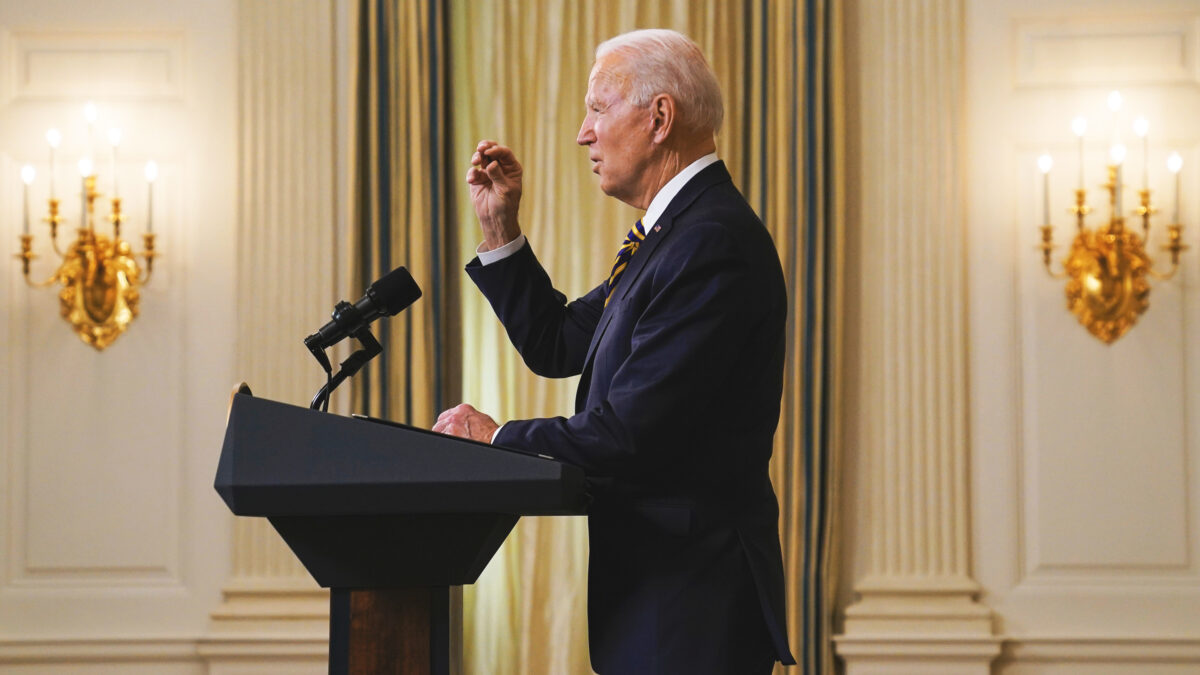
Less than eight hours after Joe Biden was inaugurated as the 46th president of the United States, the administration fielded its first question regarding abortion. Owen Jensen, a reporter for Catholic TV network EWTN, asked White House Press Secretary Jen Psaki about “two big concerns for pro-life Americans”—the Hyde Amendment, which bans federal funding, such as Medicaid, from covering abortion services, and the Mexico City policy, which withholds U.S. government funding from clinics overseas that offer or make referrals for abortion care. It was an anticipatory moment for the nearly one in four women (as well as trans men and nonbinary people) who have abortions, as well as abortion providers, clinicians and advocates. It was a chance for the Biden-Harris administration to set the tone and make good to the over 81 million people who voted them into office.
And they failed.
Psaki side-stepped the question, saying the administration would have more to say on the issue before administering a disclaimer of sorts. “I will just take the opportunity to remind all of you that he is a devout Catholic and somebody who attends church regularly,” she said. “He started his day attending church with his family this morning, but I don’t have anything more for you on that.”
Abortion stigma is back and thriving in the White House, and that is very scary under a supposedly pro-choice administration.
The majority of people who have abortions are religious, according to the Guttmacher Institute, a pro-choice research organization. A reported 17 percent of abortion patients identify as mainline Protestant, 13 percent identify as evangelical Protestant, 24 percent identify as Catholic and 8 percent report some other religious affiliation. Catholics are just as likely to have abortions as anyone else, yet by evoking the president’s faith in order to side-step a question that could have easily been answered (Biden later issued an executive order that rescinded the Mexico City policy), the Biden-Harris administration spent its first 24 hours in office reinforcing abortion stigma.
“We should absolutely expect a presidential administration, especially the Biden-Harris administration, to be willing to speak openly, honestly, affirmatively and unapologetically about the importance of abortion access, and that includes saying the word abortion,” says Andrea Miller, president of the National Institute for Reproductive Health. “If you support the ability of people to make decisions about their reproductive lives, which the vast majority of people, including the voters who elected this administration, believe, you need to be willing and able to say the word abortion.”
Biden and his administration do not seem to harbor that willingness though. On the 48th anniversary of Roe v. Wade, the landmark Supreme Court ruling that secured access to abortion care as a constitutional right, the White House issued a statement that did not once include the word abortion. Instead, the administration chose phrases such as “reproductive health,” “the right to choose” and “health outcomes.” Among the many executive orders Biden signed regarding the Covid-19 crisis, absent was an order to revoke the in-person mandate for medication abortion during the pandemic, therefore allowing the federal government to continue to force people to travel to clinics in person when studies have shown they can safely receive and manage medication abortions at home. In fact, a study published on February 18 in the British Journal of Obstetrics and Gynaecology found that a “telemedicine-hybrid model for medical abortion that includes no-test telemedicine and treatment without an ultrasound is effective, safe, acceptable and improves access to care.”
“When those who support abortion rights and abortion access use euphemisms and avoid talking specifically about abortion, the biggest problem is the void it creates,” Miller says. “It’s a void that a small but very extreme minority that is trying to eliminate abortion is ready and eager to fill with misinformation, with lies, with harassment, with violence and with policies.”
Makayla Montoya, a 21-year-old living in Texas who spoke to Playboy from a parent’s home after her apartment lost water, power and heat during the recent winter-storm crisis in the state, has experienced the ramifications of such a void, and how it can perpetuate stigma, shame and judgment, and make it easier for barriers to abortion care to remain. Montoya was 19 when she had her first abortion, and, given the limited amount of access to care in her state, she first visited a crisis pregnancy center.
“At the crisis pregnancy center they showed me a bunch of little rubber babies, they gave me a onesie and were like, ‘Oh my God! Congrats, you’re pregnant! You must be so excited!’” Montoya says. “I was like, “Um, help me?” Montoya says she had no funds to pay for her abortion and was out of work. “I was a full-time sex worker, so I was really struggling being pregnant and being able to perform at the same time,” she says. “Being pregnant and being a stripper just weren’t compatible things for me at the moment.” So she relied on her friends and former partner to help pay for her surgical abortion.
“I felt a lot of shame,” she explains. “I just let myself be sad and upset about it because everything around me told me that that’s what happens after an abortion—that you have to feel sad and shame and regret and like you lost something. It was hard. But after talking to people in my community and hearing their abortion stories and that people actually celebrated their abortions and that it was okay, I felt so much better. I don’t have any of the shame or guilt anymore, but I had resources. I had people. A lot of people don’t have that.”
A national study in 2012 found that nearly two-thirds of people who have abortions know people who would “look down on them” if they knew they had the procedure. Another study published in January 2020 found that high levels of abortion stigma at the time a person seeks abortion services can “contribute to people’s experiences of psychological distress,” including internalized perceptions of stigma that can cause “long-term consequences for their mental health.”
“I didn’t tell my mom [about my abortion]. I didn’t tell my grandparents, who I was living with at the time. I didn’t tell my cousin, who I was also living with,” Montoya says. “That was a hard secret to keep, but I felt like I had to because I grew up in a very Mexican-Catholic family. If you had an abortion—and people in my family did—you just didn’t talk about it. It was something to be ashamed of.”
“Those of us who have abortions work really hard to listen to the people in our lives who are talking about abortion access and how they talk about it to figure out whether they’re safe people to talk to about our own experiences,” says Renee Bracey Sherman, founder and executive director of We Testify, an organization dedicated to the leadership and representation of people who have had abortions. “One of the things we listen to is whether they can say the word abortion—whether they’re sharing their values and love when they’re talking about abortion. And right now, the White House isn’t doing that.”
Bracey Sherman started the #AskAboutAbortion hashtag and campaign during the 2016 presidential primaries to better assess which Democratic candidates truly support access to abortion. She says that for abortion storytellers, many of whom made the decision to share their abortion stories during the Trump administration’s tenure, when harassment and threats to abortion patients, clinics and providers doubled, the administration’s decision to avoid the word feels like a betrayal.
“I can speak for the We Testify storytellers when I say that it feels really frustrating to do the brave thing and share our stories, only for Biden to not reciprocate that by even acknowledging what we’ve done by saying the word abortion,” she says. “Abortion stigma is back and thriving in the White House, and that is very scary under a supposedly pro-choice administration.”
There is no time to be coy, or to shroud the word *abortion* in euphemisms and colloquial terms to appease a loud minority.
What makes it particularly threatening for those living in states hostile to abortion rights is the influx of anti-abortion laws being introduced at the state level now that the Supreme Court holds a conservative majority. An anti-abortion bill in Tennessee would allow men to “veto” the abortions of their partners or former partners. Republican lawmakers in Iowa introduced a bill that would allow the state to “utilize proactive targeted digital marketing using proven search engine marketing techniques” to track pregnant people seeking abortion services and target them with “specific scripting strategies to create a conversation with these pregnant women to encourage them to choose an alternative.” South Carolina passed a near-total abortion ban, outlawing the procedure before most people know they’re pregnant. (One day after it was signed, a federal court blocked the measure.) Republican lawmakers in Arizona want to prosecute people for homicide who have abortions. One lawmaker called it the “perfect bill” and said at a rally that the bill would not be amended.
This is why leaders in the abortion-rights space reject the idea that people working to expand abortion access can breathe a sigh of relief now that Trump is out of office. For far too many people in this country—particularly Black, poor, young or LGBTQ people—Roe exists in name only, and anti-abortion laws are passed at the state level regardless of who occupies the White House. All* Above All, a women-of-color-led effort to restore and sustain public insurance coverage of abortion, has been a leading voice in urging the Biden administration to say the word abortion, repeal Hyde and expand access to abortion care for the most marginalized among us.
“President Biden is a compassionate leader who supports healthcare access and economic security for all people. His values align with abortion justice: He has prioritized racial equity, economic security and pandemic relief during his first 100 days in office,” Silvia Henriquez, co-president of All* Above All, said in a statement emailed to Playboy. “We’re urging him to use his bully pulpit to send a message about his commitment to abortion justice as a part of racial and economic justice. Equally important are the actions he takes. We’re watching closely for him to follow through on his campaign promises to end the Hyde Amendment. A presidential budget without the Hyde Amendment and lifting barriers to medication abortion care fit squarely within President Biden’s stated priorities of racial equity and pandemic relief.”
NARAL has publicly asked Biden and those in his administration to say the word abortion via Twitter and other public platforms, and has called on the administration to repeal Hyde and highlighted the importance of talking about abortion to combat stigma. Alexis McGill Johnson, president of Planned Parenthood, spoke about the importance of saying the word abortion during a press call with leaders from organizations supporting the Blueprint for Sexual and Reproductive Health, Rights and Justice. “Frankly, we need to be unapologetic about saying what we mean: using the word abortion when that’s what we’re talking about,” she said.
Advocates promise that these calls are only going to grow if the administration refuses to do right by the people who elected them. When six states have only one clinic that provides abortion care; when studies have shown those who are denied abortion care are more likely to live in poverty; when the country is in the throes of a public health crisis that is disproportionately impacting Black, Indigenous and people of color; and when the nation is experiencing a rising maternal mortality rate and racial injustice— all of which fall under the purview of reproductive justice—there is simply no time to dance around the issue. There is no time to be coy, or to shroud the word abortion in euphemisms and colloquial terms to appease a loud minority. It’s time for the Biden administration unapologetically, whole-heartedly and without hesitation to stand up for and defend abortion access, the people who offer it and the people who seek it out.
“My job is to be 100% supportive of people who have abortions and advocate for people who have had abortions,” Bracey Sherman says. “Sometimes that means calling out your friends and holding them accountable when they’re causing harm.”