

Your bag is empty.
It smells like lavender and peppermint as David Bronner strolls through his family soap factory, greeting colleagues with his signature shaka (a fist with thumb and pinky extended) and reminding them of a protest against deforestation in the Amazon the upcoming weekend.
It’s almost lunchtime and everyone’s chit-chatting as they line up, inside the northwest San Diego County factory, for a buffet of organic vegan-fish tacos, curried cauliflower and salad, made fresh each day by the company’s resident chef.
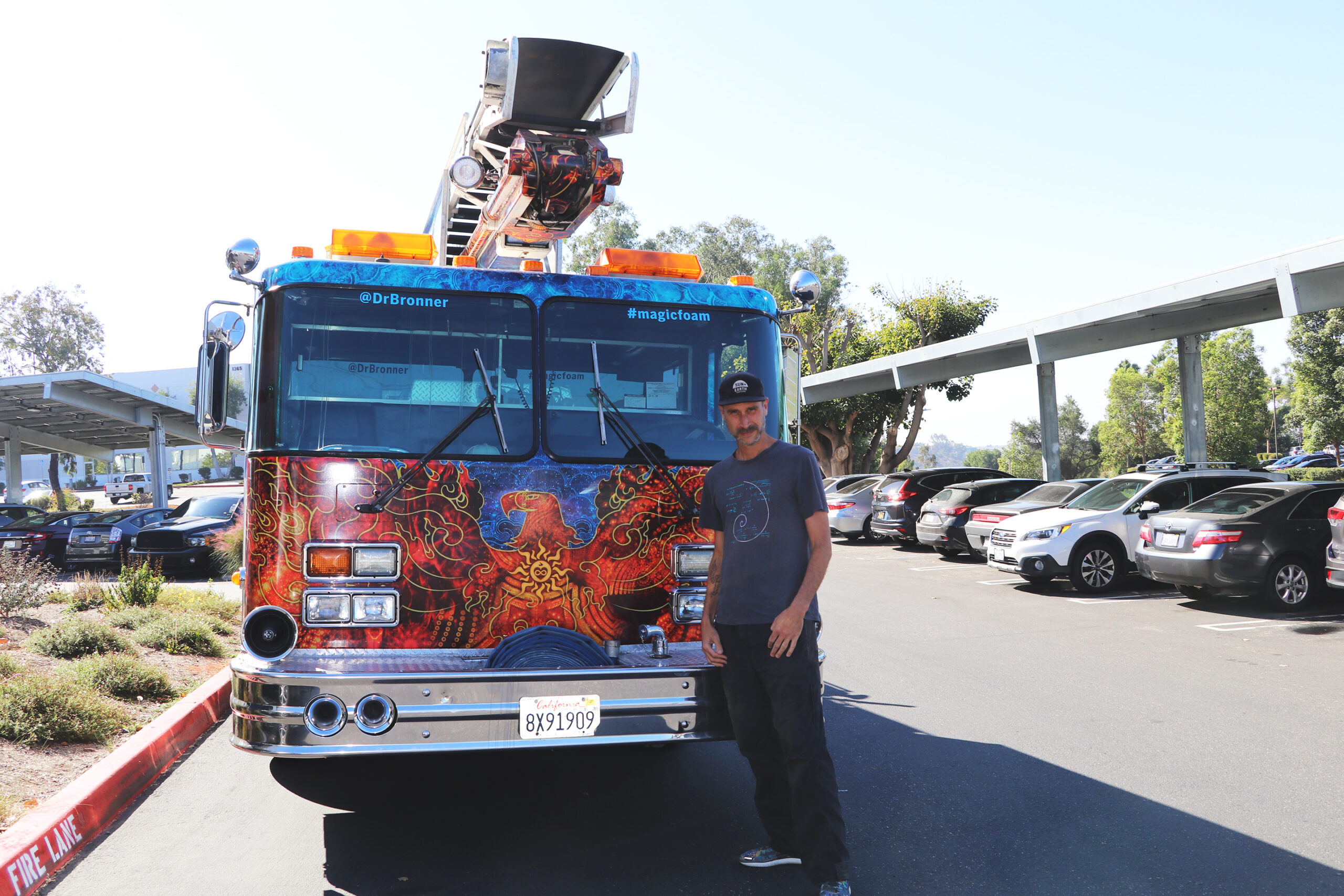
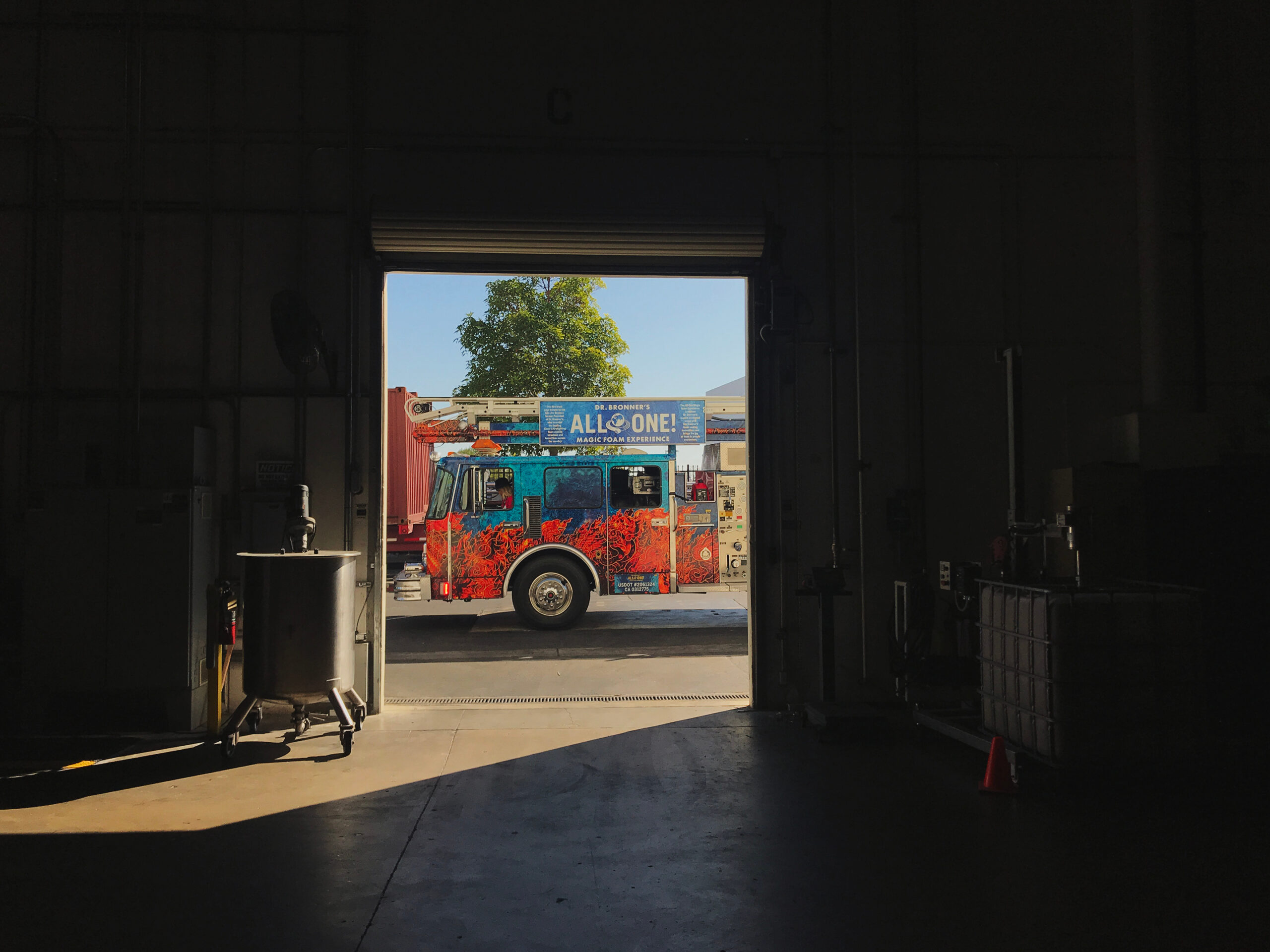
From the outside, Dr. Bronner’s Magic Soap factory looks like any other industrial complex. To get around the sprawling property, you need a vehicle—and for Bronner, that vehicle is the Magical Foam Experience, a tribute to the truck his father equipped with a fire-fighting foam of his own invention to put out structure and forest fires. The truck is painted with a majestic orange eagle (his father’s “power animal”) spreading its fiery wings over a background of cerulean mandalas.
Electronic funk blasts from within the truck, lending a Merry Prankster-meets-Willy Wonka vibe to the otherwise sterile landscape of warehouses and massive steel tanks containing the soap’s ingredients—everything from Palestinian and Israeli-sourced olive oil (to be “balanced,” Bronner says) to Sri Lankan coconut oil, which the company began using following their tsunami relief project in the country.
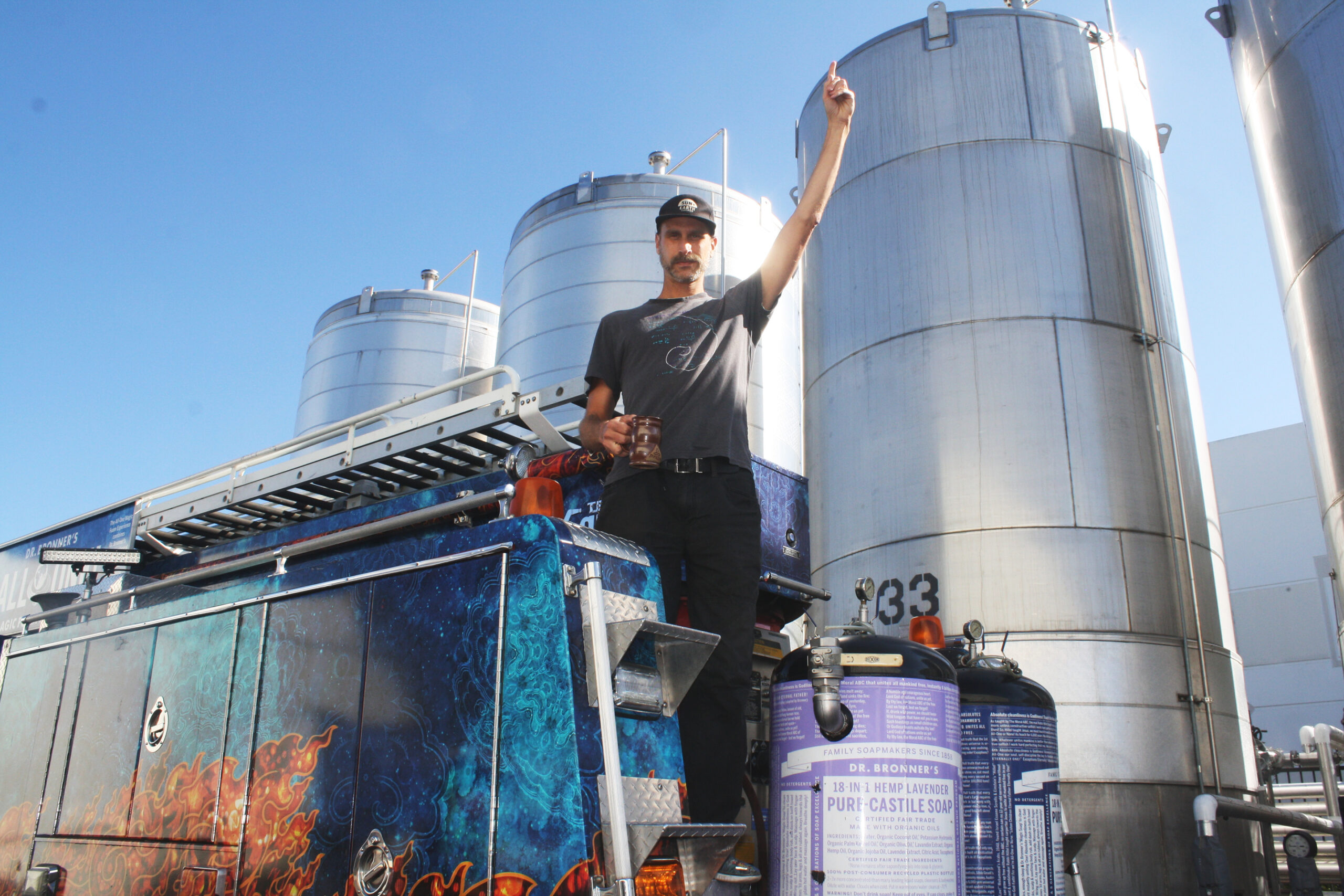
As CEO—“cosmic engagement officer”—of the company founded in 1948 by his grandfather Emanuel Bronner, a German Jewish refugee, David leads according to principles of “constructive capitalism: where you share the profit with workers and the earth from which you made it.” Executive salaries are capped at five times that of the lowest-paid employee, while every full-time “family member” receives 100 percent free healthcare and a yearly bonus of 25 percent of their salary.
The soap ingredients are sustainably and ethically sourced from organic farmers who practice regenerative agriculture to remediate the environment as they cultivate their crops. The company also funds various do-gooder initiatives, from animal advocacy to youth programs. Perhaps their most notable cause is the psychedelic movement.
“I’m trying to lead a life of service and rock the world in ways that can help make the world better,” Bronner says, now settled in his office—a dimly lit space with a standard L-shaped wood desk, a cream colored suede couch that belongs in a rec room and dozens of visionary art paintings on the walls. Next door to his mother Trudy’s office (Trudy serves as CFO), the space is apt for the kind of mid-40s CEO who dons cargo shorts, a golden triangle graphic tee and a cap, perched over a graying ponytail, that reads “Sun + Earth.”
Two computer screens flash incoming notifications from psychedelic activists responding to an open letter Bronner drafted to explain his support for one of the more controversial psychedelic causes: Oregon’s Psilocybin Service Initiative, a.k.a. PSI 2020. In September, Dr. Bronner’s donated $150,000 in matching funds to it.
I’m all about being free to use medicine however you want… but I also appreciate the importance of that more intentional container.
PSI 2020 aims to legalize psilocybin—the psychoactive component in magic mushrooms—in Oregon for medical use this year. The controversy lies in a part of the bill that would decriminalize the possession of psilocybin. But the initiative changed the language of the bill so that now it would only drop criminal sanctions for psilocybin therapy with licensed practitioners. In other words, it would still be illegal for someone to grow or forage their own mushrooms and trip solo in the woods.
The movement to end psychedelic prohibition goes far beyond Oregon. Activists in more than 100 cities and counties are working toward decriminalizing mushrooms and other psychedelic plants, while a handful of research institutions are pushing to get these substances approved as prescription therapy tools on the federal level. The road ahead is paved with thorny questions of how to reconcile these divergent camps.
At stake is the freedom of all Americans—of all classes, whether enduring a range of health issues or looking to enhance their lives—to access these substances, and the dangers we might face in the process.
Following the announcement that Dr. Bronner’s was donating money to the Oregon initiative and that the language of the bill had changed, much of the blowback came from Decriminalize Nature, a grassroots campaign that successfully passed a measure decriminalizing all plants and fungi in Oakland last June. Decrim Nature argues that selective decriminalization for only those privileged enough to access therapy perpetuates the harms of prohibition.
Travis Tyler Fluck, field coordinator for Decriminalize Denver, calls anything other than full-scale decrim “prohibition 2.0…. It still marginalizes communities who can’t afford medical access and creates an environment where rich people can get richer. That’s something cannabis has done an amazing job of.”
Bronner doesn’t quite see it that way. “I’m all about being free to use medicine however you want—in a concert, at home, in the forest, whatever,” he says. “But I also appreciate the importance of that more intentional container. The therapeutic container is the Western analogue to the indigenous ceremonial container.” Like shamans, so the thinking goes, therapists can hold space for a healing psychedelic journey.
Moreover, Bronner points out, Oregon’s therapeutic model would offer an alternative to the federal pharmaceutical model—whereby MDMA (the main compound in ecstasy) and synthetic psilocybin have been fast-tracked by the FDA to become prescription therapy tools for PTSD and depression, respectively. In Oregon, if PSI 2020 passes, Bronner explains that all kinds of underground practitioners, from therapists to shamans, will be eligible to get licensed to administer psilocybin legally. In this way, it falls somewhere in between a strictly medical setting (parallel to that which the FDA oversees) and a completely rogue one, which some prominent researchers fear could lead to careless tripping and endanger the movement.
When we talk about mass incarceration, psychedelics are not the issue.
The potential for big pharma to infiltrate the psychedelic world has become a looming threat in recent years, with activists increasingly concerned about “corporadelics” undermining broad access while dictating the “right way” to experience these medicines.
On a federal level, both nonprofit research institutions—most prominently the Multidisciplinary Association for Psychedelic Studies (MAPS)—and for-profit pharmaceutical companies are conducting clinical trials to bring psychedelic-assisted psychotherapy to market. Substances include psilocybin and MDMA as well as ketamine and non-psychoactive versions of drugs like ibogaine. The fruits of their work will likely be judged by insurance coverage, the cost of therapy and accessibility. (As for broad access to psilocybin-based medication, guaranteed insurance coverage is yet another piece of the puzzle, and one that would require its own article.)
At the same time, we’re seeing grassroots efforts to decriminalize psychedelics, as well as a few religious exemptions for the use of plants like ayahuasca and peyote—and efforts that seem to stem from many sources, like those of Tom and Sheri Eckert, chief petitioners of PSI 2020.
The Eckerts say they removed decriminalization from the bill “in order to clear the way for a comprehensive decriminalization agenda taking shape” in Oregon: the 2020 Drug Addiction Treatment and Recovery Act (DATRA). Backed by the Drug Policy Alliance, the nation’s largest nonprofit to end the Drug War, this measure would decriminalize all drugs, from psychedelics to heroin.
Bronner, who also believes in broader criminal justice and drug policy reform, is also donating $250,000 to this effort. “The request was made that they want to have that clean conversation and not have only the ‘good’ drugs decriminalized and not the ‘bad’ drugs,” Bronner explains about the change that was made to the Oregon Psilocybin Initiative. “When we talk about mass incarceration, psychedelics are not the issue.”
The head of a multimillion dollar Public Benefit Corporation, stocking soaps everywhere from Whole Foods and crunchy food co-ops to NYC bodegas and Duane Reade, Bronner occupies a distinct role in financing the progress of the psychedelic movement. A board member of MAPS, which secured FDA approval to research MDMA for post-traumatic stress disorders, Bronner committed to donating $5 million over five years to MAPS starting in 2017. He also donated $10,000 to the campaign that decriminalized psilocybin in Denver this past May, as well as pledges to donate to Decriminalize Nature and Decriminalize California, a statewide campaign to put a psilocybin initiative on the 2020 ballot.
The science is working and people are trying to change the drug laws. Behind the frontlines is the research.
Bronner has not, however, put money toward Compass Pathways, the for-profit European company aiming to bring psilocybin-for-depression to market through the FDA. “I’m a big fan of nonprofit,” he says tactfully.
Bronner himself is no stranger to the power of psychedelics. After graduating from Harvard, he traveled to Amsterdam and found himself tripping in a gay trance club, where he “died five different ways into the love and light at the heart of existence.” He envisioned both the rapture of his surroundings and the simultneous horrors of murder and rape happening elsewhere in the world. “I saw Jesus with his back to me, stepping up with calm and compassion, and I realized that I want to try to be just like him,” Bronner says. “To serve and get down the way he does.”
Such is the ethos by which he runs Dr. Bronner’s: All One or None!, as the company’s motto goes. Bronner’s support for multiple “sides” of the psychedelic movement is rare; he views them as intertwining paths to a new post-prohibition paradigm. These efforts are connected by a common goal, Bronner believes: to make psychedelics legally accessible and ultimately heal humanity with ancient yet groundbreaking medicine. Perhaps recognizing this unity of purpose could bring the whole psychedelic community together. So why hasn’t that happened?
While internal debates about the best legal framework for psychedelics continue, there’s a growing need to educate the public, not only about the therapeutic potential of psychedelics—proven by research at institutions like Johns Hopkins and NYU as well as millennia of ceremonial traditions—but also the risks. There’s no single right way to use psychedelics, but as they become more accessible the public needs tenets of set and setting to be as obvious to the conversation about harm reduction as “don’t drink and drive” is to alcohol.
There’s a fear among the scientific community that if something went wrong in a decriminalized environment—like a car accident involving psilocybin—that could derail federally-approved research, causing the feds to clamp down on what’s been steady progress in recent years. In contrast, Rick Doblin, executive director of MAPS, says he thinks the decriminalization campaigns are actually bolstering the research. “In fact, it’s the opposite,” he says. “The science is working and people are trying to change the drug laws. Behind the frontlines is the research.”
That is to say, the science benefits from the grassroots effort to destigmatize psychedelics but, in contrast to the activism, comes to be seen as the more conservative approach. As with cannabis, “medicalization precedes legalization,” says Doblin, who founded MAPS in 1986, pioneering a new wave of psychedelic research in the thick of Reagan-Era Drug War propaganda. Reframing psychedelics (and cannabis) as medicines, rather than drugs, has paved the way for a new degree of public acceptance.
We will find that this massive experiment with prohibition was a disastrous failure.
But Doblin cautions not to overstate the research. “There is a tremendous need for honest drug education,” he says. MAPS already supports psychedelic harm reduction and educational safe zones at festivals through what’s called the Zendo Project, while DPA offers a “reality-based” high school drug curriculum called Safety First.
Ayelet Waldman, author of A Really Good Day: How Microdosing Made a Mega Difference in My Mood, My Marriage, and My Life, recommends a “harm reduction model of drug education, which stresses not abstinence but rather an evidence-based approach…so that every kid understands what risks they’re taking and how to best ameliorate those risks.” Careful, honest media and literature like Waldman’s New York Times bestseller or Michael Pollan’s How to Change Your Mind help inform public perception, too.
A combination of harm-reduction tactics and peer drug education, Doblin says, will prepare us for a post-prohibition world. “We will find that this massive experiment with prohibition was a disastrous failure,” he says.
With cannabis as a gateway plant, many from the weed industry are transitioning to psychedelics—prompting questions of how not to fuck up this time around.
At a campaign meeting this past fall, a group of 20 gathered at the Hollywood apartment of Ryan Munevar, campaign director for Decriminalize California. The living room was lit up by a projector screen displaying the most recent bill language, and the walls plastered with other versions. The most psychedelic thing about the place was some neon string lights and a glowing rainbow keyboard beside a pile of books with titles like Psilocybin Mushroom Legal Defenses, Guide to California Government and The Political Campaign Desk Reference.
“What’s the shittiest thing any of you have had to deal with in the cannabis industry?” Munevar posed to the group. As executive director of Monterey County NORML (National Organization for the Reform of Marijuana Laws), Munevar did “extremely well” in the weed industry before volunteering full-time for the campaign. He’s familiar with how this plays out: “If you wanna play Monopoly, the game only ends one way.”
There are people in Santa Cruz literally sitting on mountains of shit they’re about to flip into gold, just as substrates.
Cannabis legalization has set a foreboding tone for the imminent psychedelic industry. High taxes—the unanimous answer to Munevar’s question—have lured consumers back to the black (or traditional) market, while only the most well capitalized players have been able to compete in, let alone afford to penetrate, the red tape of the legal industry.
“I haven’t been to a legal weed shop in forever,” one person chimed in.
“Be careful of the pesticides,” another responded, noting the risks of an unregulated market. Yet all in all, consumers would rather have cheap and easy access to weed than couture cannabis at several times the price tag.
That’s why decriminalization activists are encouraging DIY mushroom cultivation: to counter pharmaceutical gatekeeping. “If they want to charge us 400 times per weight of psilocybin when someone can grow this shit in their closet for $7 to $11 per pound of dry weight per yield, why the fuck would they need to go through the US government or a pharmacuetical company or church or spiritual group or whatever the fuck it is?” Munevar says.
Even so, in a decriminalized environment, mushroom dispensaries (aka shroomeries) are bound to pop up. Munevar predicts vertical integration: “They’ll cultivate their own psychedelic mushrooms, manufacture, grind them up, then add them to a weird supplement they’ll try to sell through health food stores, third party services, and people who do research on humans and animals,” he says. “There are people in Santa Cruz literally sitting on mountains of shit they’re about to flip into gold, just as substrates.”
In the Oregon initiative, to counter “corporate takeover,” branding and marketing would be banned, while a license holder would only be able to have a single grow site and five retail centers. (That said, many suspect people will find workarounds or loopholes, specifically in regard to the licensing cap.)
Weed legalization went wrong by treating cannabis as unique from any other plant, say Larry Norris and Carlos Plazola of Decriminalize Nature Oakland. “They created a whole different structure and taxation system, but we’re saying, ‘Don’t make the same mistake.’ Put it in with existing agricultural laws [or] health laws,” says Plazola. “Treat it as herbs or as food, but treat it as a plant.”
The idea of a psychedelic industry poses greater existential questions, too. “How should you be allowed to profit from something that has so much potential to heal the planet and a human being?” asks Katherine Maclean, psychedelic integration therapist and psychedelic scientist, formerly on the research faculty at Johns Hopkins. “On the one hand, you could say it has a lot of value, it has such amazing potential to make people’s lives better. On the other hand, we should charge nothing: If it is this saving grace, then everyone would have access.”
This is the end of humanity’s chance for a peaceful happy life. Do you really want to be the person selling bottled water at the end of the world?
She draws a comparison to bottled water: Like wellness—and the plants that support it—water is a natural resource and a human right. “We have extremely expensive bottled water from companies packaging something that should be free and accessible,” says Maclean. “This is the end of humanity’s chance for a peaceful, happy life. Do you really want to be the person selling bottled water at the end of the world?”
Florian Brand, co-founder of ATAI Life Sciences, the largest investor into Compass Pathways, and thereby a proponent of the for-profit route to psychedelic medicine, notes that even with the opportunity to grow your own mushrooms, such as in the Netherlands, you need more infrastructure to ensure that people can actually reap the antidepressive benefits of psilocybin. The Netherlands don’t necessarily have a lower rate of depression than anywhere else, he says, despite the availability of psilocybin. “Before you decriminalize or regulate, you have to have the infrastructure in place where people are either well educated or know about the substance,” he says.
Appropriately or ironically, depending on how you look at it, ATAI doesn’t encourage the recreational use of psilocybin.
On his right arm, David Bronner has a tattoo of a phoenix as a tribute to a friend—a designer for Dr. Bronner’s and a fellow member of their Burning Man crew—who took his own life. It’s not a topic Bronner readily dives into, but he admits that even the most experienced psychonauts need an avenue to safely integrate and work out trauma. Point being, psychedelics are never really just about the experience—there’s always life after the trip is over that demands a culture fluent in psychedelic ethos to ensure that the experience can be safely processed and incorporated into a person’s day-to-day. This remains true whether they’re tripping in an FDA-approved clinical trial or at Coachella.
Bronner’s hope—as a mediator between many different sides of the psychedelic movement—is that, as the 2020 election approaches, the initiatives within it will move beyond their disagreements in service of this larger shift toward a culture inspired by psychedelic values. At the core of this culture, he envisions, unity—All One. It’s a value, which, ironically, some psychedelic stakeholders seem to have lost sight of, but which is often felt during the most profound psychedelic experiences—and is why so many believe psychedelics hold the potential to not only heal individuals, but maybe even the world.
Shelby Hartman and Madison Margolin are Co-Founders of DoubleBlind, a newly launched magazine and digital media company focused on psychedelics.