


Your bag is empty.
Our contemporary moment is obsessed with identity. Sexual identity. Gender Identity. National identity. So when a novel emerges that deals with all those themes—plus some Shakespearean influence thrown in for good measure—one should take notice. German writer Sasha Marianna Salzmann has created just such a novel with Beside Myself, a debut that challenges the idea of fixed, immutable identities and whether they are even worth having.
Salzmann was born in Volgograd, grew up in Moscow and emigrated as a child from post-Soviet Russia to West Germany in the mid-1990s. Twins Ali and Anton, protagonists of Beside Myself, share a similar geographic journey with Salzmann’s real-life experience as a Jewish “quota refugee” who left post-Soviet Russia with their family and moved to Germany. Ali and Anton encounter antisemitism in both countries, and Ali’s journey includes rebelling against conventional ideas of gender, as does Salzmann’s—the book, however, is no autobiography. After Anton disappears, the only clue to his whereabouts is a blank postcard sent from Istanbul. Ali leaves Berlin to search for him there, the transcontinental city that bridges East and West serving as an ideal symbol for many of Salzmann’s themes.
I read Beside Myself in Cyprus, a Mediterranean island country partitioned by its own internal border, a human-made divide that can seem nothing if not arbitrary. Over the days, the sea turned from a silent transparent sheet into whooshing milky waves, as if to match the book’s shifting metaphors of fluidity, in which cultures, language, time and gender are in constant flux. A melancholic matryoshka doll of stories within stories spanning four generations of family, the novel is an exploration of the in-between. Ali and Anton are Jewish but secular; they’re Russian and German, misfits who are bullied as outcasts; they’re bisexual; and Ali injects testosterone, experiencing liminal states of gender.
Translated into 16 languages, Beside Myself takes its title inspiration from a passage in American theorist Judith Butler’s Undoing Gender. “If I can still speak to a ‘we,’ and include myself within its terms,” Butler wrote in her influential 2004 book, “I am speaking to those of us who are living in certain ways beside ourselves, whether it is in sexual passion, or emotional grief, or political rage.” In much this way, Ali lives beside her own existential longing. Hoping to leave behind her gender, ethnicity and past, she searches for a sense of self in her twin brother Anton—sometimes sexually.
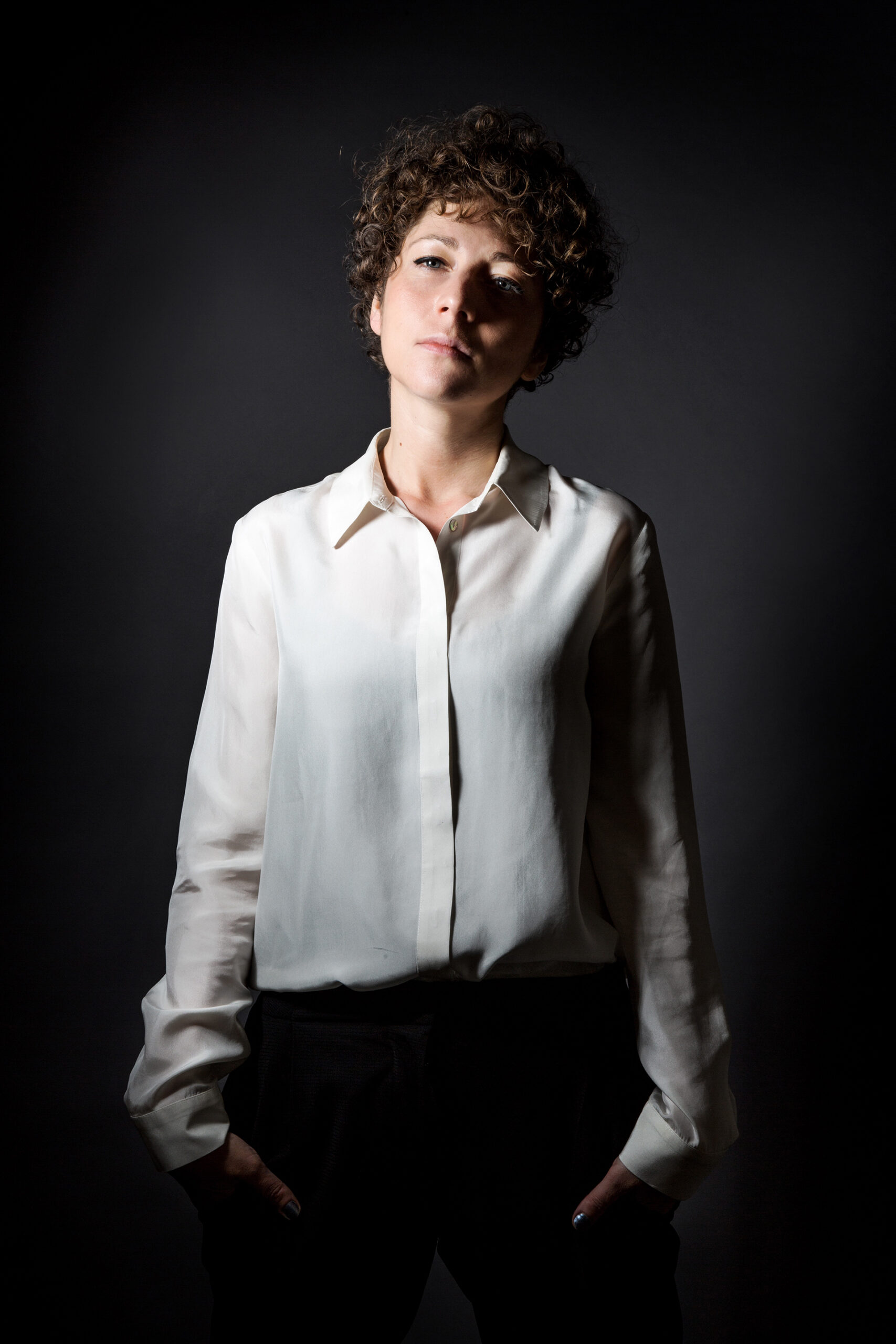
The seed of Beside Myself was planted in 2012 when Salzmann was doing a residency in Istanbul and fell immediately in love with the city, eventually staying for four years. Now living in Berlin, Salzmann has lately been busy writing a second novel, temporarily pressing pause on a celebrated theater career. In Salzmann’s book-filled apartment in Berlin’s Kreuzberg neighborhood, we sat to talk about identity, monogamy, intimacy and more.
When I e-mailed you about this interview, I received an auto-response saying that you were at a retreat in a lesbian convent. What’s a lesbian convent?
You mean because every convent is lesbian?
Right?
It’s just my way to say that I’m writing and can’t get back to e-mails. It works because people are so confused that they just leave me alone.
Ali describes Istanbul as a window to Berlin.
The bridge between Berlin and Istanbul is very short. I had such beautiful, crazy encounters meeting people I made out with in Berlin later in the club in Istanbul. It felt like one city. I lived there during the so-called golden years, when queer life was visible. Of course, I had the privilege of a German passport. If you entered a place in Istanbul, you could be sure that at least one person in the room would understand German.
Your novel features symbols of Berlin in Istanbul, including P&S Player’s cigarettes and thick cigarette smoke.
In Istanbul, they smoke five times more. It’s connected to the 2019 earthquake, and the political earthquake too. Everybody’s waiting for death. There’s a feeling of “I don’t know if I’m going to live tomorrow.”
As the crossway between Europe and Asia, is Istanbul the ultimate “trans” city?
There’s a different aspect of the same body, because I always saw Istanbul as a living creature. The obvious trans aspect is the multi-language—Turkish people from Armenia, or Kurds, or Czechs. You have thousands of different cultures within one, and in the city elements from all these different time periods—the 21st century going back to the Middle Ages—are visible. It vibrates very trans.
Those layers of time are reflected in your narrative’s generational back and forth.
This is how I feel about my body too—consciously carrying all the generations before me. You see it in architecture, very old houses and the very new—different layers of what life could be. Time is a protagonist in Istanbul.
Your metaphors of fluidity—migration and gender transitioning—bring to mind Paul B. Preciado. What impact has the philosopher had on your work?
He completely shaped my thinking since university. Testo Junkie was an especially big inspiration for my book. The idea of taking hormones not to fit in, but to say, “I hack gender. I play with it. I don’t want your privileges. I don’t want you to like me,” is basically what Ali is doing.
When she self-administers testosterone?
Yeah.
Your book interrogates the idea of one’s existence being fixed to a nation, a gender or a sexuality.
I really don’t know how people can feel so fixed, that this is what I am. Every part of me is so fluid that I don’t know how that feels. But I know that they are the majority, or at least they claim to be the majority, of the planet we live on.
The identity debates we have right now are very much pushed from the wrong corner. We’re under attack from right-wing populism, so we’re not freely discussing what we actually want. We’re so driven by fears and accusations from the right that we don’t take the opportunity to say, “I’ll find out. I don’t know today.” It’s a privilege to say, “I don’t need a gender.” Having been in the streets demonstrating with people who would die for the term trans, I cannot tell them, “Hey, come on. What do you need it for?” This is why I have Ali and Kato [a lover in Istanbul]: Kato knows that he’s a man, so he takes drugs to be one. Ali never really needed them. We could exist together on one planet and not fight for the need of having an identity, but unfortunately, we have this tendency to fight each other all the time.
You mention the right, but the left is also fixated on identities and policing people who say, “What about something else?”
It’s coming from everywhere because of those who are in power. People under oppression tend to bite each other on the neck, and this is what’s happening. I agree—I can’t live with people policing each other all the time, who look forward to policing someone.
People sexualize it in a way that I found boring. Yeah, it’s a sex scene. But what else?
Misogynistic Russian proverbs appear throughout the book, as well as slut-shaming and episodes of violence against women. Was it your intention to show how misogynistic norms, like policing women’s sexuality, become normalized and internalized via trauma that passes from one generation to the next?
It makes me so upset that it never stops. Isn’t it crazy? Regarding intergenerational trauma, rape is one of the biggest issues we don’t talk about. It seems like a singular issue that ends with the body of the woman. Of course, that’s not true.
I’ve spent half my life writing for stage, meaning you see your words. I’m very conscious about not reproducing violence onstage. I talked to people I trust, who are very aware and political, about how to deal with the cliché of the drunk Russian man hitting his woman. Or the raped woman. Everything I never want to see. They said it’s important to think that, but it’s also important to show where we come from. You cannot censor yourself. You can be criticized afterwards, and you can be part of the criticism, but write it down. It was important for Ali’s condition, because I was wondering why this human is so torn.
Is there still a tendency to assume that when a woman writes, it is autobiography? That she’s a “diarist”?
A woman immigrant, especially. I don’t identify as a woman, but people say, “That immigrant girl is writing something. It must be her diary. Nice.” That’s my experience of many years. Because I can’t fight it, I laugh about it. There is something productive artistically in thinking about what art and writing is. It always goes back to yourself. You’re basically a filter for stories. It goes through your body, and of course you write something that is close to you. There’s no reason to hide it. I’m not afraid to say that there are many parts from my life in there, but it’s funny how people are like, “How’s your twin brother doing?”
Jeffrey Eugenides’s Middlesex is also a family migration saga that involves sibling incest, which some found provocative. What’s the reaction to your book been like?
It was so different, country-wise. Reactions to the incest were, unfortunately, very unpolitical. I wish I’d have had more queer discussions on it. Most just thought it was a hot topic: “How did you write the sex scene?” I was like, “What’s the actual question?” People sexualize it in a way that I found boring. Yeah, it’s a sex scene. But what else? I never got to the actual discussion about a person looking for the other self in her body, which is what Ali’s doing.
The book is my liberating of Shakespeare’s Twelfth Night, where there’s a ship crash, and the princess is separated. Viola wakes up on the shore, puts on the clothes of her twin brother, and goes into an unknown country as him, finding her brother in herself. This is exactly what happens in my book. The sexual aspect of the incest is very much connected to my thinking about gender, and I do not believe in the concept of “I find the perfect half in another person, and then I’m complete.”
Life is full of magic and mystery. It would be sad to not portray that.
“The one”—monogamy?
Yeah. “And now the circle is completed.” That drives me nuts.
That one person can fulfill our every need?
Somehow people buy this fairy tale. The concept is very strong. If you’re not monogamous, you’re just promiscuous and sick, right?
You have problems with intimacy, or you just haven’t found the “right” person?
Exactly, they give you this look. Coming back to Anton and Ali, that’s the whole point. Ali’s digging so hard in herself for something that is broken, and her searching for Anton is part of this. It’s not a love story between a brother and a sister. I don’t think that sex between people, if it’s consensual, is wrong, or that being trans is a sign of sickness.
When Ali and her best friend and roommate in Berlin, Elyas, share a heady moment in the book, you touch on the idea of how sex can be more about affection. It’s not lust they feel, but they consider sexual intimacy because they want to express closeness. We tend to separate sex, romantic love and friendship, but they’re not so separated for everybody. Is that an idea of the incest?
Totally. That’s what the relationship between Ali and Elyas, and, really, friendship is. Sex is a way of communication, to make a connection. If it’s a close friend, and you’re in love—you would kill for the person—sex is one option to express that. That was always true for my friendships. I don’t have to sleep with the people, but I never understood why that would be a boundary.
This is true for Ali and how she goes out in the world. She’s promiscuous, and not because she looks for “the one”. Maybe she doesn’t even make a big difference between Anton and Elyas in that sense.
The most enigmatic passages in the book are of the inch-long cats, which occur in fable-like encounters with mystical old women. Where did that imagery come from?
Istanbul is the city of cats. In the street, they can be very small, like rats. You can put them in one hand. They’re like hungry gangs. That’s something mystical I tried to establish. I was reading a lot of South American literature when I wrote that book. I love… What’s the term?
Magic realism?
Yes, I love magic realism and these great writers like Bolaño, Marquez, Vásquez. Life is full of magic and mystery. It would be sad to not portray that.
I’ll let you get back to your convent now. Thank you, Sasha.
This interview has been edited for clarity and brevity.