

Your bag is empty.
Nick Kroll doesn’t like being online.
Although much of his early career was defined by his outsize sketch characters, many of whom have become viral figures, Kroll preferred to let the internet’s gaze stop there.
“I don’t love giving personal access, so the whole thing used to make my skin crawl,” Kroll says over a Zoom call from his home in Los Angeles. “I stayed away from it for the most part because I’d rather have my work speak for what my personal beliefs are. I really struggle on social media because it’s not what I intended to do. I intended to do comedy and write and be an actor and produce things. I didn’t intend to be a personality who has a take on everything.”
That ended in 2020. This interview happened just a few days after November’s presidential election was officially called for Joe Biden. The victory provided a cautiously optimistic bookend to a turbulent year that included a global health dilemma, a racial justice reckoning and a leadership crisis. From quarantine, public and private figures alike were forced to rethink how they showed up on social media.
“At a time when so many people felt powerless and someone like me has a platform, it became impossible to stay quiet,” Kroll says.
That took different forms. Sometimes it was signal-boosting GoFundMe accounts for the families of victims of police brutality such as Breonna Taylor and Jacob Blake or encouraging donations to organizations such as Black Visions Collective and Equal Justice Initiative. But it was also confronting past failures on his own projects, namely the decision to cast Jenny Slate as a young girl of color on his critically adored Netflix show Big Mouth, the fourth season of which premieres December 4.
We had to admit our blind spots, and I think we have ultimately landed in a really good place with Ayo Edebiri, who is such a talented and funny and smart performer and writer.
“We sincerely regret and apologize for our original decision to cast a white actor to voice a biracial character,” Kroll posted on his Instagram and Twitter in June, as Black Lives Matter discussions rose to the foreground of national media. “We made a mistake, took our privilege for granted, and we are working hard to do better moving forward.”
When I asked if the issue of Slate voicing a nonwhite character had ever come up prior to this summer, he acknowledges that it had.
“Jenny had vocalized it in the past. It kept coming up in various ways. Then around the George Floyd murder and everything that followed, Jenny said she really didn’t feel comfortable, so we went to our black writers and cast members to talk about it,” Kroll says of the decision to recast the character. “I can’t say they were easy conversations, but none of it was contentious. It all made sense.”
“We had to admit our blind spots, and I think we have ultimately landed in a really good place with Ayo [Edebiri], who is such a talented and funny and smart performer and writer.”
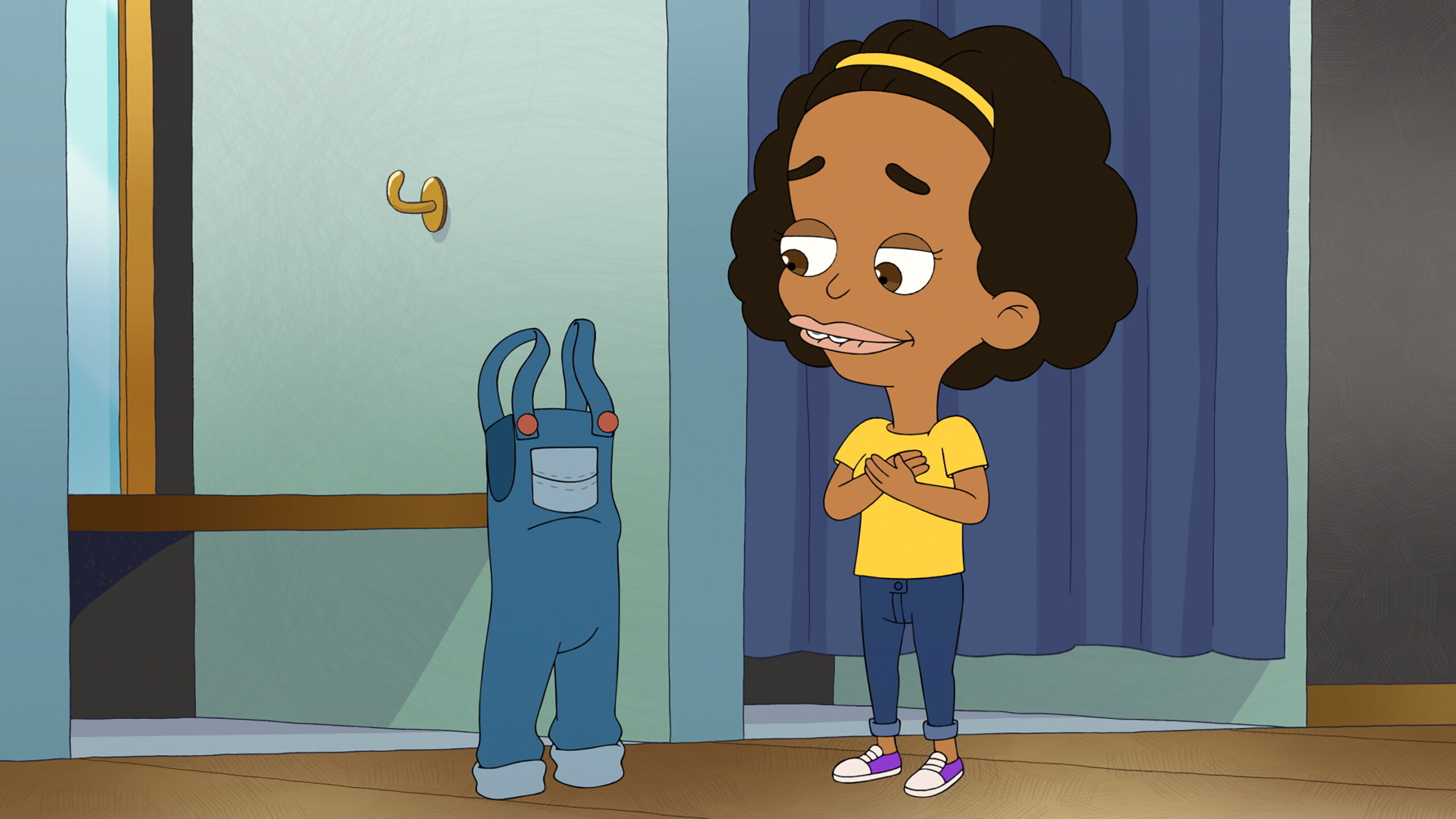
The casting of Edebiri feels even more timely when you realize season four goes into the characters’ explorations of identity. Following Slate’s decision to step down from voicing the half-black Missy Foreman-Greenwald, comedian and writer Edebiri assumed the role beginning with season four’s penultimate episode.
“It makes sense and it’s the right thing to do, especially as we’re diving more into Missy’s story,” says Edebiri, who’d come aboard the show as a writer eight months prior.
“What helps make Kroll’s voice so relevant is he has the ability to change. He still has his point of view and the things that make him him,” Edebiri says. “But he’s able to learn and grow. There are people who only want their comedic clones around them because they think that’s how they keep their legacy, but he doesn’t seem interested in that.”
The 42-year-old Kroll is serious about becoming a better ally, and a better version of himself. And some of that is reflected in his work on the hit Big Mouth, which he co-created, writes for and voices multiple characters on.
As the public face of a no-holds-barred animated sitcom centered on junior-high classmates grappling with puberty, Kroll doesn’t fit an obvious mold of social-justice warriordom. But with Netflix blessing the show with a rare multiseason renewal, Big Mouth has proven itself a standout among a current crop of sexually diverse and sex-positive series that aim to educate as much as entertain. His show’s success has encouraged Kroll to continue achieving more with his comedy than simply getting laughs. He’s determined to use it as a platform to help others understand lessons he’s long struggled to teach himself.
Kroll grew up the youngest of four in affluent Westchester County, New York. He attended Jewish day school, private prep school and Washington D.C.’s Georgetown University. Although Kroll majored in history, he simultaneously gravitated toward media studies and performance.
As a freshman, Kroll bombed a Funniest Act on Campus contest but was encouraged to audition for future one-man-show maestro Mike Birbiglia’s burgeoning Georgetown Players improv troupe. By senior year, Kroll was the director, and responsible for casting then-freshman John Mulaney, who would become a frequent collaborator and eventual Big Mouth co-star.
In early 2002, Kroll headed to New York City, where he soon began writing for Chappelle’s Show. Within seven years, he was playing uber-asshole Rodney Ruxin on FX ensemble comedy The League.
As Kroll’s star rose with The League, Comedy Central offered an outlet for him to showcase his long-running characters. Kroll Show’s Bobby Bottleservice, Fabrice Fabrice, El Chupacabra, Rich Dicks and Oh, Hello cranks Gil Faizon (Kroll) and George St. Geegland (Mulaney) proved themselves noxious, needy, perfectly self-absorbed satires of reality-TV wannabes.
In 2015, as both The League and his namesake show were ending after decent runs, Kroll looked for ways to challenge himself even further. While voicing a literal feminine douche in Seth Rogen’s Sausage Party, Kroll recognized animation as an outlet to “draw anything and go anywhere.”
“I was on two TV shows and felt incredibly lucky to be on both of them, but also walking through the airport was a little intense at times,” Kroll says of that time. “I was not and am not as recognizable as a lot of my friends, but I think I was like, ‘Okay, this is what it feels like to be on TV a lot. Maybe if I do animation, where you don’t see my face at all, that will be a nice change of pace as well as just creatively different.”
The resulting Big Mouth is a smart, fast-paced raunchfest that celebrates both physical changes and emotional growth. Randy “hormone monsters,” frequent musical numbers and plenty of cartoon nudity share space with frank discussions of mental illness, family dysfunction and feminism. The character diversity—ethnicity, sexual orientation, ableness—is off the charts. Three seasons in, the series has been nominated for two Emmys and cited by Time magazine as a highlight of modern adult animation’s “new Golden Age.” Along with the teen-focused Sex Education and Pen15, Big Mouth is proactively helping shift public discourse around sex from taboo to on-trend.
“We carry so much of our puberty stuff with us into adulthood,” Kroll acknowledges. “That anxiety is something all of us deal with, and it doesn’t just go away like pimples do.” Citing inescapable anxiety fodder like social media, 24-hour news cycles and election worries, he continues, “Trying to figure out tools to help lessen it is really useful right now. Hopefully the silliness of our show takes away some of its power.”
Big Mouth’s fourth season, which has anxiety as a central theme, became Kroll’s most personal work to date. Autobiographical plot points abound: experiencing insecurities and inadequacies in public camp showers, sabotaging his deepest friendships, even meeting a future version of his character Nick Birch as an adult paralyzed by the threat of romantic intimacy.
We carry so much of our puberty stuff with us into adulthood. That anxiety is something all of us deal with, and it doesn’t just go away like pimples do.
“At the time we were writing this, which was a year and a half ago, I was in a relationship but I hadn’t fully committed,” he says. “I was really dealing with questions of intimacy and the fear of, Will I be this person who is unable to fully connect to someone?”
The entire season, Kroll says, was emotionally draining to write. “I’m in therapy and I talk about the stuff I’m working through in therapy in the writers’ room, and I’m taking the stuff we’re talking about in the writers’ room into therapy, you know?”
In 2019, in addition to the announcement it had picked up Big Mouth through season six, Netflix revealed a spinoff, Human Resources. Kroll describes the latter as “a workplace comedy about the world of the monsters and creatures on Big Mouth,” one strategically designed to cover stories of “birth and death and divorce; all the other huge elements of life that a show about a bunch of kids going through puberty doesn’t really allow real estate for.”
The hefty workload of dual shows doesn’t faze him—The League and Kroll Show ran concurrently—particularly now that Big Mouth can intentionally pace itself toward specific character goals. Like, perchance, Nick Birch going all the way with a girl?
“If that were the case,” Kroll groans, “it would be around episode 190—a.k.a., I was 19 when I lost my virginity.”
On the acting front, Kroll is adamant about expanding his range of roles, following dramas such as 2016’s Loving and 2018’s Operation Finale with the upcoming Olivia Wilde thriller Don’t Worry Darling. The blogosphere even spread rumors he was up for the Marvel role of Moon Knight, a Batman-esque hero who struggles with his family’s Jewish roots.
You take an extra look at what you’re doing, what the joke is and who the target of the joke is. It doesn’t stop you from continuing to do crazy, fun things. It just makes you think a little more before you do something.
“I think I experienced that alongside the internet,” Kroll laughs. “But something like that would be super cool. Who isn’t intrigued by that world? And that particular character for me, as a Jewish guy: Lot of Jewish guys writing comic books; not a ton of Jewish superheroes at the center of them. But I would love to do all that stuff. I’m a big fan of the combo platter.”
Whether it’s animation or drama or activism, Kroll isn’t done trying new things and growing. In light of the world—and comedy—changing, I ask if he would do anything differently today if he could rework some of the Kroll Show characters that made him famous, such as the gay, multiethnic Fabrice Fabrice; the Latino El Chupacabra; or even the differently abled portrayals in Wheels Ontario.
“There are definitely things I would not do now that I did years ago,” Kroll says. “But we all have to own everything we’ve done because we were the ones who did them. You take an extra look at what you’re doing, what the joke is and who the target of the joke is. It doesn’t stop you from continuing to do crazy, fun things. It just makes you have to work a little harder and think a little more before you do or say something. That’s okay.”
With Big Mouth, Kroll has found a platform to keep his focus trained on the future, professionally as well as personally. He may have left other dated characters behind, but there will always be more work to put in.
“The beauty of doing a show about kids going through puberty—and really a show about kids going through changes—is that they can evolve and change both physically and emotionally,” he says. “For us creatively, we can make our show do the same.”