Your bag is empty.
This story was first published by Playboy Netherlands.
Youth is wasted on the young, I read somewhere once. Perhaps. But not by me.
The rhythmic click of my heels was something I found steadying, my gait, which always trails behind me. The voice of my legs. I walked along a string of houses that used to signal poverty and now signal wealth. Beside a dark-green front door stood a cargo bike. Through the window: a Matisse exhibition poster, warm light, a bookcase. The kind of people who live here are in things, the circles, the companies, the networks. Not people like me, orbiting somewhere outside. They have dogs with soft, odorless fur. Beige sofas, no stains, no dog hair. Beige everything. A little crypto, just in case. A pension. Hybrid cars. Mothers with babies strapped into Artipoppe carriers, legs in Lululemon. Parents who return their children’s library books on time. Their bank cards never beep insufficient funds at the register. They know each other from university, from the tennis field, from a wedding in Singapore. These were lives I envied and simultaneously resented, because they are lived by so many people, too rarely interrogated by the people living them, following the same pattern, the same upward graph. Accumulating. Always more. More money, children, esteem, shares, a bigger car, a bigger garden. Not for people like me. I would want to smash through the structure, the expectations, the inner circles, and ride that cargo bike straight into the canal.
On the terrace of a fashionable café, a couple sat in black coats, smoking. His hand rested on her knee. She looked at me; I smiled back, though I had no way of knowing whether she could read that on my face.
Best to establish, from the outset, who’s in charge. He was, after all, my new side job.
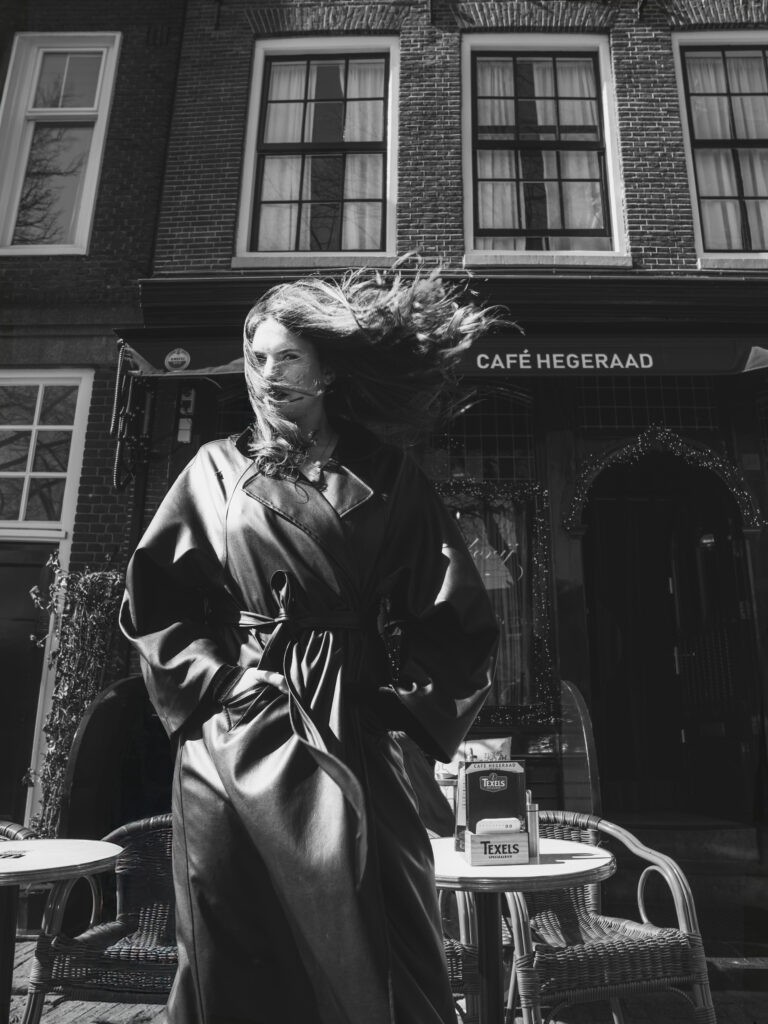
I had arranged to meet him at Café Hegeraad, a place where I was unlikely to run into anyone I knew. The café always seemed to exist in shade. Black-and-white photographs lined the walls, people who no longer exist, an Amsterdam that no longer exists. Except in there. In there, that Amsterdam was still alive. I liked coming here: reading the paper, listening to the murmur of strangers, drinking black coffee, eating the small slice of gingerbread cake that came with it. It reminded me of childhood, chocolate sprinkles, on gingerbread cake, fresh orange juice squeezed by my father.
Across from the café, on the cobblestones of the Noordermarkt, sat a black BMW, its hazard lights blinking with a kind of nervous excitement. I was nearly there. I straightened my collar. Pulled the belt of my coat tight around my waist. I hesitated. It would have been smarter not to enter. Just as it would have been smarter not to run red lights every single day, to floss more, to actually attend lectures, to find a nice boyfriend my own age, to do an internship at a gallery in London. Maybe I should take up field hockey, or rowing, or join the board of my student association. Normal. Student. My hand pushed open the wooden door as if of its own accord.
He was staring at a beer mat he was flipping between his right index and middle finger. I knew immediately it was him, even though I hadn’t seen a photo. His presence was misplaced here, it clashed with the beer-drinking regulars, with the Amsterdamse nonchalance. His suit was too new, his posture too rigid. He looked up when he saw me with a faint start, as if he’d forgotten he was waiting for someone. He cleared his throat, stood up, and extended his hand. It was as warm as the fresh croissant I’d picked up that morning and carried home in a paper napkin. A good, firm handshake, though mine was just slightly firmer. Best to establish, from the outset, who’s in charge. He was, after all, my new side job.
“Good afternoon, Madame Bovary.” That was my username. Not especially original, but effective enough to filter out the less culturally fluent sugar daddies. My profile ended with a quote from George Burns: Happiness? A good cigar, a good meal, and a good woman — or a bad woman; it depends on how much happiness you can handle.
“Hi,” I said.
He stepped behind me, swept my hair to one side, lifted my coat from my shoulders, and hung it carefully on the hook. His own coat lay draped over his chair, its hem grazing the floor. Gray. Long. A broad forehead, a supposed sign of intelligence. A deep crease between his brows. Old, though. Older than I’d hoped.
“What would you like to drink?”
“Red, please.” He ordered a bottle.
“I came straight from a meeting,” he said, gesturing at his suit with mild apology. “Hence this.”
“It suits you.”
He asked about my studies. “Art history,” I told him.
“You like it?”
“It’s a degree for people who like doing things they enjoy. My father always said I could study anything I wanted — except art history.” I paused. “He shouldn’t have said that.”
“I did economics,” he offered.
“Ah. That’s also an option.”
“But I like art history too. Art historians especially.” He grinned. “Well then. To us.” The foam from his beer slid down the glass and over his thumbnail. “I think this is a good start.”
“To a good start,” I agreed. I reached for my wine, actually quite decent, and accidentally kicked his shin while stretching my legs.
“Sorry.”
“Don’t be. You’re welcome to kick me.” He held my gaze a beat too long, as though he had disclosed something of great consequence. I didn’t yet understand what he meant by that look. A newspaper turned; a chair scraped; the men at the next table glanced our way and let their eyes linger.
“So. What are you looking for?”
“I’m not really attracted to men my own age,” I said, for the same reason job applicants say they’re too much of a perfectionist. “And I need to finish my thesis, but my other job takes up too much time.”
My previous side jobs had all been failures. I was no good at administration, at Excel, at punctuality, at hierarchy. But I knew I would be good at this, even if I was still in the dark about exactly what this entailed.
“And you?” I asked. “What brings you to a site like that?”
“I don’t need to write a thesis,” he said, amused.
“You just want a young girlfriend?”
“In part. Finding a woman my own age who is genuinely free, in how she lives, in how she thinks, is like searching for a needle in a haystack. So yes, I’m looking for someone young in spirit.”
“How’s the search going?” I refilled my own glass.
“I have to say I’ve never found a site quite like this one. Beautiful, intelligent women, without exception. For a while I had an, let’s call it an arrangement, with a woman from The Hague. But she turned out to be psychologically not entirely stable. Despite the attraction, I had to end it.” I wondered what had happened. He didn’t elaborate.
“And you?” he asked, resting his chin on his fist.
“You’re my first date.” A safe word, date. It wasn’t entirely true, but what did truth mean here, exactly? It was about as true as the fact that my name was Madame Bovary. This arrangement was built around desire, around the satisfaction of needs, around finding the space between them, not around truth. In that sense, it was like any other relationship, only clearer, with terms discussed in advance. A contract.
We talked about art. He collected work by emerging artists. What his company actually did, something in financial services, I had already forgotten. He would explain it many times more; I would forget it just as many times. We didn’t discuss his past. Not his children, whom he mentioned offhandedly only after several meetings. I didn’t mention my father, recently dead. To do so would have made the 32 years between us too loud, too present. For now, nothing stood between us but the square table: two full glasses of wine, an empty beer glass, a small disheveled stack of beer mats.
The encounter unfolded like a script, like something already written, perhaps even fated. The way an actor moves freely within the edges of a stage, that was how I felt within the frame we were building together.
“I’d like you to come next week. I’ll arrange a train ticket. Does that sound good?”
Does that sound good? Yes and no.
“Lovely,” I said.
He made a signing motion in the air, as though autographing it. The waiter brought the check. My new side job retrieved my coat from the hook, held it open for me to slip into, straightened my sleeves, rubbed my back, squeezed my shoulder briefly, then let his hand come to rest at the small of my back. I linked my arm through his.
It was dusk. I warmed my hands in my pockets. I kissed his cheek, one kiss, the way I greeted friends. He smelled exactly as I’d expected: like a well-maintained man, like fabric softener. “See you soon,” it was the most honest thing I could say. He stood in the light of the café. I knew he was watching as I unlocked my bicycle and rode away. In the near distance, a car door slammed.
His house was a labyrinth. Doors without handles, cabinets without pulls. More than once I pressed fruitlessly against a wall in search of the bathroom. From the living room, I looked out over his terrace, where a solitary olive tree stood in the moonlight. No trace of his children, who lived there half the time. Every few minutes he walked from the black leather sofa to the record player perched on a twentieth-century design cabinet. With meticulous care he lowered the needle. He came toward me dancing, or rather waddling, his arms moving alongside his body, his fingers snapping. It was stiff; it was endearing. I took his outstretched hand and danced close to him. His hands on my hips. We drifted together like a rowboat on a still sea.
“Let me get a sip of my wine. Want some?” Without waiting for an answer, I kissed him on the mouth and spat the red wine between his lips.
“Here you go.”
He shook his head in mock reproach. “Naughty,” he said.
I knew that evening I would cross into the indecent, into the territory of an undeniable shared secret. Sex complicates everything, after all. But I had always loved complications.
The youth of my body stood in sharp contrast to his gray chest hair, to the white curls that grew on the backs of his hands. His skin felt like a duvet with slightly more cover than filling. He gripped my upper arms the way a baker kneads dough. I let myself be kneaded. His unruly desire woke mine. With men my own age I always felt the urge to prove myself. Here, I did not. My uncertainty dissolved into his boundless wanting, into his practiced hands. I was enough, beautiful enough, wanted enough. In that intoxication of acceptance I crossed into indecency without it feeling indecent.
On weekdays I studied in Amsterdam. Weekends I spent with him in Belgium. We visited museums, walked through the Ardennes, traveled to Tuscany. Everywhere we went, he arranged a small desk so I could work on my thesis. I never sat at it. Mostly we stayed inside his glass house without doorknobs, our fort, far from staring eyes, from my friends, from my grief, from my age. He cooked lobster; we lay on the sofa and watched erotic thrillers; I read the Belgium magazine Humo while he rubbed my feet with quiet, inexhaustible patience. We came to know each other well, and would remain, in every way that mattered, completely unknown to each other.
“It frightens me, how you can play me like no one else ever has. Will you be careful with me?” he asked, running his long fingers through my hair.
“I’ll try,” I said, and then: “But I am allowed to kick you.”
That evening we watched Bitter Moon. I understood why he wanted me to see it. It revealed something of him: an inner conflict, a complex relationship to power, a secret wish to surrender. A hunger for the transgressive. I recognized it, and understood why something had clicked between us.
I watched Emmanuelle Seigner, transfixed. She had a sexual magnetism that is rare now, complex, intelligent, her own, unretouched. Carnal. Animal. Dark. Roman Polanski directed her; they are also more than 30 years apart. That night, that fact seemed worth sitting with.
He traced the outline of my upper lip with his index finger.
“You have a beautiful upper lip,” he said. “Full, with a lovely curve. A willful curl.”
“You sound like a plastic surgeon.”
His frown deepened. “Not at all. A surgeon wants to change a face. I wouldn’t change a single thing about you.”
“Do you know what I find beautiful about you?” I said. “Your nose. It’s the nose of a Roman emperor. I love Roman emperors.” I kissed the slight bridge of his nose, his warm earlobe, his right nostril, his temples.
The youth of my body stood in sharp contrast to his gray chest hair, to the white curls that grew on the backs of his hands.
His pubic hair was red, something that surprised me the first time, as though hair shielded from sunlight holds its color longer, like a Japanese woodblock print. Color is best preserved when the print is stored safely away, far from the light and life in which everything fades.
I took his hands. Licked his lips where a small flap of dry skin hung, which I tried and failed to pull free with my teeth.
“Look at me,” I told him, at the exact moment when Mimi, played by Seigner, vomited in a party hat on screen.
“I can do whatever I want with you,” I said. “From now on, you do exactly as I say.” I took his wrists and held them above his head. My body moved without consulting my mind. I wanted to drown in my own water. To sink into the deepest black of myself. To be nothing but a pulsing body, a feral animal.
“I’m going to come,” he groaned.
“No,” I said. “You wait until I give you permission.” I wasn’t sure if I was imagining it, but his lower lip seemed to tremble briefly. A tuft of gray hair was plastered to his damp forehead. I thought of Hitler, which was the last thing I wanted to think.
Permission never came. Not that night.
My initials had already faded from his wrist, despite having been drawn there the night before in permanent marker.
In the small park across from his house, a man threw a stick for a brown Labrador. The dog regarded it with total indifference. I watched this for a while, then turned to figure out the coffee machine, found the button, spooned ground beans into the filter basket, spilled most of it on the counter, twisted the basket back into place. He came bounding into the kitchen as though he’d just won the lottery. Not that he needed to.
“Darling, I was gone a little longer because I wanted to get you the best almond croissants in Antwerp. Only the best for you. And I obviously didn’t want to get kicked,” he added quickly.
“Good boy,” I said. “Here, the very best coffee, made especially for you.” I set it beside him and hugged him good morning. The morning sun laid long lines across the countertop and the wooden floor.
“It’s in your blood, isn’t it, that dominant streak,” he said, wiping the spilled grounds from the counter with his bare hand, catching them in the cup of his other palm. “It’s Dutch in general, but especially Amsterdammers. There’s a book called something like: Why the Dutch are always right but the Belgians are always correct.“
“Sharp title. I think it’s true. You Belgians stay so in the background. There’s so much doubt built into your language.”
“We speak the same language, Madame. Perhaps that’s precisely why we’re correct. Our accent leaves room for doubt, for emptiness and reflection. For the nuances that truth requires.”
“Those odd words like seffens, isn’t that just filler?” I couldn’t help finding Flemish slightly ridiculous.
Flakes of croissant clung to his lips. My initials had already faded from his wrist, despite having been drawn there the night before in permanent marker. He beamed like a boy who’d had his shirt signed by his football hero. It was an expression of his desire to belong to something, and of my desire to lay claim to someone, so I couldn’t lose them. A theory as durable as permanent marker on skin.
It was Sunday. That afternoon I was back on the train to Amsterdam. The next day, back in the lecture hall, taking notes on paintings made by men who had also, probably, loved women they shouldn’t have.