Your bag is empty.
President Jimmy Carter's Playboy Interview almost cost him the election.
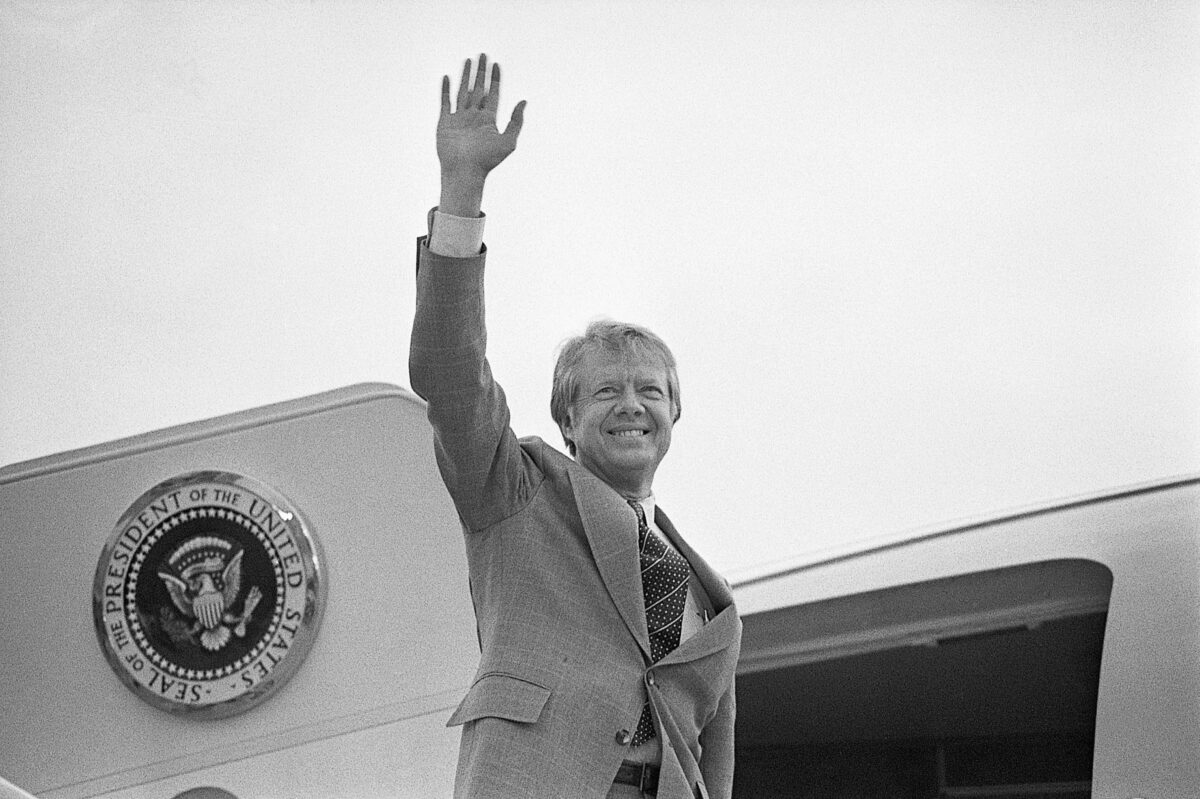
In the course of this magazine’s history, the Playboy Interview has broken news, caused mass controversy, and changed careers. But rarely has it nearly changed the direction of the country’s history. That was the case with President Jimmy Carter’s Playboy Interview, which nearly cost him the election.
Published 50 years ago in the November 1976 issue, Carter, then the Democratic nominee and former Georgia governor, was growing frustrated at the end of an hours-long interview in which the subject of his religion was pressed. Carter was a Baptist at the time, and his advisors worried his conservative faith would be a hinderance as the Democratic candidate. Playboy interviewer Robert Scheer asked Carter numerous times whether his faith would lead him to conservative policies on social justice issues, which Carter entertained at first. After a bit, though, the candidate told Scheer to move on, agitated by the persistent questioning.
At the very end of the interview, after the formal questioning had ended, a “seemingly casual question was tossed off,” an editor’s note in the original story read: “Do you feel you’ve reassured people with this interview, people who are uneasy about your religious beliefs, who wonder if you’re going to make a rigid, unbending President?”
Carter launched into a long speech, which he acknowledged was still being recorded. He argued that his religious moral backbone wasn’t a hinderance but rather an asset, saying that he wouldn’t engage in the “lying, cheating and distorting the truth” done by his predecessors, Presidents Richard Nixon and Lyndon B. Johnson. But in making that point, he also made an admission that nearly ended his campaign, just weeks before the election.
Read Carter’s Full Playboy Interview Here
“I try not to commit a deliberate sin. I recognize that I’m going to do it anyhow, because I’m human and I’m tempted. And Christ set some almost impossible standards for us. Christ said, ‘I tell you that anyone who looks on a woman with lust has in his heart already committed adultery,'” Carter said. “I’ve looked on a lot of women with lust. I’ve committed adultery in my heart many times. This is something that God recognizes I will do–and I have done it–and God forgives me for it. But that doesn’t mean that I condemn someone who not only looks on a woman with lust but who leaves his wife and shacks up with somebody out of wedlock.”
The headlines wrote themselves. “Carter’s Comments on Sex Cause Concern,” The New York Times wrote an article filled with voters saying they could no longer vote for Carter because of his adultery comments.
“Four months ago most of the people I knew were pro-Carter,” Southern Baptist televangelist Jerry Falwell told The Washington Post at the time. “Today, that has totally reversed.”
Marge Thurman, chairwoman of Georgia’s Democratic Party, called the reaction to Carter’s one-liner as “bad, bad, bad,” according to the Atlanta Journal-Constitution. “I thought it was disastrous. I don’t know why in the hell he did it.”
The statement had impact. Over the summer of 1976, Carter held a huge polling lead over his opponent, incumbent President Gerald Ford. The actual results of the election were much more slim: Carter edged out Ford by a mere 2 percent in the popular vote. He won 55 percent of the electoral college.
But according to one U.S. Representative from the time Andrew Young, Carter might have accomplished his goal. “[Carter] has taken care of his religion problem once and for all,” Rep. Young said, according to the Journal-Constitution. The issue around Carter’s religion wasn’t just that some viewed him as potentially too conservative because of his beliefs, as highlighted in Playboy’s line of questioning.
“We’re being so persistent because of this matter of self-righteousness, because of the moral certainty of so many of your statements,” Scheer pressed in the interview. “People wonder if Jimmy Carter ever is unsure. Has he ever been wrong, has he ever had a failure of moral nerve?”
Carter answered that question outright: “There are a lot of things I could have done differently had I known during my early life what I now know. I would certainly have spoken out more clearly and loudly on the civil rights issue. I would have demanded that our nation never get involved initially in the Vietnam War. I would have told the country in 1972 that Watergate was a much more horrible crime than we thought at the time. It’s easy to say in hindsight what you would have done if you had had information you now have.”
He answered it again when he admitted to emotional adultery—a sign that perhaps he wasn’t so rigid afterall.