Your bag is empty.
Meet the New York-based artist who uses found objects to tantalize onlookers

It’s a muggy day and four fans are recycling hot air through Hannah Levy’s Bronx studio. A pile of pink, gold and blue wire retainers are spread out on a central table alongside a horseshoe crab carcass. These orthodontic devices might awaken tender memories of awkward school pictures or the felt artistic freedom of choosing a cartoon character to decorate the roof of your mouth. A glitter retainer is currently being sold on Etsy for 55 dollars.
But Levy isn’t interested in the cult of nostalgia. She’s in the process of building a marble, retainer-shaped bench for the New York City High Line, an interactive sculpture that will mean something different to each person who sits on it, climbs on it, or skates on its handrail.
“I’m interested in the underlying connotations of certain forms, and the retainer is such a class-based thing,” the New York-born 28-year-old says, thumbing the plastic of Hello Kitty-emblazoned mouth gear. “After the recession, people who had already gone bankrupt were taking out new loans to get their kids orthodonture care. The idea of the McMansion and the idea of the perfect smile go hand-in-hand.”
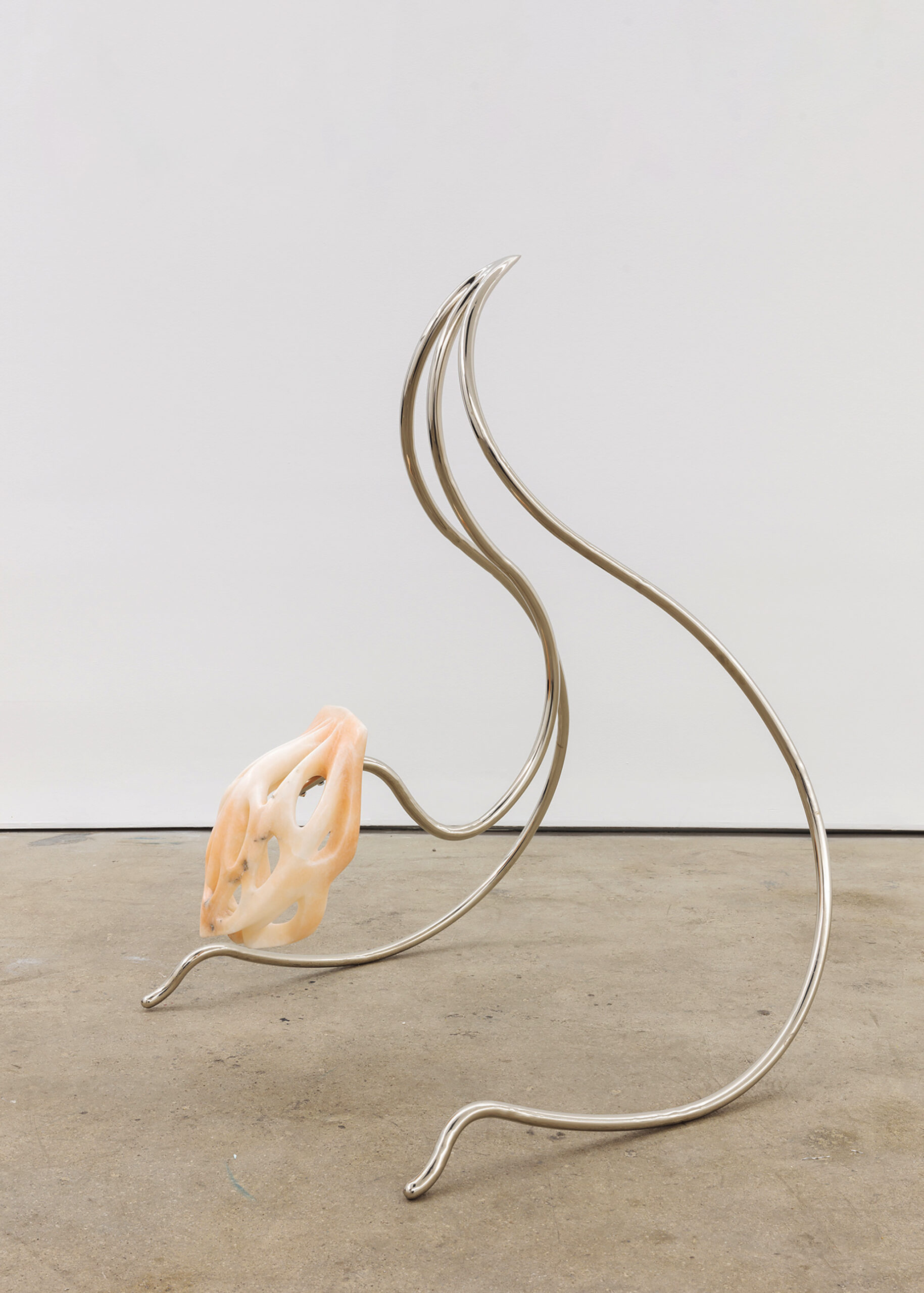
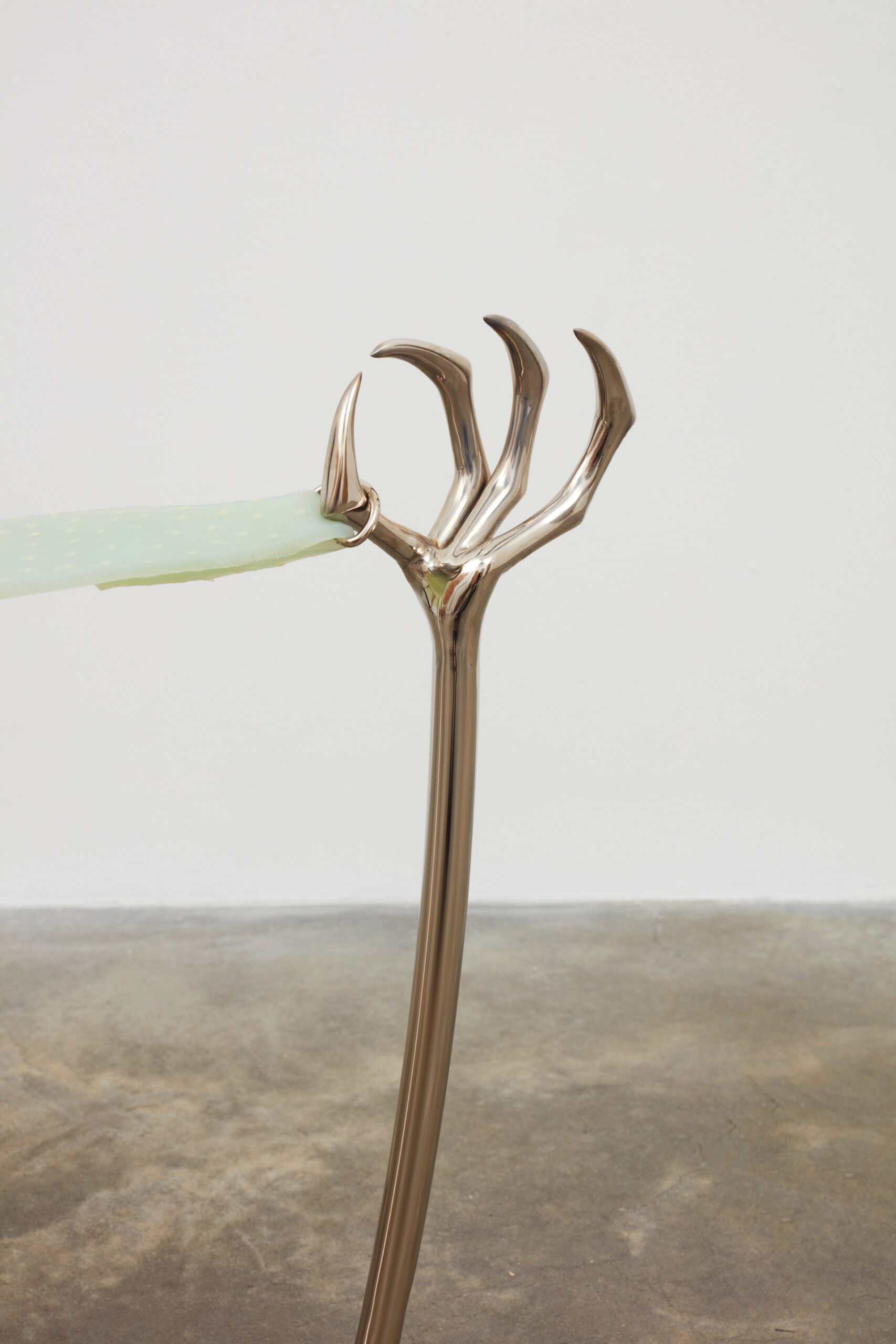
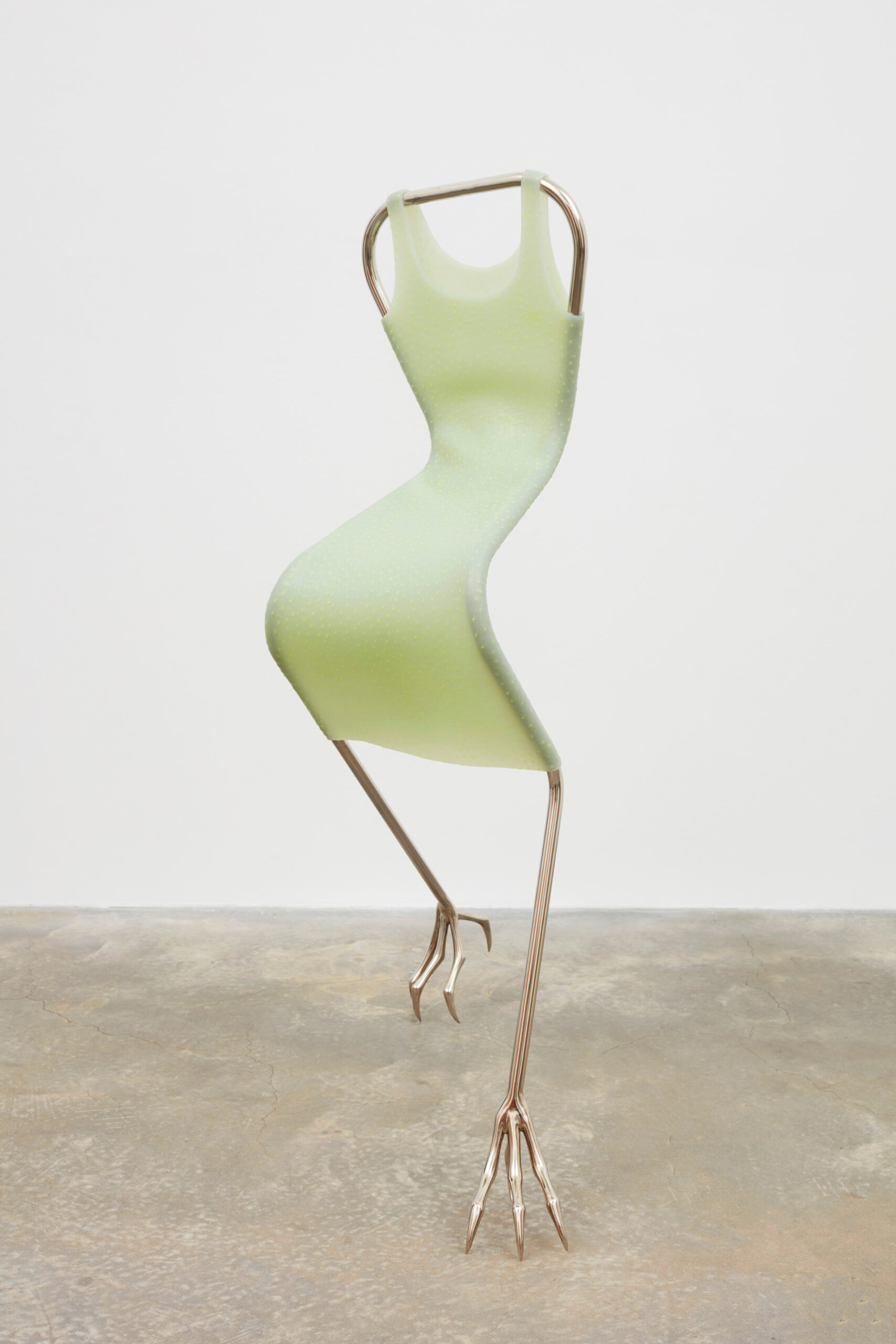
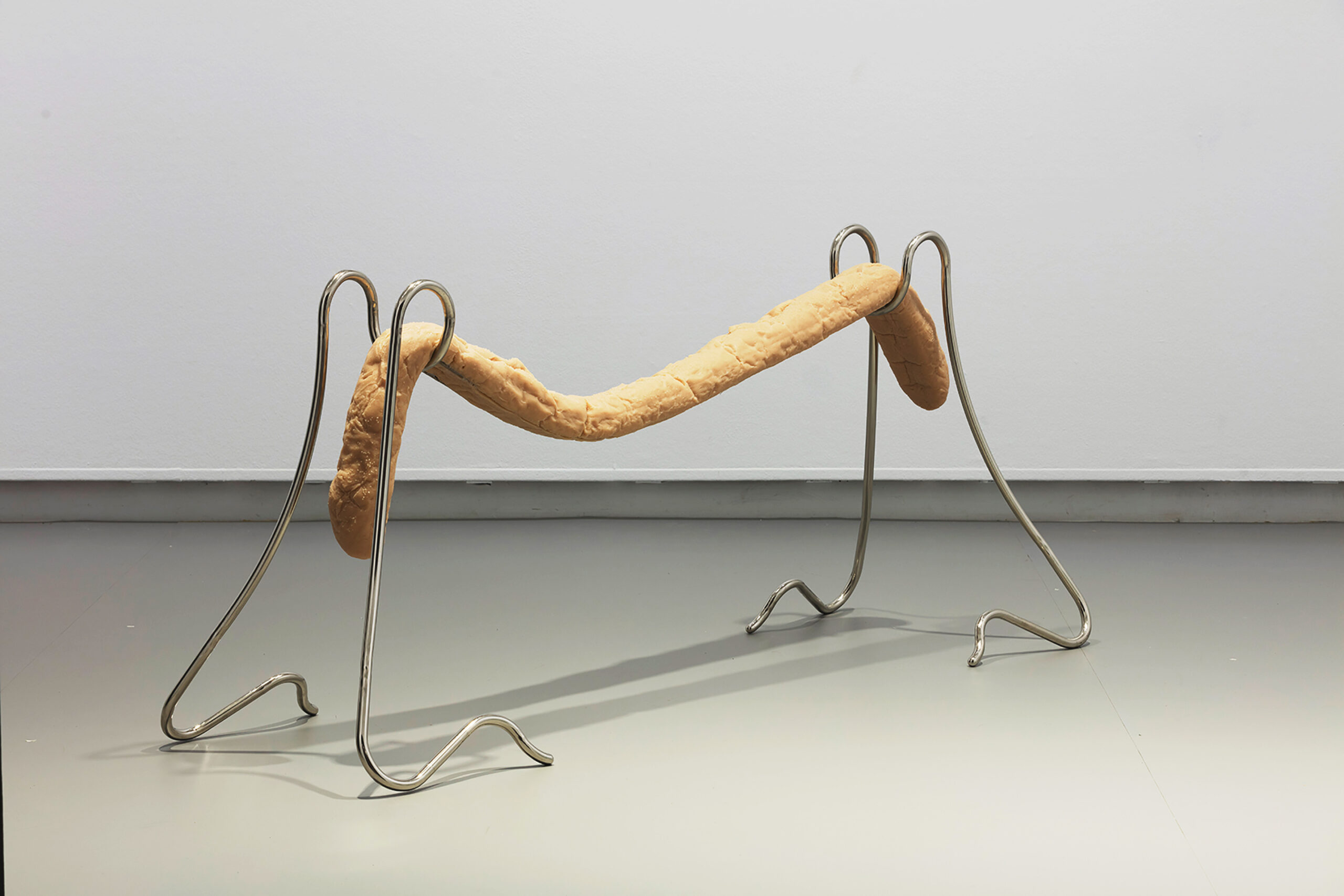
Levy is clear about her neutral approach, a position less critical of these material signifiers, grounded in bodily experience and how we interact with them. The retainer itself looks like it could be a miniature Levy model, as she primarily works with colored silicone, steel and metal. Her sculptures reconfigure the respectively stretchy and rigid materials, settling into figures that feel both human and alien. A warty gourd-shaped lump sits atop elongated steel crow legs. Metallic claws hold limp asparagus. A cream-colored, pearl-embedded rubbery sleeve covers a conceptual lawn chair. The contrasts evoke a familiar dissonance, an innate discomfort.
“I’m always thinking about the combination between organic and industrial forms. The retainer is something that does it naturally, a cast that exists on its own. Apple earbuds are like universal casts of the inner ear,” she reflects tangentially. In 2017, Levy reimagined an Apple commercial that featured POV footage of hands swiping on an iPhone screen. Her version shows fingers rubbing and squishing a silicone cast of the old Apple earbuds case.
It’s easy to have sexual thoughts about nonsexual objects. Perversion and eroticism are just facts of existing.
Tense duality is at the core of Levy’s practice— attraction and repulsion, human and object, flesh and hardware, animate and inanimate, synthetic and natural. Her work sparks an existential discomfort, confronting the contradictions of embodiment. To experience one of her pieces is to uncover a distorted reflection of yourself. Aside from the bench-in-progress, her sculptures often adopt the appearance of furniture without the functionality. They warp human-like curvature and sarcuous surfaces. Their textures inspire touch, but the instinct is stifled in a gallery setting.
“On a visceral level, I like material that you can visually understand as hard, cold, and smooth against something you can see as soft and flesh-like. Both metal and silicone can look pristine from afar, but their physical reality is sticky. I like that my work can get dirty over the course of a show with little fingerprints and imperfections.”
There’s a book on her desk, Pornotopia. “It’s about PLAYBOY’s influence on the American interior,” she explains. “Hugh Hefner created the idea of the bachelor pad, an alternative masculinity that wasn’t just about sports. There can be this masculine version of a man who isn’t physically active and walks around in a bathrobe…that can be sexy too.”
“The manipulation is almost masturbatory, but there’s something very innocent about it too. My work plays with sexuality, but I try not to be too explicit,” says Levy, who completed her masters degree at the Städelschule, Frankfurt in 2015. There’s something nice about suggesting things and letting the viewer decide if it’s actually there or if it’s just their mind thinking in a dirty way. It’s easy to have sexual thoughts about nonsexual objects. Perversion and eroticism are just facts of existing.”
This style of sensory, first-person video recently went viral. Videos dubbed “oddly satisfying” or Auto Sensory Meridian Response (ASMR) trigger tingling sensations by amplifying visually, tactically and sonically arousing experiences, like the goopy sound and feel of playing with slime, the gratifying smoothness of a perfectly iced cake or the soothing impression of a soft, breathy whisper. Proponents insist that ASMR is nonsexual, sometimes used to facilitate rest or meditation. Like Levy’s work, these videos question the sexual nature of their subjects versus our suppressed sexual inclinations.
Last year, she revisited the format with a new video, in which a pair of feminine hands extract pearls from oysters, digging into tissue with long, manicured nails. The audio magnifies the oyster’s sticky mucus. Each pearl hits the table with a sharp, delicate plunk. A viewer might construe commentary about commodity fetishism or femininity, maybe with an elevated class awareness elicited by groomed fingernails bearing the labor of pearl farming. But the hands also feign this sense of intimacy as they massage mollusk innards and fake Apple products, operating with mechanical care.
Levy cites ’70s interior design as a main influence, fascinated by the idea that a “sad, caucasian beige” indicated good taste during that era. “There are obvious political connotations. But there’s also something kinky sitting on a surface that’s the same color as your skin. I have this recurring mental image of an overweight white guy in khakis sitting on an overstuffed beige chair. It’s somehow the kinkiest thing. I picture him in a sweaty room with his arms sticking to the synthetic skin of the vinyl of the chair.”
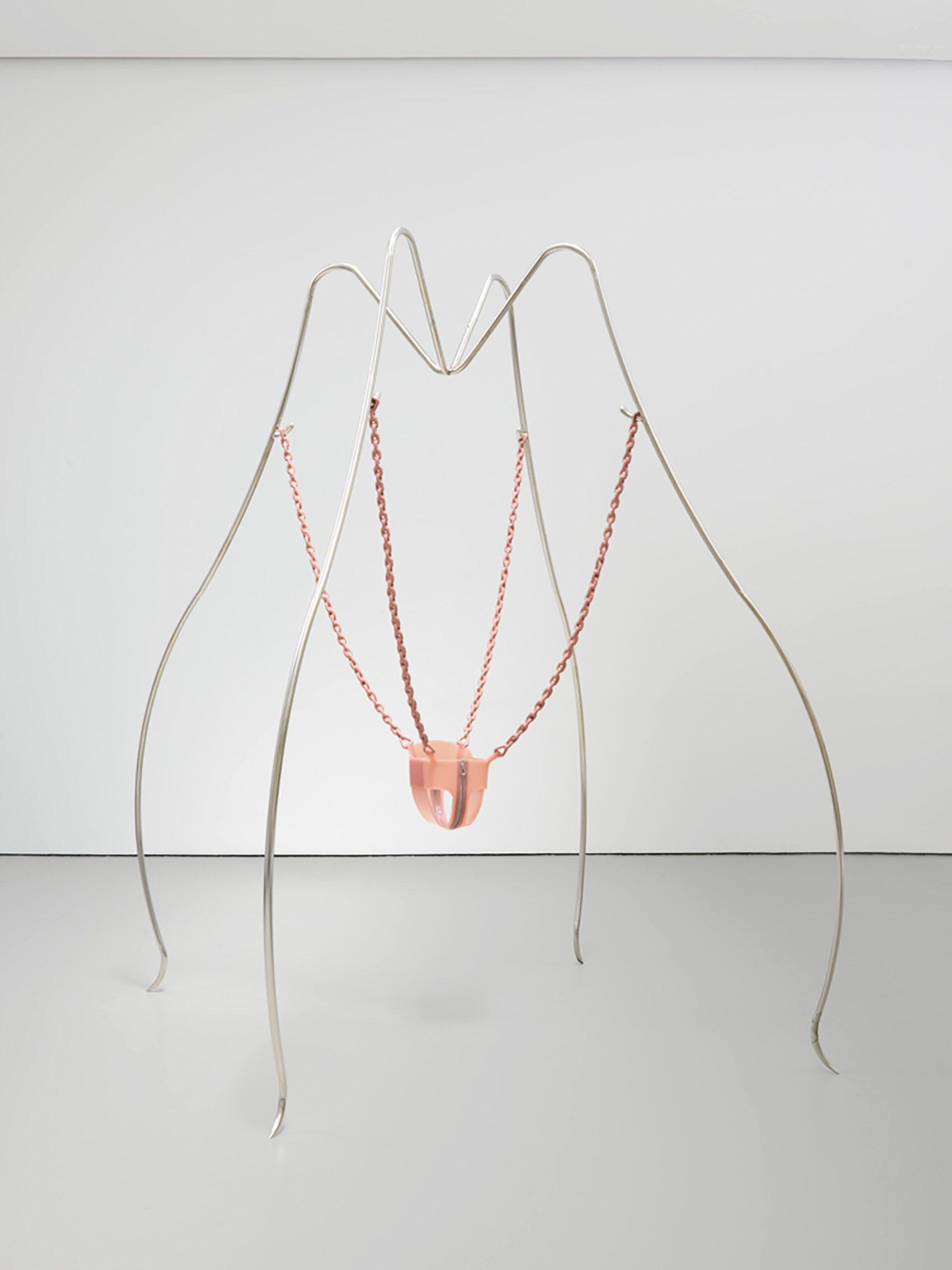
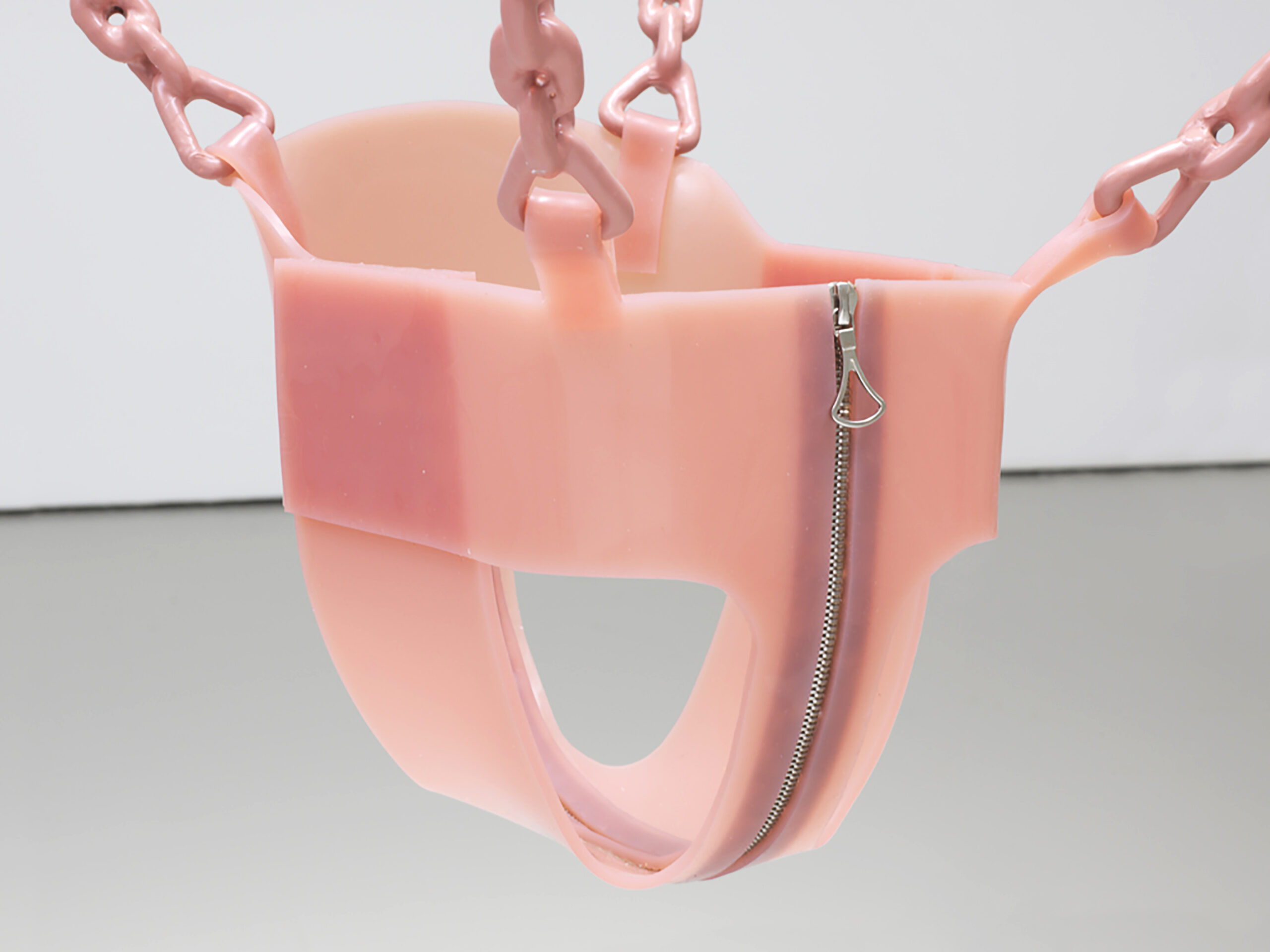
The artist’s structures occupy a flux state, an uncanny valley that transcends categorical organization. “When I make a piece, I start with two or three things that I want to combine. I like to use Google images,” she says, gesturing to the grid of dental X-ray photos on her computer monitor. Levy mentions one of her 2018 works, a baby pink silicone swing hanging from overarching steel spider legs. The diaper-like seat has a zipper running up the front. It exists somewhere between Louise Bourgeois, child’s toy, and sex toy.
“I like to play with scale, which can end up in a childlike place. I try to use a three-fourths scale, so it’s not like a baby’s thing or even a toddler’s thing, it comes out to be this 10 year-old size,” she explains. “At 10, you’re starting to sit in adult-sized chairs. It’s this scale that doesn’t really exist already. I’m interested in these child-specific forms.”
The bodily structures and shades running through Levy’s work recall ’60s sculptor and post-minimal pioneer Eva Hesse, who mirrored and mutated our physicality with latex, fiberglass, and stockings. Levy challenges the male-dominated minimalist genre from a non-gendered angle, just as Hesse did decades ago. And while her practice isn’t founded in feminism, she acknowledges the presence of femininity in her work. “It’s my inherent point of view,” she considers. “I come from this place of body anxiety, which has been typically considered feminine, but anyone can experience it.”
“There’s something about the bodily awareness of going through puberty that is a constant touchpoint for me,” she says. “And furniture is inherently bodily. Furniture is where you rest a body.”