Your bag is empty.


The Financial Audit host has become the Jerry Springer of YouTube. And while viewers love to hate, they also can't get enough.
This story appears in our Fall 2026 issue featuring cover star Charli XCX, on newsstands September 28th. Want us to come to your place? Subscribe here to get it delivered to your door.
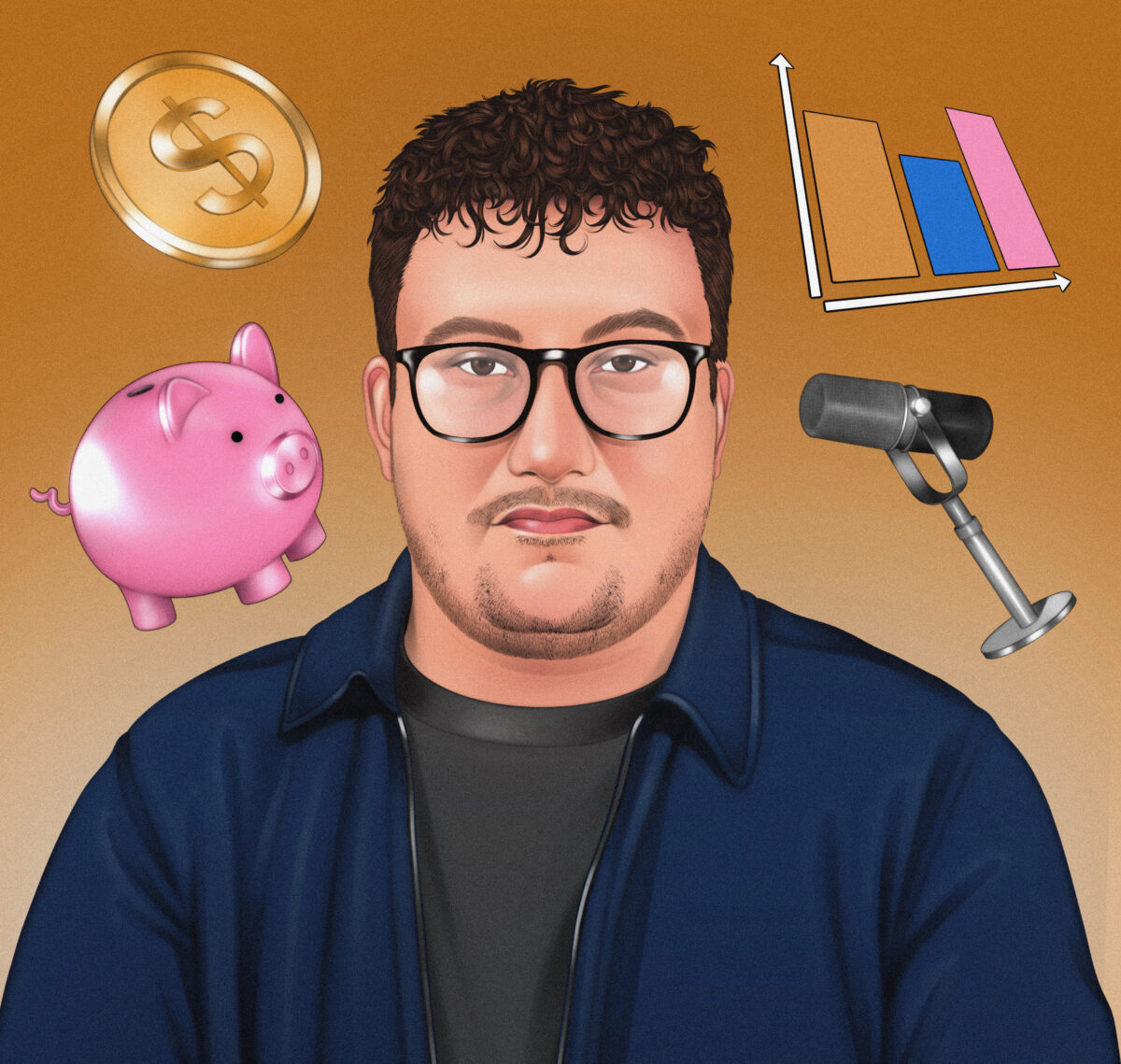
Caleb Hammer insists he didn’t set out to become a political figure. All he wanted to do, he tells me, was teach people about personal finance so they could avoid the same ignorant mistakes that landed him in $67,000 of debt.
Amid his ascent to becoming one of the most popular, highest-earning creators on all of YouTube, Hammer has transformed in the public imagination from a humble resource of sound money-management advice to a flash point in the culture wars. He’s been called a racist, a misogynist, a homophobe, a transphobe, and a far-right fascist lacking empathy for the working poor—accusations that Hammer rejects.
“People have brought me into politics from the beginning,” Hammer, 31, tells me from the Austin studio for Financial Audit, the YouTube show with 3.6 million subscribers that has fueled his online fame. “They’ve always put me on the right, which doesn’t even fully align with my political views. … So it’s really hard when I see people on the super far left throw me into this fascist, evil thing.”
If any subject might seem immune from the culture wars, it’s personal finance. The rules of good money management are exceedingly short and simple, so much so that University of Chicago public policy professor Harold Pollack famously said all the personal finance guidance that the average person will ever need could fit on one side of a three-by-five-inch index card.
But as Financial Audit routinely shows, many Americans are unprepared for even a minor monetary setback—more than a third wouldn’t be able to cover a $400 emergency expense, according to the Federal Reserve. The issue is whom to blame: Americans themselves or our economic and political systems.
On Financial Audit, Hammer pores over guests’ bank, credit card, and investment statements to assess the health of their finances and asks them about their lifestyle and spending habits.
The guests run the gamut politically and culturally. Financial Audit has hosted millionaire OnlyFans creators, avowed socialists, a man who dropped the N-word (with a hard er, no less), victims of multilevel-marketing scammers, simps who blow all their money on e-girls, Disney adults who go into debt visiting the Happiest Place on Earth, car-crazed Americans who buy vehicles they can’t afford, and Michigan governor Gretchen Whitmer, who agreed to let Hammer grill her about the state’s finances.
The Financial Audit studio has the same drab aesthetic as podcasts everywhere: gray walls, wood-grain furniture, and a tastefully placed houseplant (in Financial Audit’s case, a very healthy fiddle-leaf fig). But the colorful guests, combined with Hammer’s confrontational interview style, often make for combustible viewing.
Hammer is a free-market advocate who calls out his guests’ self-destructive spending and lifestyle decisions in often unsparing terms.
When a female guest revealed that she had been married only two weeks before getting divorced, Hammer snidely quipped, “That makes sense.” As she started to cry, the woman responded, “That wasn’t very nice.”
Hammer then edited the interaction into a viral clip titled “Top 3 Craziest Caleb Hammer Moments.”
Hammer shows me the dim production cave where six editors furiously cut together the hours of video content that Hammer’s operation produces each day. He then leads me into the expansive main office space with double-height ceilings and software engineers hacking away at Dollarwise, a subscription-only personal budgeting app.
“I would be able to live a really, really, really comfortable and happy life if everything just, like, stopped,” Hammer tells me. Across its various properties, Hammer Media generates tens of millions of dollars per year, employs 40 people, and plans to hire “dozens” more in the coming months, Hammer says. Already, the company has outgrown the office space it renovated earlier this year; the studio moves to Dallas next year.
Hammer’s trolling has garnered him comparisons to Jerry Springer, host of the eponymous trashy daytime talk show in the ’90s and 2000s—a comparison that Hammer doesn’t mind. “We like to pick interesting people, and extreme people tend to be more interesting,” Hammer says. While Springer set his guests up to fight with each other, he wasn’t known for sparring with them himself.
Hammer knows what he’s doing; the provocations are intentional. He admits to having an “insensitive” sense of humor. He casually dismisses people and ideas as “retarded” and his combative female guests as “bitches.” He dabbles in the kinds of mildly offensive race- and sexuality-based jokes that locals might hear at the Comedy Mothership, the Austin comedy club owned by fellow podcast mogul Joe Rogan (himself a big Caleb Hammer fan).
“The person in front of me fully consented to [the conversation], and I’m not making fun of things that they [consider off-limits],” Hammer says. Before every Financial Audit episode, guests submit a list of topics they don’t want addressed, Hammer explains, and his team sometimes goes so far as to discourage a guest from participating if they believe that person can’t withstand Hammer’s barbs. “I’m really confused why these people”—the audience—“are being offended on behalf of someone who’s not offended in the first place,” Hammer says.
When “Jade,” a trans woman, revealed on Financial Audit that she had received her breast augmentation for free through Colorado’s Medicaid program, it caused a firestorm among the online right, which opposes funding gender-affirming surgeries with taxpayer dollars.
“I knew it would be clippable and I fed into that,” Winter Evans (“Jade”) says. (All Financial Audit guests are given pseudonyms so they don’t use the show for self-promotion.) But she also caught flak from the left for opposing transgender healthcare for minors and saying the transition process should be closely monitored by a psychologist.
When Evans revealed she finesses men out of cash, Hammer responded, “Why is it the ugliest people who get the most money?” prompting Evans to clown on his “broccoli top” haircut.
Still, Evans walked away from the show with a positive impression of Hammer. “His haters won’t understand how he is and how he works unless they’re on the show,” she says. “He does care about his guests, and he does want them to better themselves.”
Chelsea Fagan, cofounder of the Financial Diet, a multiplatform personal finance brand, sees Hammer differently, describing him and his personal-responsibility ethos as “the number one entry point to the right-wing pipeline.” “Aside from how obviously crass and base all of this is, it also teaches you the most powerful conservative principle, which is that your station in life is your fault and a direct reflection of your moral worthiness,” she recently said in a TikTok video about Hammer’s content.
His critics do have a point: Americans suffer from systemic economic issues beyond their control—specifically, wages in recent decades not keeping up with the skyrocketing costs of education, housing, and healthcare. The once-vibrant middle class that made America the envy of the rest of the world is being squeezed, and many of the benchmarks of the American dream (owning a home, getting an affordable college education) are prohibitively expensive for a growing portion of the population.
Hammer doesn’t deny this; he concedes that millennials and Gen Zers do not have the cushy housing market that Boomers enjoyed, and that young people face a uniquely difficult financial situation. But he says none of that excuses being frivolous with whatever a person does have.
Hammer’s most radical proposition is that we Americans rethink our cultural relationship with certain financial benchmarks. A college degree and owning a home don’t make sense for everyone, Hammer argues, and the American obsession with flashy cars is often financially ruinous.
A large portion of Hammer’s own debt came from pursuing a degree in music composition at Western Michigan University. (He dropped out before finishing.) “I was coached by my parents, like many people in this country, to go to any college for any degree and borrow whatever amount of money it takes to get it,” Hammer says. There’s a low return on spending tens, if not hundreds, of thousands of dollars on a humanities or arts degree. Hammer is a fierce advocate for community college and argues that, as a rule of thumb, a degree shouldn’t cost more than the salary that a graduate can expect to earn in their first year out of school.
Hammer started making videos only four years ago, just him and a cameraman, and now he manages an eight-figure media enterprise with a dozen brands under its umbrella. But the success has come at a cost: a lot of haters. Earlier this year, Hammer hired personal security after receiving death threats. The receptionist at Hammer Media is a burly redheaded man with a thick beard.
“It eats you up at first,” Hammer says. “Especially if you grow quickly, you’re not prepared for what it’s like. Even if there’s some valid criticism, it’s disproportionate and very heavy. Why do these people hate me? Why are they saying things about my life? They don’t know me.”
Doing a two-hour interview with me is a strain on Hammer’s schedule. Even before we are finished, Mika Castro, head of Financial Audit, sits on one of the office couches anxiously waiting for Hammer to finish our discussion.
“I kind of need you soon,” Castro pleads.
“Am I killing myself?” Hammer asks, referring to the tight production schedule.
“Maybe,” Castro replies.
Hammer repeatedly describes his fans—right and left—as “normal” people, people exhausted by the intense partisanship of the Trump years and yearning for a less combative political discourse. As for his far-left critics, he doesn’t care to win them over anyway. “They’re so extreme and lost,” Hammer says. “They’re never going to be a part of my community, so I don’t give a shit.”
Hammer shakes my hand, and Castro whisks him to a conference room to hear pitches from the production team. It’s a busy Monday afternoon at Hammer Media, and there are people online he needs to enrage.