Your bag is empty.

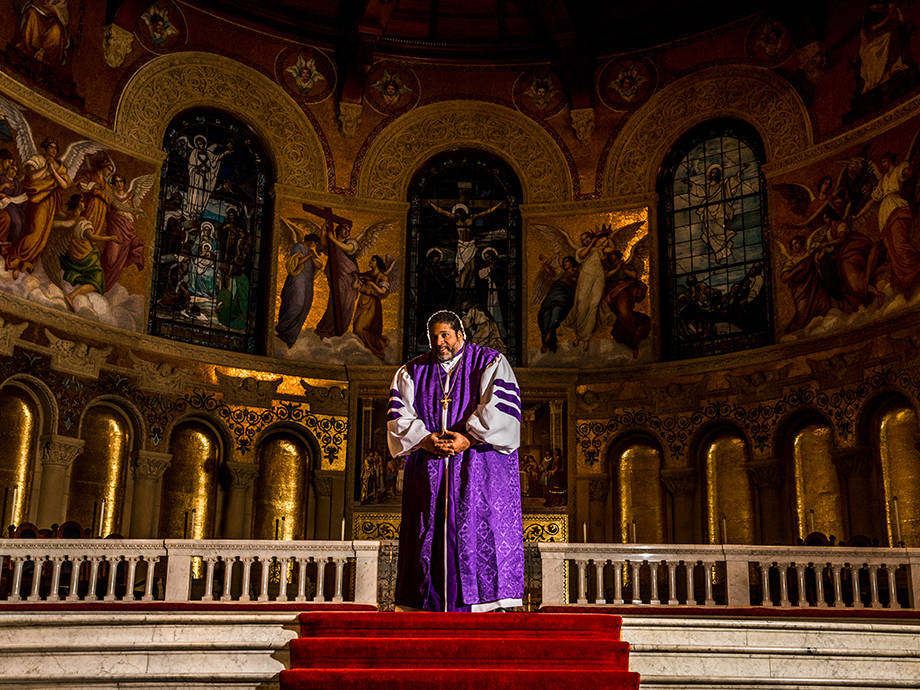
From his pulpit in Goldsboro, North Carolina, the progressive preacher is mustering an army of love
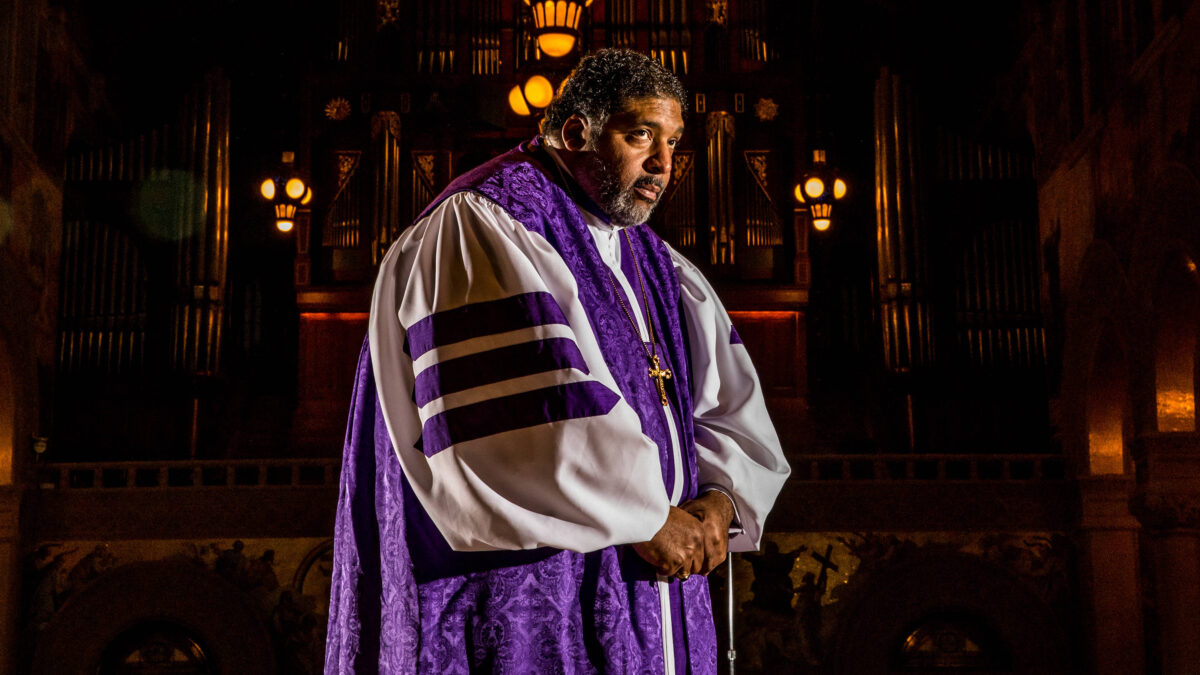
The precise origin of Watch Night—a New Year’s Eve prayer service, common in Southern black churches, in which a congregation assembles to recall the moment the calendar flipped from 1862 to 1863 and Abraham Lincoln’s Emancipation Proclamation became law—is murky, but the sentiment involved is consonant with the season: Let us gather to celebrate the thrill of change and the promise of renewal.
This past December 31, at the Pullen Memorial Baptist Church in Raleigh, North Carolina, parishioners had filled most of the pews by 6:30 P.M. Latecomers jockeyed for standing room near the back. A banner stretching from one end of the balcony to the other read “Poor People’s Campaign: A National Call for Moral Revival.” A camera crew snaked power cords up and down the pulpit stairs, preparing for a live internet broadcast. The crowd was a mix of regular churchgoers, graying activists and young couples in expensive eyeglasses. Buttons broadcasting liberal causes and catchphrases (“Love Trumps Hate,” “Nasty Woman,” “Black Lives Matter”) were abundant.
The night’s headliner was the minister and activist William J. Barber II—newly minted MacArthur Fellow, former president of the North Carolina chapter of the NAACP and co-chair of the revived Poor People’s Campaign, a movement conceived by Martin Luther King Jr. in 1967. Barber and I were scheduled to meet for a formal interview before the service, but his brother, Charles Barber, a minister in Georgia, had recently been diagnosed with inoperable pancreatic cancer, and earlier that day the situation had grown grim. One of his colleagues called to say that Barber needed to spend the day with family.
My breath caught as I put my phone back on the hotel nightstand. How could anyone, faced with that kind of news, address a sprawling congregation, let alone send it into a new year armed with hope?
“When we talk about morality, we’re not just talking about Christianity.”
Barber was born in 1963, in Indianapolis. Around his fifth birthday, his parents moved him from Indiana to a segregated kindergarten in Washington County, deep in North Carolina’s so-called black belt. His father had grown up there and wanted to help desegregate the state’s public school system. He became one of the first black teachers in the county; Barber’s mother was the school’s first black office manager. (She still works there: “The great-grandchildren of some people who called her nigger when we first came now call her Mama Barber,” Barber writes in his book, The Third Reconstruction. On weekends, his father traveled around the state, holding revivals in one-room churches. “He was sharing the gospel message that gave him hope, believing that it was good news for others as well,” Barber writes. “But at the same time he was also building connections as an organizer.”
The elder Barber’s decision to move his young family to the segregated South demonstrated his conviction that faith and activism are inextricable. “He believed that racism was against the imago Dei, the image of God in every person, and that systemic racism and poverty were forms of false worship, idol worship, the worship of self over the care for all humanity,” Barber tells me, speaking over the phone two weeks into the new year. “My parents could have stayed in the Midwest, but they chose to bring me to a segregated kindergarten. They came because a black principal asked them to come back home, and Daddy said that he accepted what he believed was a Macedonian call. In the Bible, the poor Christians said to Paul, ‘Come help us.’ And he did.”
Barber’s home base is the Greenleaf Christian Church in Goldsboro, about 55 miles southeast of Raleigh. If you listen to old sermons recorded on crackly 78 rpm discs in the 1920s and 1930s—preachers like the Reverend J.M. Gates of Atlanta hollering about how “death’s black train is coming”—you’ll recognize Barber’s heavy, undulating cadences, the repetition of key phrases, the call-and-response rhythms, the rich, intoxicating music of his voice. The North Carolina–based writer Benjamin Hedin, author of the 2015 book In Search of the Movement: The Struggle for Civil Rights Then and Now, contextualizes Barber’s rhetorical powers within the civil rights movement. “I think oratory is the proper tradition in which to place Barber, rather than activist or nonviolent apostle,” he tells me. “Barber’s place is to offer from the pulpit, where it has traditionally been offered, a source of hope and renewal and moral clarity. It actualizes all the hope and aspirations society by itself cannot.”
Barber considers Duke professor and theologian William C. Turner one of the greatest influences on his spiritual life, and in conversation he’s quick to cite Turner’s comments about the link between belief and boots-on-the-ground advocacy: “Whatever you call it—being born again, touched by the spirit, moved by the divine, baptized in the water—whatever you call your ‘religious experience,’ if it does not initiate a quarrel with the world, and a quarrel with injustice, and a quarrel with hatred, and a quarrel with discrimination, and a quarrel with division, then your claim to have had a religious experience is terribly suspect.”
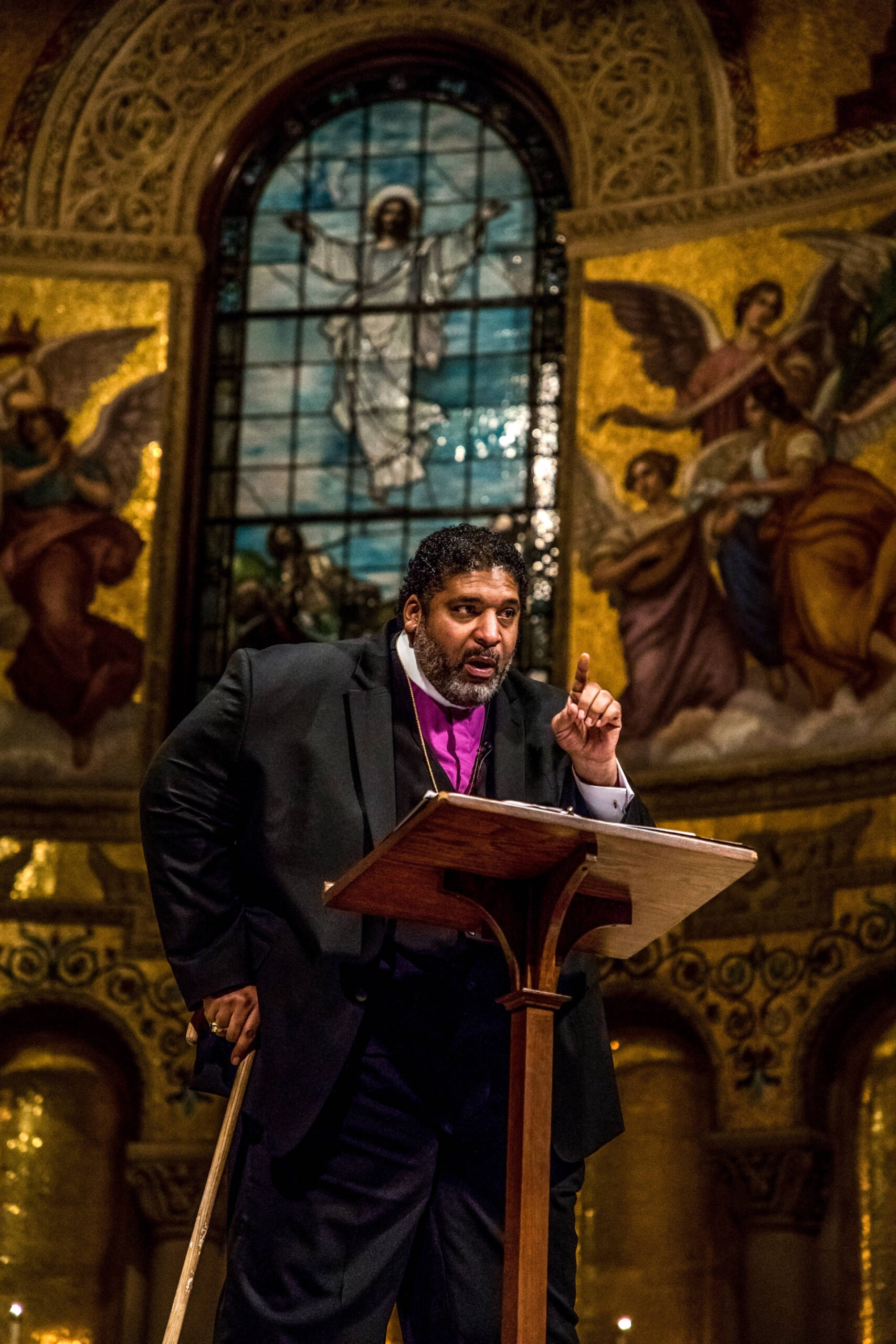
Barber is nothing if not cognizant of the difference between words and deeds. In 2013 he became known nationally for his involvement in the Moral Mondays campaign, in which he led the peaceful occupation of the North Carolina capitol building. The action got national press, perhaps because it demonstrated Barber’s singular ability to balance faith, activism and an intersectionality that can surprise casual atheists and traditional believers alike.
Pat McCrory, the state’s new Republican governor, was determined to attack policies designed to protect the poor or otherwise disenfranchised: He slashed unemployment benefits, signed a bill that opted North Carolina out of an expanded Medicaid program and repealed the Racial Justice Act, which had allowed death row inmates to challenge their convictions if they believed they had been subject to racial discrimination. He also deregulated mountaintop fracking, eliminated tenure for public-school teachers, tried to prevent public health insurance policies from covering abortions and, in 2016, signed something called the Public Facilities Privacy and Security Act, a bit of legislation that, among other things, contained directives regarding bathroom use: Per its dictates, in government buildings people could use only the bathrooms that corresponded with the sex printed on their birth certificates.
The Moral Mondays protests eventually spread to other districts and cities; more than 1,000 people, including Barber, were arrested in the first two years. In 2016, McCrory lost the election to Roy Cooper, a Democrat, making him the first sitting governor to blow a regular general reelection campaign in North Carolina since 1850. He later blamed his defeat on “the non-citizen vote,” though it was almost certainly due to the economic fallout following his endorsement of the Public Facilities Privacy and Security Act. News organizations estimated that it cost the state more than 1,750 jobs and more than $77 million in investments and other spending, after corporations including PayPal and Deutsche Bank froze their expansion plans, Bruce Springsteen and Ringo Starr canceled concerts there and the NCAA excluded the state from hosting playoff games.
In 2016 Barber again commanded national attention, during a 10-minute speech at the Democratic National Convention. He shuffled onstage in a dark suit and a lavender shirt. His beard was closely cropped and flecked with gray. He began, “I’m a preacher, and I’m a theologically conservative liberal evangelical biblicist.” The crowd seemed uncertain how to receive this. “I work to conserve a divine tradition that teaches us to do justice, love mercy and walk humbly with our God,” he went on. “I’m worried by the way faith is cynically used by some to serve hate, fear, racism and greed.” The crowd swooned. A headline in The Washington Post declared, “The Rev. William Barber Dropped the Mic.”
Barber’s work is staunchly nondenominational, and he welcomes individuals who are repulsed by institutionalized religion, have been cast out of their churches, are scarred by the right’s long-standing co-option of “morality” or find the very notion of God absurd. “Our movement is not asking people to be Christian. When we talk about morality, we’re not just talking about Christianity. That’s not even my only entry point; it’s an entry point,” Barber says. “We have black, white, brown, native, Asian, atheist, people of faith, people not of faith, young, old, gay, straight. A moral fusion movement is not about people becoming Christian, or any particular faith. A moral fusion movement says, ‘Listen, there are some issues that aren’t left versus right, Democrat versus Republican, but right versus wrong.’”
In addition to his role at Greenleaf, Barber is president of Repairers of the Breach, a nonprofit that takes its name from a portion of Isaiah 58:12 (“Your ancient ruins shall be rebuilt; you shall raise up the foundations of many generations; you shall be called the repairer of the breach, the restorer of streets to live in”). The issues he cares about the most—voter suppression, endemic poverty, health care—he sees as moral obligations, which we have heretofore collectively failed to prioritize or demand. Donald Trump’s presidency is merely a symptom of the moral void at the nation’s center, he insists, and hardly the cause of it. He reminds me that violence against the poor both preceded and will outlast this administration.
Cornel West, also a decorated theologian, was an early supporter of Barber’s work. “He is a spiritual giant, a great freedom fighter and a grand organic intellectual,” West told me recently. “He puts a smile on Martin Luther King’s face from the grave. I have great love and respect for him.” Comparisons to King are not uncommon.
In a way, Barber’s work is predicated on the idea that morality is self-evident. For decades, American popular culture has normalized self-idolatry and individualism, to the point that it’s now widely seen as a virtue: “I’ma worry ’bout me, give a fuck about you” is how Drake puts it in “Started From the Bottom,” which remains (even if Drake is Canadian) as good a parable of the American dream as anything. America was founded on promises of independence and self-betterment, yet Barber is suggesting we should worry less about ourselves and more about our neighbors. His message is radical insofar as it requires a significant recalibration of the American psyche—away from grotesque exaggerations of the Horatio Alger myth and toward the promise of Emma Lazarus’s “The New Colossus” mounted inside the Statue of Liberty.
Barber can be a challenging subject, in large part because he’s resistant to letting his ego overshadow the movement. He has submitted to his work so fully, it’s difficult to cleave the man from the mission. It seems obvious Barber’s advocacy comes at a personal cost, yet he’s preternaturally adept at contextualizing his suffering in a way that inevitably diminishes it. His pain, whether physical, internal or existential, can always be managed. (The physical pain is very real: Barber suffers from ankylosing spondylitis, an inflammatory disease that, over time, causes the vertebrae of the spine to fuse.) This too feels radical in an era of incessant broadcasting, in which the airing of grievances is its own online pastime.
When I ask Barber if he ever fears for his safety—after Charleston and in light of massacres everywhere—he is reluctant to answer. “I look at violence in two forms,” he finally replies. “And I’ll say it quickly. When Coretta Scott King was asked about violence after her husband’s murder, she said, ‘Yes, but there are other forms of violence, like denying health care, denying education, denying culture, denying a living wage, denying labor rights.’ Another form of violence is an apathetic attitude that refuses to address these other forms of violence. So I’ve experienced that kind of violence, first of all. But then, yes, I’ve also experienced the violence of.…” He pauses. “I don’t talk about it a lot or give glory to it, but I’ve received notes that say things like ‘You’re in the dead pool; you’ll be dead by Christmas.’ I’ve seen the ugly, ugly things on the internet. I received some of that stuff in 2011, before Trump was ever around. But that’s not the me I want folks to know.”
He is similarly reserved when I ask if he’s considering a presidential bid. “I don’t really have any desire to hold political office,” he says. But he is quickly energized as he segues to thoughts of the future, forecasting a movement peopled by citizens “who are willing to put their bodies on the line, their mouths to work, who are willing to lose their pulpits” to spread the essential message “that change has happened, change is happening, change can happen, change will happen and that we are the people.”
“Change has happened, change is happening, change can happen, change will happen and we are the people.”
On New Year’s Eve, Barber’s sermon was preceded by at least an hour of singing and remarks from half a dozen other speakers, including the Reverend Liz Theoharis, his co-chair in the Poor People’s Campaign. (She wore a clerical stole over her ministerial robes that read “Jesus Was a Poor Man.”) “We never have a stage at a Poor People’s Campaign event where a person stands by themselves,” Barber says. “That’s intentional. And we never talk about any one issue separate from any other, so that we’re not fighting in silos.”
When he finally rose to speak—he had been sitting on the side of the stage, watching and listening, nodding, occasionally offering a quiet “That’s right!”—he acknowledged that his day had been arduous. He then delivered a 45-minute sermon that gathered strength as it went, like a slab of snow cascading into an avalanche. He made the case that people helping one another on a national scale is possible. It shouldn’t even be that hard. Reorganize the budgets; resist gerrymandering; make sure every citizen is healthy and allowed to vote.
By the end, I was dizzy. We filed outside. Midnight was still three hours away. People shook hands in the cold, wishing each other well in the forthcoming year.
A few days into January, Barber’s brother passed away. “If he was going, it was a blessing that he was able to die with his mama singing the songs of the church to him,” Barber tells me. His voice, that assured baritone, now sounds thin, and it quavers as he describes the funeral. But as it did in Raleigh, it gathers an inexorable momentum as he delves deeper into his work and his faith—how we can change and why we need to. Listening to him on the phone, as in the pulpit on New Year’s Eve, I feel awake, and hopeful.