Your bag is empty.

The ‘Breaking Bad’ actor on getting kicked in the face by Chuck Norris, the death of RJ Mitte and the show’s enduring legacy.

It’s been 13 years since Dean Norris last played Hank Schrader, but he still can’t escape the regular reminders that he was Walter White’s brother-in-law on Breaking Bad.
Over his shoulder as he appears onscreen for this interview, there are the custom candles of Hank as a saint. At conventions, fans plead for him to tell them off like Hank did on the show. And on his desk, there’s Schraderbräu, the fictionalized German lager that Hank brewed on the show that now exists in real life and that fans will be able to buy online next month.
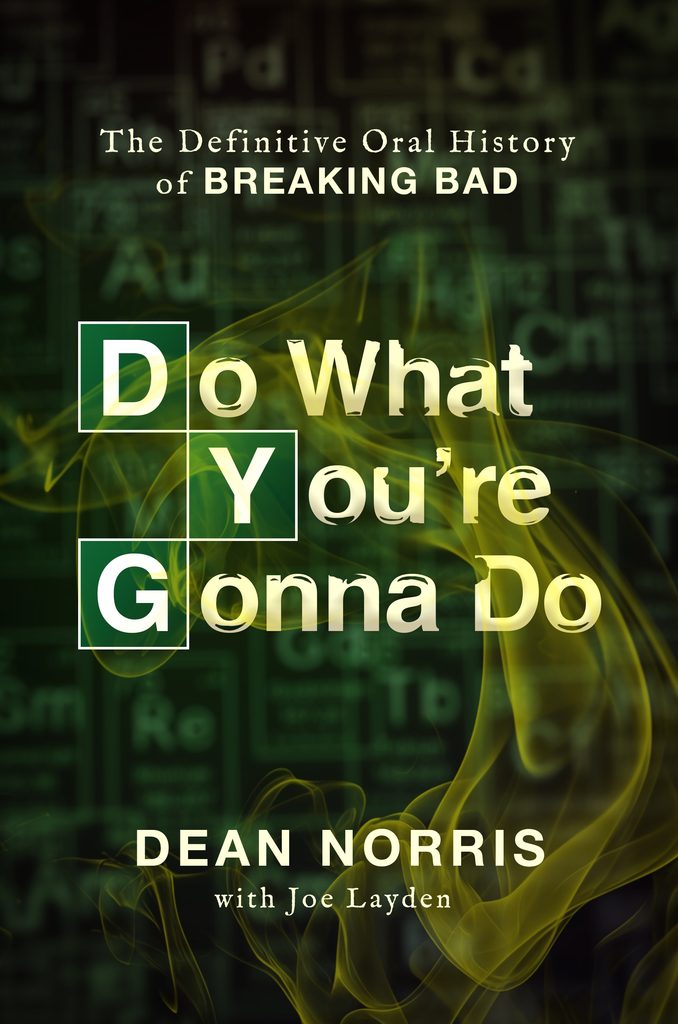
Breaking Bad lives on in pop culture, especially now that The New York Times has named it the best show of the first 25 years of the 21st century. Norris and co-writer Joe Layden break down the show’s place in Do What You’re Gonna Do: The Definitive Oral History of Breaking Bad, which is out on Tuesday. Playboy caught up with Norris in early November to talk about what it was like to get kicked in the face by Chuck Norris, his favorite scenes and what it’s meant to be attached to the show.
This interview has been edited and condensed for clarity. This conversation contains spoilers for Breaking Bad, and took place before the news of Norris’ divorce became public.
Q1: From a young age, your father wanted you to get into entertainment. Did you always want to be an actor, or did you feel like you were pushed into it?
NORRIS: Unusually, acting was kind of it for me since I was 5. When you’re young in school they ask, “What do you want to be when you grow up?” I was pretty smart in high school as a valedictorian, so maybe becoming a lawyer ran through my mind. Certainly, [while attending] Harvard, the idea of becoming an investment banker in the mid ‘80s was intriguing, but my true love was the concept of entertainment. I wish I was a better musician; I would love to have done that. But acting was kind of like the second cousin to that. It wasn’t till midway through Harvard that I said, “OK, I’m going to waste this Harvard degree and try this ridiculously hard concept called acting.” It worked out.
Q2: I had read about how you would go on these recruiting trips to investment banks in New York as an excuse to go on auditions. Did you intentionally bomb these interviews? How did that work?
NORRIS: I’m a college kid and I didn’t come from a lot of money, so they would fly me down, put me in a night in New York City. I would go in that morning in a suit and chit-chat about how I thought you can make money in the stock market or whatever. I’d change into my jeans and T-shirt, and I was auditioning not only for possible acting jobs but also for graduate schools. I auditioned for NYU, Juilliard and Royal Academy of Dramatic Art, which is where I ended up going. But yeah, my trips down were paid for by investment bankers (laughs).
Q3: I know you’ve had more than 150 roles, but I gotta know what it was like to get punched and kicked in the head by Chuck Norris on Walker, Texas Ranger. Was that actually him or his stunt double?
NORRIS: It was him, and it was great. It was quite an honor to get smacked around by him; he didn’t hurt me and he was very precise man. He could get very close to the face, but he had that kind of control because that’s what he did.
Q4: You wrote in the book that while you were shooting the pilot for Breaking Bad, you walked up to Bryan Cranston and shook his hand and said, “Thank you for this seven-year job that you just gave me.” What do you remember most about the pilot and just being so confident that oh, this might be around for a while?
NORRIS: It was that first readthrough. We haven’t even we hadn’t even started shooting yet, and everyone gathered in Albuquerque—all the AMC CEOs, the people at Sony, everybody in a big conference room. We read the script, and every time [Cranston’s] reading it … every time he read a line, it was in a way that was just so good and so honest and so correct. I was like, “Damn, this guy’s great.” That’s when I went up to him and I said, “Hey, buddy, thanks for the seven-year job.” He says he doesn’t remember that, but I remember it very well because I remember being just like blown away by that.
Q5: I was really moved by what you wrote about understanding Hank’s anxiety and pain right after your father died. You wrote how you started to tap into that real-life experience to bring Hank’s own story to life. How did you translate that pain of your dad’s passing to what we see onscreen back then?
NORRIS: It was a weird coincidence, turn of fate, or however you want to say it. When my dad passed, is when Vince started writing scripts where Hank was not as much of a blowhard. That’s when you started seeing the PTSD from going down to El Paso and seeing Danny Trejo’s head blow up, and his fight with Tuco. One thing I learned about law enforcement is most of these guys never really fire their gun in an entire career. You’re prepared for it, but you never actually do it. So, when it actually happens, you don’t realize you’re in a battle. That was a battle with Tuco, and that just affected him. He didn’t quite know it at the time, but it kind of crept up on him.
God bless my dad—I got to use the pain of that to kind of add to what was going through Hank at that time. My dad was in the hospital for three, four months, and Vince wrote me out of an episode so that I could stay with my dad.
Q6: You wrote in the book how you had been waiting 20 years for a role like Hank, and you knew that you would never be a part of something like this again. When was the moment that you knew it was like, “Oh shit, we made it?”
NORRIS: Our worry was that they couldn’t keep that level of creativity up [after the pilot]. Really, that was a great script. There was no way the number-two script can be as good as this one. And of course, it was. The number-three was, too, and then the whole season was like that.
But I think from a public sense, it really was when Netflix picked it up, which was Season Three. It was 30 percent of Netflix’s streaming at the beginning. After that, we started getting known on the street—“Holy shit, it’s Hank!” That’s when we really saw that this big audience was starting to come around.
Q7: This marriage between Breaking Bad and Netflix is still so fascinating to me because I really do think it helped how we stream things. You just touched on it, but how do you think the show and this partnership with Netflix changed people’s viewing habits when it came to watching an episodic TV show like this one?
NORRIS: I think it completely changed how [Netflix] did stuff. Now, you didn’t have to wait every Sunday. Although, I thought it was nice to wait every Sunday because you needed that time to build anticipation to kind of digest what you would see. I even liked the commercials because I needed that commercial to get a tea or drink a beer (laughs). Netflix just changed everything because now people who had heard about [the show], but had never seen it could go through the first three seasons, and tuned into Season Four, Five and Six to catch it all.
Q8: Since you mentioned it earlier, The New York Times did name Breaking Bad as the top show of the first 25 years this century. In the book, you pointed out how the first preview from The Times was not that favorable, saying along the lines of this show feels like a slog and might not be worth the investment since it won’t be around. What’s it like to start there and then end up here as The New York Times’ best show so far this century.
NORRIS: I was very protective, and I thought they weren’t effusive enough about how good the show was. Then, it was like everybody said, “I knew this was a hit. I knew this was a thing.” Eventually, all the newspapers all came around and said, “OK, this is the show.” But yeah, The New York Times was just timid. They didn’t say bad things. They were just timid.
[Breaking Bad] was 30 percent of Netflix’s streaming at the beginning. After that, we started getting known on the street—“Holy shit, it’s Hank!” That’s when we really saw that this big audience was starting to come around.
Q9: I was rewatching some of Hank’s best scenes last night. My favorite is the garage fight in Season Five, and I feel like you and Bryan had this chemistry that was just incredible, especially in these latter episodes once Hank finds out who Walt is. What was it like for you to not just film that scene, but also see this character that you invested in so much transform into this really formidable foe for Walter White?
NORRIS: It was such an honor and pleasure to get to do a show where you had an arc where things changed. This was a guy who progressed from this big blowhard kind of guy into a guy that was struggling with his own mental health. I always joked to Vince [Gilligan], “Do I need to re-audition for this role for Season Three?” Because the scenes weren’t all jokey, and Hank had to deal with some serious stuff. From an actor’s point of view, it couldn’t have been a more exciting thing to do.
Q10: Do you think the scene in the bathroom when Hank finally puts it all together is the most illuminating shit in TV history?
NORRIS: (Laughs) I haven’t seen too many shit scenes, so I think I could lay claim to a pretty important taking-a-shit scene. I thought the scene was really genius on Vince’s part. What I was glad that didn’t happen, was that Hank was sitting in his office and he goes, “Hey, wait a minute,” and he puts it all together, In this case, Walter White was free, he was done and had tied up all the loose ends. It’s just this little thing, where Hank reaches back and it’s like, “What’s this?” And it’s “Holy fuck!” Everybody was wondering how Hank would figure it out. You know how that would happen, and it happened in like the most mundane way of him just going to the bathroom.
Q11: The intensity in the episode “Ozymandias” is something I still think about in terms of all-time great TV. I read in the book how you told director Rian Johnson that your one note was about wanting to summon your inner-Dennis Hopper from True Romance to get the most out of the scene. You could really see in that scene that it’s the one time that Walter White cared about his actions. What do you remember about the intensity of that day when Hank was killed off?
NORRIS: Not only was it Hank’s death scene, but it was my last scene to shoot for the show. It was me saying goodbye to the show, it was saying goodbye to Bryan, and it was just so much emotional weight that came with that day, let alone that scene. When I got done when I died, that was it. They all clapped, and they gave me this big picture that everybody had signed. I was like, “That’s it. I’m done. It’s all over.” This six-year run had come to an end, and I had to say goodbye to everybody. It was almost too emotional for me. I learned from interviewing Bryan that they were a little disappointed I didn’t stay. I didn’t know that anybody gave a shit, but it was too much for me to stay there. I had a plane the next day, but I called and said, “Is there anyway I can get on a 7 o’clock flight?” I said, “Fuck it,” and I just left. I did what they call the Irish exit. I couldn’t dwell on it somehow. I should have maybe, in retrospect, stuck around, but I didn’t. I just was like, “I gotta go.”
Q12: Vince Gilligan mentioned in the book how he had talked about the idea of keeping Hank alive. What do you think Hank’s life would have looked like afterward, and what would you have wanted from a just a hypothetical Hank spinoff if that ever did happen?
NORRIS: I think it ended so well for Hank. Even though there was the death, I thought it was a great death scene. The show was the definition of his life, which was chasing Heisenberg. So, I’m not sure a post-Heisenberg series would be all that fun with Hank. I think that was a good goodbye to Hank.
Q13: You’ve had all these other roles, but I get the sense people just know you as Hank—and I imagine it’ll be that way for the rest of your life. How do you feel about people summarizing your career down to one role?
NORRIS: I’m very appreciative of it. Actors wait forever to have one of these things, and here I am, getting on with this iconic show. I’m sure it’s going to be the first line in my obituary. I got a few more years in me; I got a couple decades left. There might be something that comes along, but it’s hard to imagine something comes along as good as this. If this is the one I’m remembered for, I’m OK with that.
Q14: After Breaking Bad, what still excites you and what else do you want to do?
NORRIS: I’ve never played a lawyer, and there’s plenty of lawyer stuff out there. Just as long as the writing’s interesting, fun and incisive, I’m there for it. Sometimes, you take work because it’s work, and you need to make your money and make your mortgage and all that stuff. And sometimes, you take stuff that makes you go, “Oh man, I can’t wait to play that.” You’re a little spoiled by being in Breaking Bad, but there is some great stuff out there. I would have loved to have been in Succession, for instance.
Q15: It’s a very good segue. What’s been your favorite show since Breaking Bad, and do you think any show has come close in terms of what you guys accomplished?
NORRIS: For me, it’s Succession in the last 10 years. I’ve watched them all. Mad Men, which was before us, I thought was a great show. Oddly enough, I think Euphoria was, in a completely different way, a great show. There’s been some great stuff, don’t get me wrong, but Succession was the same kind of thing. You had Brian Cox as this antihero guy, but I just loved him in it.
Q16: We’re talking three weeks since RJ Mitte’s passing. Toward the end of the book, and this was really hard to read, but he said, “I will be 80 years old in a nursing home, and there will probably be someone looking at me through a window saying, ‘There’s Walter Junior,’ as I’m sitting in a chair dying, and I’m OK with that.” How are you doing, and how are you processing everything, knowing that those are some of his final words?
NORRIS: It’s so heartbreaking. If you knew him, he was so kindhearted. If you’re having a bad day, I could just talk to RJ and I’d feel better. He was at this convention that I was at about three weeks before it happened, and he just seemed like RJ to me. It just goes to show you don’t know what people are going through. God, I wish that whatever moment it was that he decided to do that, he just paused just called somebody. To anyone reading this, don’t be afraid and don’t be ashamed or anything like that. People ask me like, “Would it have been different if he died in a car accident?” Maybe it shouldn’t, but this was something that maybe could have been prevented. It just knocks you in the head because you wish he just called me, or any or any of us, and said that he was hurting. So, anybody out there, don’t do that. Talk to somebody.
Q17: We’re speaking one day before the midterms, and you haven’t been shy about being loud and proud in support of Democratic candidates and causes. How would you describe the state our country now, and what do you hope will happen over these next two years?
NORRIS: Well, I hope that sanity is gradually seeping back into the populace. Demagogues, throughout history, they work, and you can fool a lot of people. It’s been disheartening to have seen our country collectively, and this is just a big con man who’s out for making money for himself, which is clear. It’s nice to see that sanity hopefully has started to rear its lovely head. Corruption has become one of the top three voter concerns, and I was really heartened to see that. This is the United States of America, man. We stand for something. We stand for justice.
This was something that maybe could have been prevented. It just knocks you in the head because you wish [RJ] just called me, or any or any of us, and said that he was hurting.
Q18: What is your favorite Breaking Bad scene that that you still think about?
NORRIS: I go back to a scene right before the parking-lot scene, where the Mexicans are going to try to cut my head off. I’m sitting on this bed with my wife, played by Betsy Brandt, and it’s this long monologue where he just goes into the fact that he’s not the man he thought he was. He says, “I don’t think I’m cut out to be a cop anymore,” and that still gives me chills. This is after he beat up Jesse Pinkman, and he goes, “Nope, I did it.” It was just a great moment, and that that scene on the bed with Betsy, and she was so great to work with. Her love in her eyes for her husband Hank was just so beautiful to watch. That little scene is something that always sticks with me.
Q19: You have existed in this very interesting space where people ask you to tell them, “Go fuck yourself.” What do you think about this and when was the last time someone asked for this?
NORRIS: I just got back from LA Comic Con, and literally every other person that’s in line when I sign, they say, “Will you please tell me to fuck off?” (laughs) So, I guess it’ll stick with me for a while.
Q20: Can you tell me to fuck off?
NORRIS: Go fuck yourself!