Your bag is empty.
The artist also known as Sturgill Simpson is done with suffering and depression. Now he's singing about sex and rebellion.

This story appears in our Fall 2026 issue featuring cover star Charli XCX, on newsstands September 28th. Want us to come to your place? Subscribe here to get it delivered to your door.
In 2014 Sturgill Simpson—a Navy veteran from a small town in central Kentucky, then in his mid-30s—released Metamodern Sounds in Country Music. Referencing the bardo and covering ’80s synth-pop band When in Rome, the breakthrough promised a shift in the genre, and the rules about what a country song could contain were suddenly suspended. Simpson took the success, though, and sprinted in other directions, subsequently releasing two bluegrass records and a concept album about Civil War romance. And then, after an extended absence, Simpson returned in 2024 under a new name, Johnny Blue Skies.
The second album by Johnny Blue Skies & the Dark Clouds, Mutiny After Midnight, is one of the year’s best and most subversive records, with songs about fucking and songs about fucking the system, coiled like the serpents of a caduceus around a pillar of country-funk. Simpson pursued a wildly unconventional release plan for the record, leaking it on YouTube himself, dropping a physical-only release a couple of weeks later, and waiting months before streaming it on traditional services. He also didn’t do any interviews, at least until he paused band practice long enough to talk to Playboy.
That song was initially called “Midlife Crisis,” and once the chorus landed, I was like, “That’s a better title.” I had a couple of slippery years, like there was a sinister, unseen force trying to pull my light out. I had to shake that off. I did some pretty heavy therapy, and I felt like I was seeing the whole world in color again for the first time in 20 years. I was chasing something that I should have been chasing all along.
You get to a point with all of it, even with success, where you’re surrounded by these people that are pushing you down this path of the game. I woke up one day after a long break and was like, “This ain’t it. This isn’t why I wanted to do this when I was a kid. How do we get back to it, what it’s supposed to be?” Sharing light and trying to make the world beautiful, every moment you get a chance to. Like when we go out on stage, our job is to make everybody in that room forget everything else going on in their life for every minute they’re with us.
That’s why I do it, dude. I’m a fucking millionaire. I could be sitting in Thailand right now. When I’m doing that shit, at least once a night for 30 or 40 seconds, I’m levitating. It is total dissociation that I’ve never experienced from any other outlet on earth—drugs or meditation. The feeling I get when we really lock in and it’s just floating—it’s the greatest feeling ever. We all just tune in and stop thinking. You’re lost in it.
Nonexistent until about four years ago. I rejected it out of ignorance in my 20s, when I got out of the Navy and moved back to Kentucky. All I cared about was bluegrass. The vocals always lost me. There was a cliquish little scene in the town I moved to with the kids that lived that life. They felt like a bunch of rich kids pretending they weren’t. They were business hippies, and I was like, “What’s going on here? Everybody’s selling drugs and has a name like Little Tree.”
I had a bad vocal injury, so I was in an impostor syndrome spiral for years. I went and traveled, sometimes with my family and sometimes without. And my agent was like, “[Weir] wants you to come to Mexico and sit in. He wants you to play guitar for the band.” We got on the phone, and I said, “I’m not the most steeped guy.” And he said, “Oh, then you’re perfect. Everybody tries to play like Jerry, and I want you to play like you.” The next thing I know, I get a list of 70 fucking tunes to learn in three days. I felt so stupid within an hour. It was for me.
“Scarlet Begonias” is the sound of what Paris feels like in springtime—the life, the people, the sidewalk culture. Every day you don’t even know what you’re going to go out and experience. “Me and My Uncle” is probably the greatest honky-tonk country burner of all time. I’ve lost some friends, some heroes, some childhood friends, because your life changes and other people’s lives don’t, which is fucking heartbreaking. There’s an isolation that comes with this business that people don’t talk about enough. “Morning Dew” was a kick to the chest.
Getting to go out and play that song—specifically that song with Bob at the end of his life—I remember being hyperaware of the immense serendipity of it all. Looking out at that crowd in that place in that park in that minute with that man and that song, the three or four years of my life and all the things that no one will ever know about me because I’m not going to talk about them because it’s none of their fucking business—all led me to that moment. It was like, “All right, this is why I’m here. How do I take this energy to my band?” It was fucking beautiful, man.
I was in Spain. I hate to say it, but I remember thinking, “Yeah, of course he did. What else could go wrong this year?” Whether it’s your grandfather or Merle Haggard or John Prine, you meet these guys and become friends and start to feel comfortable and really talking and being open and learning, and one day, they’re just fucking gone.
That it’s impossible to make a mistake.
Other than jazz, that’s as American as it gets, man. That shit was born out of the dirt here. Melody, structure, form, harmony—tight, tight, tight, tight. We’re rehearsing right now, two months before we go out and play the first show. Because if you don’t hate the fucking music, you’re not ready to go play in front of people. By the time we start the tour, we’ve played it so much we’re deconstructing the songs.
Most importantly, we’re getting all the wheels greased, moving in unison. We’ve got to be tight, tight, tight, tight. If a band’s tight, I’ll watch shit I’m not even into. I was living in Seattle when I got out of the Navy, and I was dating this girl who was into all kinds of stuff I would not have explored, like south Seattle industrial warehouse raves. She was like, “Do you want to go see this band Tool?” I’m like, “What’s that?” To this day, it was one of the top three live music experiences of my life, because they were so fucking tight. I went home, bought the records, and absorbed that music for three months. It was very soulful, heavy, hard music, and I have always said that any good music is soul music.
Exactly. As much as we can fit into two sides of vinyl. We had a double album, but I knew it was going to cost a fortune to print it on vinyl and would take six months in production. We didn’t want to wait that long. It’s not a song cycle. It’s a concept. It’s a mutiny. If you’re not burning shit down, you better be dancing and fucking, because that’s really the only freedom you have.
I had all the thankless fucking jobs. There are so many people I met when I moved to Nashville 15 years ago who had exponentially more talent than I do, but they had no work ethic. Or they thought that, because they were brilliant, they didn’t have to earn their medals. No, bitch, get in the van and go do circles and sleep on fucking floors for six months until 12 people in a room give a shit. That’s the only thing that’s going to be lasting. If you’re waiting on some machine to pump you out, that machine is going to flush your ass too. Talent’s not as rare as people think.
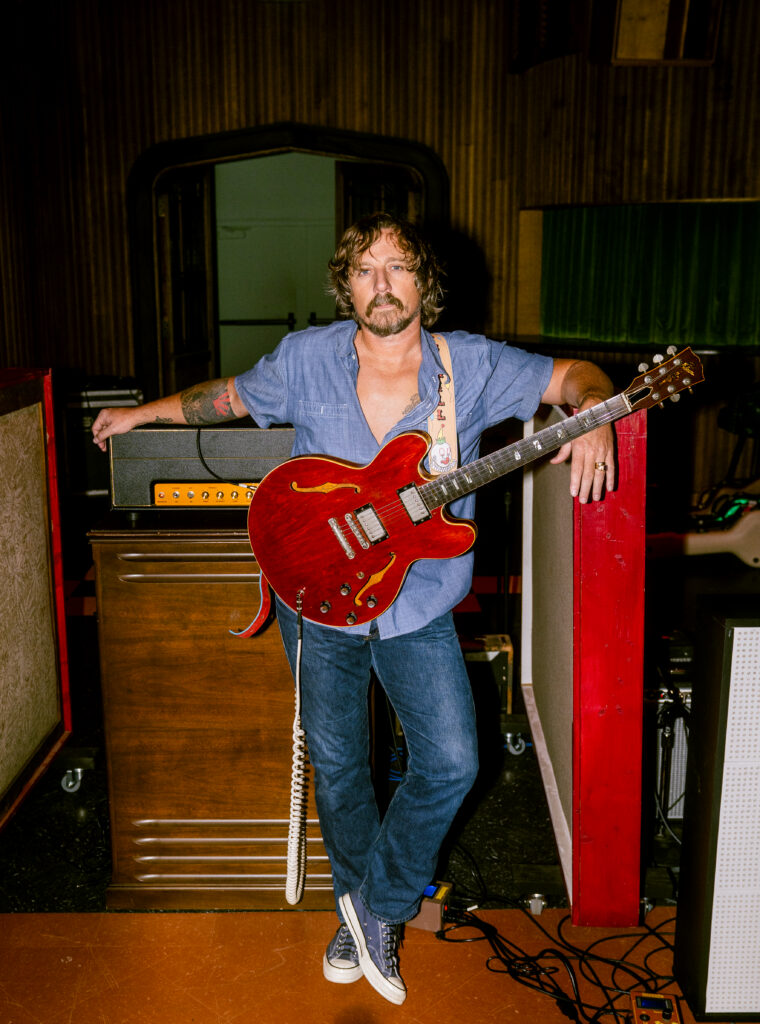
For me, it was always the work. People call me a pretentious, fart-sniffing asshole, but whatever. I take the work pretty seriously, but I don’t take myself seriously. When we’re in the studio, that is the real success: We get to do this again. We just spent two years on the road. Did we get better? What is that microscope going to show you about your abilities and your craft? What have you absorbed and lived in that time, and how are you expressing that?
Not everything has to be a Proustian novel. Sometimes you can just write a song about a girl’s bubbles and fucking. People can be like, “Oh, this is surface-level.” No, man, this is fun. I have suffered and was depressed for a lot of my life, and I am kind of done with feeling that way. We went into the studio with two weeks before a show. We were all like, “We’re here. Let’s come in every day, make a groove, and write a song.” Some days we wrote about civil unrest and civil disobedience, and some days we wrote about fucking, you know?
Again, if we’re not going to burn it all down, we might as well go dance. This country was founded by a bunch of people who burned it all down over a three-pence tax on tea, and now we’re just bitching in the comments section. During Covid, everyone was out in the streets, but it mostly makes me wonder if we were just tired of sitting inside. Did anybody really give a fuck? In the face of what we’re looking at, where is everybody? I have spent a lot of time in Europe in the last couple of years, and the French and the Spanish shut down everything. We’re not going to work. Turn the trains off. The economy stops. We’re about to have a butt-naked fucking party in the streets and dance until you guys listen to us.
Because we’re going to fucking Buc-ee’s. The distraction mechanism works so good, because people like me are entertaining. Movies are coming out, and we’re talking about that shit instead of other things we probably should be talking about. I’m just trying to live above hell, dude, and have a good time with my band. I thought, naively, at one time that I could effect change on the only thing I was connected to—the country music industry. I foolishly thought, “I am going to put this thing out there, and it will move things.” And maybe it did, but I know if it did, the industry would never acknowledge it. Now I’ve just realized that’s not my fight, that I don’t give a fuck. I tell the guys in the band all the time, “We’re not in the music business. We’re in the Johnny Blue Skies & the Dark Clouds business.” We just want to be this little pirate ship, going from island to island.
Oh, no, part of the job is to piss people off. We’re not educators, man. I’m supposed to provoke, even my fans. I want to challenge my fans. I want to troll my fans. They give us shit, and I want to give it right back. You have to wake people up; otherwise, they’ll just sit copacetic in their own stew. I like making music, but most of my career has been based on pissing people off, or at least challenging the quo.
It’s a social commentary record, but you can’t get anybody to listen to that shit, so you have to tell them it’s about fucking. I read The Odyssey four times when I was in the Navy in 1997, and it’s the greatest story ever told. I’ve been writing in nautical metaphors and referencing that story in just about every one of my fucking records. You got to sneak in the gate, man. Sometimes you got to pretend to be a traditional country artist so you can go and make the music you really want to fucking make.
It’s all for me. This is the only place anymore that I feel like I have any right to say anything; otherwise, you’re just soapboxing or virtue-signaling or being some pious kid online. When I hurt my vocal cords and took a break from the business and deleted all my social media, I saw friends still out there trying to stay visible—oh God, we’re a bunch of numbnuts. We’re suckers. If you’ve got something to say and you’re a songwriter, put it in the music. If you can’t say it in that, maybe you’re not that good at it.
When I joined the Navy, my understanding was that I have to get the fuck out of this town, any way I can. I didn’t have any money. I knew I wasn’t going to college. I read all these books, and I wanted to see all these places that I didn’t know how I was going to see otherwise. But, honestly, I love my country, man. I was a wild kid, and I might not have been the most squared-away sailor. But if it came down to it, I would have absolutely died on a ship in the middle of the ocean for the United States of America. I am a patriot.
It’s an idea, in conception, that is worth believing in, worth dying for. People all over the fucking world are dying because they wish they could have that idea. You go other places, and you see how spoiled and entitled and fortunate and privileged we really are. You feel like this place was born for a reason, and it could be gone very easily for an even lesser reason. Somewhere along the line, that arm of tyranny, that sword of colonial oppression, being the good guys and the world police got a little misconstrued and exploited and manipulated by arms manufacturers or petroleum companies—people making money.
I put my nearly 50-year-old body through a three-hour wringer four or five nights a week, then sleep on a bus. You’re like, “Man, I’ve got an hour to go, and I have got to piss so bad right now. But if I just rock harder and sweat more, I won’t have to pee.” It ages you but keeps you young. And singing like that, from the diaphragm, for three hours is a workout from the inside out. I feel tired, but I’m taking much better care of myself physically and emotionally. These last few years, I’ve barely broken a sweat most nights, because I’m in such a relaxed zen flow with it all. I used to sweat so much, because it’s fight-or-flight. I finally got past all that, totally relaxed. It doesn’t feel like effort, but I know we’re working. They used to tell us in the Navy, “Calm is contagious.” So I’m just trying to be still and calm like a cat, then expend energy at the appropriate time.
It was third or fourth grade, and we had pretty good seats, because my dad was a state trooper with connections. I had heard the records, but I had never seen a concert of that magnitude. They just looked like they were having the time of their lives. These guys were just running around, smiling these big ol’ cheesy grins. Alex Van Halen did some crazy drum solo. Eddie played these little guitars on “Spanish Fly” and “Eruption” for his solo set, in some overalls and Chuck Taylors, just cheesing the whole time. I thought, “What could possibly be a cooler thing to do in life than this?” And then I started reading guitar magazines and then reading the wrong books in high school and joined the Navy like a dumbass. Things took a different direction.
But I’m realizing in real time Eddie led me to a lot of other things that led me to a lot of other things, trying to get to the bottom of a bottomless hole. So Eddie Van Halen was probably the most impactful, formative-years musician in my life. So maybe I’ll play “Eruption,” maybe some “Ice Cream Man.” God, I love all those records. That shit’s so badass. But that’s where the Cats play, dude. That’s a big deal for me.