Your bag is empty.
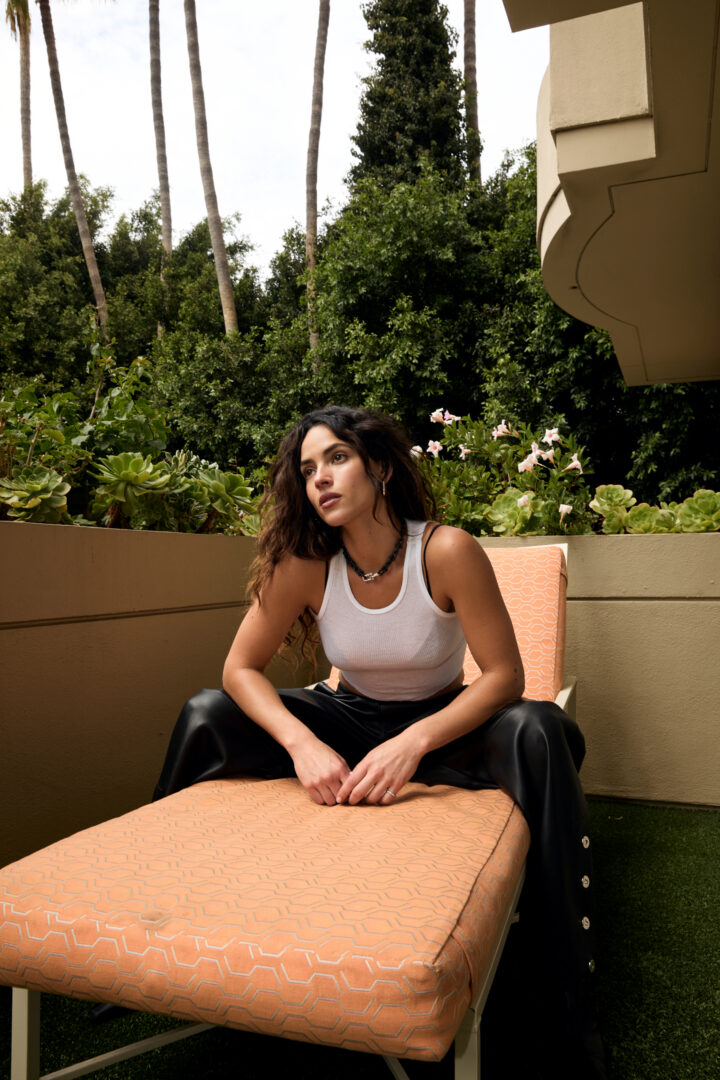
The Spanish singer on "dangerous" beauty standards, sexual freedom versus emotional freedom, and why she'll never wear a kitten heel.

For Alba Farelo, the Spanish singer and songwriter, the fierce sexiness of Bad Gyal comes naturally. While studying fashion in Barcelona in 2016, she caught the internet’s attention with a Catalan take on Rihanna’s “Work.” What started as a DIY experiment quickly turned into something much bigger, with Bad Gyal building a career rooted in reggaetón, dancehall and electronic music.
A string of hits followed, including “Fiebre” and the powerhouse “Chulo Pt. 2” alongside Tokischa and Young Miko, plus collaborations with artists like Karol G and Omar Courtz. With the release of her album Más Cara in March, Bad Gyal found herself commanding global attention. Fashion has remained central to her identity, and she has also increasingly used her platform to support humanitarian causes.
In other words, Bad Gyal is the rare kind of baddie who can talk reggaetón, body image, creative direction and kitten heels with equal authority. We spoke to her in the middle of New York Fashion Week, while getting fitted for the Tommy Hilfiger show.
I think both of them have that confidence. At the end of the day, both Bad Gyal and Alba are human. I always say that without Alba, Bad Gyal wouldn’t exist, and Bad Gyal is a part of Alba. Obviously, I’m human, and like everyone else I have insecurities. I have my highs and my lows. But I do consider myself someone who had to do a lot of work on my self-confidence and self-love in order to start building my own vision and career. As a woman, in order to defend your own proposal, allow yourself to explore, work on what you love and really be free in that, I think you have to work on your confidence in yourself.
It definitely affects you. Feeling observed makes you much more sensitive to how you’re perceived in a way that maybe you wouldn’t experience if you weren’t so exposed. You become aware that people are watching you and people have opinions. I think it’s about balance. You have to maintain your own clear vision and know what you want to communicate when you speak or express yourself through your art, and try to put that feeling of constantly being watched to the side. It’s not easy, but it’s about finding that balance.
Probably that I’m this really crazy party girl. Obviously, I love dancing, I love the club, I love music and I enjoy going out. But I think I project an image that’s much crazier than I actually am. In reality, I’m a calmer girl. I have a pretty introverted side too. If you only look at my project and the character of Bad Gyal, you probably wouldn’t assume that I have that more low key side.
Mostly spending time at home. When I have free time, I really value being in my city, being at home and just having a normal day. Having time to walk around, train, cook. I really enjoy my work and all the experiences and travel that come with it, but when I have time off, I really enjoy everyday life.
I work with a trainer, which really helps because my life changes depending on what I’m doing. If I’m touring or rehearsing heavily, that’s completely different from being at Fashion Week or being in the studio. My body goes through different periods of more activity, less activity, more rest, less rest. If I’m touring, I sleep less. It’s good to have someone who adapts the training to where I am and what my body needs.
With food, I prioritize a lot of protein, simple carbohydrates, vegetables and fruit. But I actually eat a lot. People see someone who looks fit or slim and assume you have to barely eat to look like that, but that’s not true for me at all. I need food because it’s my fuel for training and for getting through workdays and shows. I eat very clean and take care of my diet, but I make sure I’m eating everything my body needs.
Right now, my normal meal is extremely simple: ground beef or ground chicken with eggs. I don’t overcook the eggs because I like them creamy. Then I’ll have sweet potato, or sometimes avocado, and basically make myself a homemade bowl. For a cheat meal, pasta. Whatever type of pasta I’m craving. Or really good bread with olive oil. Or pa amb tomàquet, since I’m Catalan. You rub tomato into the bread with olive oil. It’s a very Catalan thing, and everyone I know who isn’t Catalan and tries it falls in love with it. I could eat pa amb tomàquet all cheat day.
It’s a big challenge. Being a woman in the music industry, or really any industry where you’re exposed, you’re constantly judged. There’s a lot of pressure. I think women should be completely free to do whatever they want with their bodies and make whatever decisions they want. At the same time, I feel like the industry is moving more and more toward surgery and toward these artificial beauty standards that aren’t naturally achievable. I find that a little dangerous because young girls don’t have as many women to look up to who haven’t felt like they needed to change something about themselves. The industry keeps moving toward more perfection, more impossible beauty standards, more surgeries, more fitness, more everything.
When you’re exposed, you have to work a lot on your mental health. That’s something I’m actively trying to do because I want to sustain my mental health while continuing to do what I love and build my career. I’m not going to lie and say being a woman in the industry right now is easy. The expectations are getting crazy.
I understand that it’s my best work so far, and that feels very rewarding. While you’re making something, maybe you aren’t completely aware of that. But I feel like the album was at the level of the woman I had become and the songwriter and artist I had become. It feels good to see people receive something you put so much effort into and to see in real life that you were at the level you wanted to be. Right before you release something, there’s always some doubt. During the actual process of making it, I felt very secure. I felt like, “I know what I’m doing. I’m happy with what I’m doing.” But in that final phase before release, I had a little bit of doubt. Seeing people enjoy it really helped me.
One hundred percent. Whenever I’ve done things to please other people, it hasn’t worked for me. It’s impossible to please everyone. There is always going to be someone who isn’t aligned with what you’re doing or simply doesn’t like it. That’s actually something I don’t struggle with too much. I do things the way I like them.
For me, it has always felt very natural. From very early on, that attitude, that role, that energy was something I always felt very comfortable embodying. I never saw myself as submissive or weak. Even when I was a kid, I was very bossy. I was a leader. I was like, “I want this this way, and you’re going to do it the way I want it.” From childhood to being a teenager to becoming a woman, that’s simply the way I see life and approach everything. It has always been part of me.
I’ve struggled much more with being emotionally vulnerable. Sharing my feelings, or showing the people I love when I’m in a weaker place, when I’m unsure of myself or struggling, that has been difficult for me. Compared to that, being sexually free is much easier.
Confidence. And being kind, or simply nice. Not fake nice. Just someone who’s chill. Someone who isn’t putting on this pose where everything is stiff and they’re trying to prove, “I’m the coolest.” I also find it attractive when someone has something unique and different about them, when they bring their own character and personality to the table. Nowadays, I feel like everybody wants to be the same. That’s a little boring to me. That isn’t sexy.
Completely different. I actually think being desired is extremely overrated. I don’t think being desired is that big of a deal. Especially as a woman, if we’re talking about being desired by men, I don’t think that’s a flex at all. Men are very weak. Feeling desirable is different because I think that comes more from self-love. Maybe you’ve done certain things that put you in that mood—things that are good for you and good for your self-esteem. That matters much more.
Surround yourself with the right girlfriends. I hear all kinds of crazy stories and I’m like, “What?” I’ve never had those kinds of issues with my girls. Having that sisterhood, having a group of women you can really trust, where you uplift one another and everyone is genuinely good hearted, that’s definitely going to help you feel more confident, happier and more blessed.
I think it has given me a much wider vision. It gives me many more possibilities and allows me to be freer in how I express myself through clothing instead of being tied to something very specific, to where I come from or whatever trends were happening on the streets where I used to hang out. I’ve been able to see so many shows and collections, work with stylists and do so many shoots. It has given me more tools to express whatever I want and to allow my own personality and character to evolve. That’s one of the beautiful things about life: evolving and trying new things. But I think I’ve always preserved my identity. That never leaves.
It’s not that I don’t want to see it. It’s just not for me. Kitten heels. The little heel? No. I need a high heel. I need a Louboutin. I need a red bottom. I need Giuseppe Zanotti. I need the bad bitch heel because I’m short.
I do that a lot. I have stage outfits that were custom made for me, and eventually I’ll end up using a piece for a night out, a date night, dinner or the club. I keep using my clothes. I’ve also been incredibly lucky to have custom pieces from brands that I really love. I love reusing them over and over.
Like a creative director. The musician part is already done. The music is there. I just need to be in charge of the technical side and decide how I want everything to sound. But when you’re creating the live show, I go much more into the creative director side. That’s what you need to make the show solid. To make sure all the elements work together and are aligned with the concept, the album, the music and what you’re representing during that phase and that era.
I have my days. There are days where I’m really into it, and then there are other days where I’d rather stay at the hotel and watch a movie. It depends on my mood. And I’m a woman, so I think something that isn’t talked about enough in the press is that women go through hormonal cycles. That has a lot to do with how you feel and whether you want to be seen or not. But naturally, I am someone who enjoys it. I like playing dress up. I like getting dressed, doing the glam, the hair and the makeup. Most of the time, I do enjoy it. Then I like seeing how the pictures turned out and what my fans thought about the look. It’s fun. At the end of the day, I’m an artist. I do this because I like doing it and because I enjoy it.
I think people in the community still have to be incredibly strong. It’s unfair, but even today they have to be strong in order to fully be themselves. Of course we’ve evolved, but we’re still not where we should be. People from the community have to have that strength, and I think when they see Bad Gyal, a woman who presents herself as strong and powerful, they connect with that energy because that’s exactly what they are.