Your bag is empty.
From Shondaland to the stage, Anna Deavere Smith is delivering some of the most vital performances of our time. Her weapon of choice: an ear for American voices
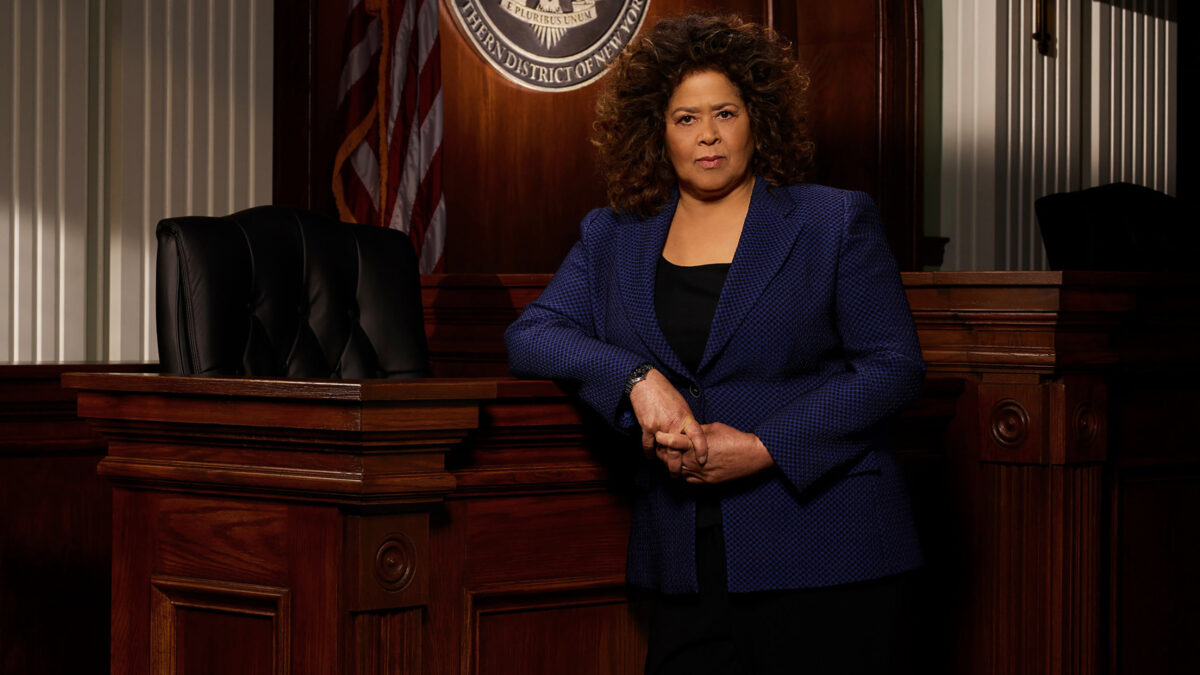
It’s a crisp March afternoon, and Anna Deavere Smith is two pages into a biography of Ella Fitzgerald. “I can’t sing,” she says, “so I’m interested in singers.” I’ve just joined her at a restaurant in the Beverly Hills Hotel, and already the 67-year-old playwright and performer has flashed the self-effacement and avid curiosity that guides her work. Her latest, Notes From the Field, is a one-woman show about the pattern of funneling underprivileged schoolchildren straight into juvenile hall, also known as the school-to-prison pipeline. The show, which ran off Broadway for two months in 2016, debuted on HBO in February. A month later, she reappeared as steely clerk Tina Krissman on Shonda Rhimes’s new legal drama For the People.
With a CV that stretches back to the early 1970s, Smith has dished out Sorkinian tongue-twisters as National Security Advisor Nancy McNally on The West Wing, gone head-to-head with pill-popping Edie Falco on Nurse Jackie and played Tracee Ellis Ross’s crunchy mom on Black-ish. Since 1992 she has been crafting and performing one-woman shows that probe some of America’s most polarizing crises. Fires in the Mirror, her Pulitzer-nominated debut, investigated the racial tensions between Black and Orthodox Jewish residents of a Brooklyn neighborhood. She was later commissioned by the Mark Taper Forum in Los Angeles to create Twilight: Los Angeles, 1992, a sweeping look at the riots that followed the acquittal of LAPD officers charged with beating Rodney King. With Notes From the Field, her initial goal was to investigate racism and poverty in her hometown of Baltimore. In each case, what makes Smith’s shows so effective is her commitment to inhabiting other lives in a way that theater is uniquely equipped to facilitate: “I’m taking a tape recorder, going around and seeing if I can get over any kind of limitations of my race, my gender and my age in order to experience America from the point of view of people very different from me.
Smith interviews upward of a few hundred people per project, developing what she says is more a “tapestry” than a conventional story line. The resulting work goes far beyond the sum of its parts. Minimal costuming and props (glasses and hoodies, cell phones and coffee mugs) mark obvious physical differences, but it’s Smith’s granular study of voice that brings each character roaring to life. No slang goes unuttered; no vocal cadence isn’t hers to master. Therein lies the power of her work: “My grandfather, when I was a child, said, ‘If you say a word often enough, it becomes you.’ And so I’ve really been trying to become America, word for word.”
I’ve been really trying to become America, word for word.
Smith became interested in the potency of speech—”how Shakespeare’s language could deliver not just content but identity”—during her training at the American Conservatory Theater in San Francisco. “I started studying everything I could that had to do with expression of language,” she says, “anything that required a speaker to not just give information but to influence and sway the audience.” Political rhetoric became a pillar of her studies, particularly recordings of Fidel Castro, Che Guevara and JFK. Politicians informed her third one-woman play, House Arrest, a non-narrative show about the U.S. presidency, which she researched in part by going on the road with both Bill Clinton and Bob Dole during the 1996 presidential campaign. (Presidents have become something of a regular feature in Smith’s life: In 2013 she received a National Humanities Medal from Barack Obama.)
For Notes From the Field she interviewed more than 250 subjects to unpack how troubled students, particularly young people of color and indigenous heritage and in areas of poverty, go from acting up in class to getting trapped in America’s carceral state. Smith consulted everyone from Sherrilyn Ifill, president and director-counsel of the NAACP Legal Defense and Educational Fund, to Niya Kenny, the Spring Valley High student who filmed a female classmate being dragged out of her chair by an on-campus cop. Nearly all the monologues share a sense that disadvantaged students are by and large denied the understanding and complexity enjoyed by their more mainstream peers. What started as a project about law enforcement in her hometown became an opportunity to examine the whole country—a country hobbled by prejudice so deep that it’s become reflexive.
So why, with a message that urgent, would an artist of Smith’s soaring ambition choose theater?
“When I was younger I was like, ‘I cannot just wait around for them to put me in the Glamorama,’ she says, referring to her short-lived stint on All My Children and the salon on that show. “‘I’d better spend my time figuring out how to practice this craft that I care about, or this is gonna be bad.’ I always sort of regret that I didn’t try to make my career in television bigger, for a lot of reasons: influence, a bigger platform. But I’m not a TV Warrior.”
She has a lot of respect for her For the People co-stars such as Hope Davis, but she’s particularly mesmerized by the power of television writers, especially the ones she has encountered in Shondaland. “I think Shonda is a historic phenomenon,” she says. “I don’t think there has ever been a Black woman with the type of influence she has.”
The growing access Black women have to public creative outlets is a recurring theme in our conversation. She perks up at the mention of Insecure creator and star Issa Rae and suggests that if Toni Morrison were starting out now she would dominate prestige drama television. Even at the beginning of 2018, we are in a remarkably fertile moment for Black women of all stripes expressing themselves in public: Master of None‘s Lena Waithe debuted her hour-long drama The Chi in January; books such as Ijeoma Oluo’s So You Want to Talk About Race and Brittney Cooper’s Eloquent Rage offer new-and accessible—perspectives on Black lives.
But the stories about young Black girls in Notes From the Field show just how much further we have to go. Once again, it comes down to language. “There’s a cop that says it best,” Smith says while describing the 2015 incident at a pool party in McKinney, Texas, during which a Black teenage girl dressed only in a bikini was thrown to the ground and restrained by a police officer. “He walks over to that group of girls and says, ‘If you don’t stop running your mouth….’ That’s the thing I have always felt anxious about as a Black woman.”
Smith watched the video many times that summer. To her, it represented more than just police brutality; it was a visual testimony that being Black and female means you’re not allowed to be three-dimensional, carefree, messy and young. “It’s one thing if a Black woman is saying words from a script in a movie or television show,” she says. “But if it’s the words coming out of your own mouth? You’d really better watch yourself.”
Against that constant threat, Smith has found a way to confront an unjust world in its own language. Her recent successes, spanning theater, cable and prime-time broadcast TV, suggest that the world might finally be ready to listen.