Your bag is empty.

The country’s first fine-dining cannabis restaurant is sure to light up Los Angeles. But will the activism that Chef Andrea Drummer infuses into every bite transform the industry?
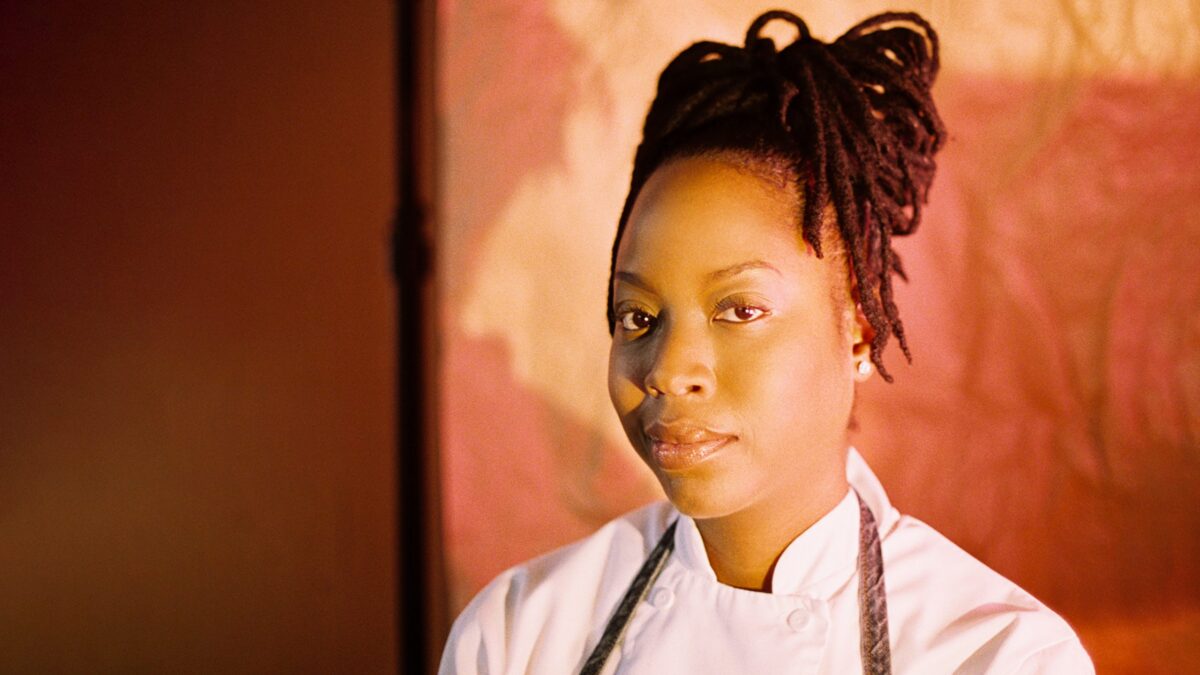
Chef Andrea Drummer puts the final touches on a fried-chicken sandwich while her sous-chef flits around the kitchen, popping ingredients into the fryer. “This brine is nice,” Drummer says, taking a bite of a pickle. “But see this?” She pokes at the bread collapsing under the weight of coleslaw and the hunk of meat. “This should never happen.” She turns to me and sighs. “This sandwich needs more work.”
It’s a scene like countless others in the tense, giddy lead-up to a restaurant’s opening night—but the establishment in this case is Lowell Farms: A Cannabis Café, the first legal cannabis restaurant in the United States. “It’s intimidating,” the 47-year-old chef confesses.
In the stuffy kitchen of the under-construction site in West Hollywood, California, Drummer has been experimenting all week in preparation for the fall opening. Despite the pressure, she appears calm and focused as she stands by the stove in a dark denim apron, a red bandanna holding her hair and beaded bracelets decorating her wrists.
“There are a lot of eyes on me,” Drummer says softly over the din of carpenters and kitchen fans. “I want to do right by everyone.”
Advocacy and cannabis— they go hand in hand.
The restaurant, co-owned by cannabis cultivators Lowell Herb Co., marks a shift in an industry hoping to appeal to a market that includes college kids as well as their parents and grandparents—and an industry with a long history of racial tensions and high incarceration rates. Eleven states have legalized recreational marijuana use since 2012, and though the industry raked in a total of $10.4 billion in 2018 and is projected to be worth $32 billion globally by 2022, there’s still plenty of room for social integration. And that’s just what this fine-dining experience offers.
Residents of those 11 states may be open to cannabis consumption but turned off by the common perception of legal bud culture: going to a dispensary where young stoners present you with overpriced pre-rolls; returning home to sit in front of your television and giggle for no reason. But “we all eat,” Drummer notes. “I think it’s important to engage with cannabis the same way a person does when they go out for martinis.” The Lowell café will not serve alcohol, so the restaurant will be a pioneering experiment in which cannabis is the main social lubricant—testing Drummer’s theory that sharing a meal and getting high are both communal experiences that have the power to help people connect.
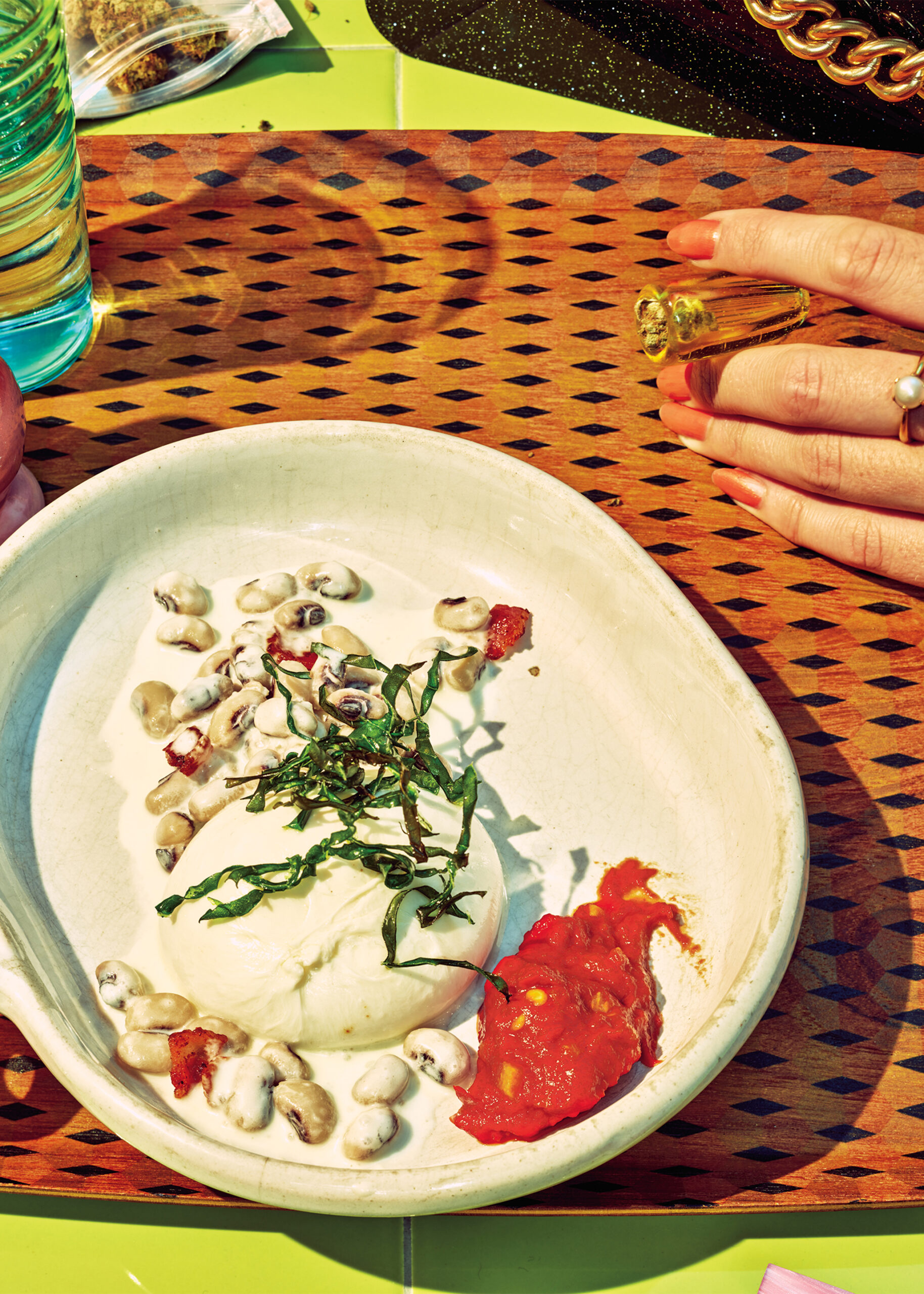
When the eatery opens this fall, cannabis sommeliers will tend to each dining party to suggest food and strain pairings based on individual preferences. Diners will then have the option of enjoying joints or vaporizers before and during their meal. “We’re trying to focus on the idea that it’s going to be approachable for many different people, so the entire place will have overgrown living walls—very aromatic, very lush,” says restaurant director Kevin Brady, who goes on to praise Drummer’s attention to detail and longtime contributions to the Lowell brand. “Andrea has been partnered with Lowell from the beginning, when we petitioned the city for a license [in 2016],” he says.

Drummer carefully considers how each strain pairs with a given dish. “I think of the cannabis as I would rosemary or mint—the flavor profile, the notes, if the strain is more pungent or more mild,” she says. “It’s very farm-to-table in every respect, with our food and with the bud.” She goes on to explain how she’ll create dishes to complement both the flavors and the psychoactive effects of whatever strain is “in season.” Blue Dream, for example, pairs well with sweet and savory dishes alike due to its mild flavor and notes of blueberry. Drummer adds that the strain elicits an uplifting high that you might associate with dessert, so she’s thinking about pairing it with cereal-milk ice cream sandwiches. She’s also creating dishes with stronger flavors: “When you consume cannabis, your senses are heightened, so the food’s flavor profile is very forward. It’s not a muted palate.”
Drummer views the Lowell café as her opportunity to elevate cannabis-food pairing into a culinary art—and to eventually bring cannabis-infused concoctions to the menu. The café had initially planned to serve Drummer’s gourmet edibles, but current laws forced the company to pivot. “The state legislature is still formulating its policy around cannabis infusions. It’s unclear, and we’d rather take the conservative approach,” Brady says, noting that prepackaged edibles will be available for purchase. “We’re still working to figure out what those next steps look like.”

While the market for legal edibles—think gummies and brownies—has more than doubled since 2011, the products are extremely difficult to regulate. Dosages are unpredictable, and potential toxins have reportedly come up as a result of extraction technology. Meanwhile, the underground cannabis dinner events that continue to appear throughout the country come with problems of their own: A seat at the table can cost more than $100, and the addition of cannabis can feel like a profit-grubbing afterthought. Still, Drummer notes, compared with the combination of alcohol and food, “cannabis is kinder” if it’s done right. When she cooks with cannabis, she often finds herself listening from the kitchen for a shift in tone once the effects hit her diners. “I hear the cadence go up in such a beautiful way,” she says. “It’s like a symphony.”
It’s a lot of pressure, but what’s the alternative?
But even Drummer had to be convinced of the powers of the bud. “I grew up in the South, where there are certain things you don’t talk about, and that influenced the direction of my career initially,” she says. Raised in a strict Baptist family in Fort Lauderdale, Florida, she was fascinated with food from an early age but thought everyone who indulged in cannabis was lazy. Ironically, she worked as a “very anti-cannabis” drug counselor from 1997 until 2005. It wasn’t until she moved to California in late 2007 that her mind changed: Drummer found herself working for a weed-friendly attorney who proved that people who partake can be successful. When she later suffered from sciatica, the near-instant back relief cannabis offered meant she could pursue her passion as a professional chef. In 2009 she enrolled at Le Cordon Bleu College of Culinary Arts in Pasadena, and by 2012 she’d founded her cannabis dinner service, Elevation VIP Cooperative. “It liberated me,” she says of her career pivot.
The Lowell Herb Co. team met Drummer at an event in 2016. The brand was impressed by Drummer’s experience under celebrity chefs such as Thomas Keller of the French Laundry. Her work as an outspoken cannabis advocate sealed the deal. “Advocacy and cannabis—they go hand in hand,” Drummer says. During our conversation over the hot (and getting hotter) stove, she points to the company’s social-equity programs, such as last year’s billboards in downtown Los Angeles that advertised jobs for nonviolent cannabis offenders.
“What was important to me was the team they assembled and how diverse it was,” said Drummer at a UCLA “Being Black in Cannabis” panel in February, citing the company’s hiring practices. “They didn’t just offer me a job,” she added. “They offered me a partnership.”
Drummer’s visibility as a black female chef matters. Since starting Elevation VIP she has worked her way to the top, including landing an appearance as a competitor on Netflix’s cannabis cooking show Cooking on High in 2018. Her name has appeared on lists of America’s top cannabis chefs, which is how her sous-chef, Rochelle Tyler, discovered her. “I was like, ‘Oh, that’s so cool, a black woman on the list,’ ” says Tyler, also a woman of color, who started working for Drummer after an introduction from a mutual friend. “She’s always speaking up for people like us.”
More than 80 percent of legal cannabis companies are under white ownership, while only about four percent are owned by black people. At the same time, cannabis arrests are rising in the U.S. On average, blacks are almost four times more likely to be arrested for cannabis than their white counterparts, despite roughly equal use. There is, however, a chance for cannabis legalization to be informed by social justice, if the people in power keep these disparities in mind. The House Judiciary Subcommittee on Crime, Terrorism, and Homeland Security held its first hearing in July 2019 to discuss social equity in the industry—an early step toward mending prohibition’s damage and aiding communities disproportionately harmed by the drug war.
“If you’re in this industry and blind to the fact that a great number of black and brown people are incarcerated for doing the very thing we have the freedom to earn a living from, I would say shame on you,” Drummer says. The chef describes her vision of diversity-minded hiring practices: “I want to change the landscape of who we see in the industry. I would love for anyone who has been exonerated of a nonviolent cannabis crime to come and work in the kitchen.”

It has been two hours since I arrived, and I’m starting to feel a little claustrophobic. But Drummer is still engrossed in food prep, now tinkering with the ice cream sandwiches. I pack up my things and make my way to the door, stopping to wish her luck. She grasps my hand and looks me in the eye. “I’m so scared,” she says in a low voice. “It’s a lot of pressure, but what’s the alternative? Sitting around and not being able to change the narrative? Not being able to hire people to be a part of this industry? Not having learned anything?”
She shakes her head. “So I’ll take it,” she says. “I’ll do the work so someone else doesn’t have to.”