
Your bag is empty.

Will leaving a big-studio gig to follow his passion and create a new type of gameplay pay off?

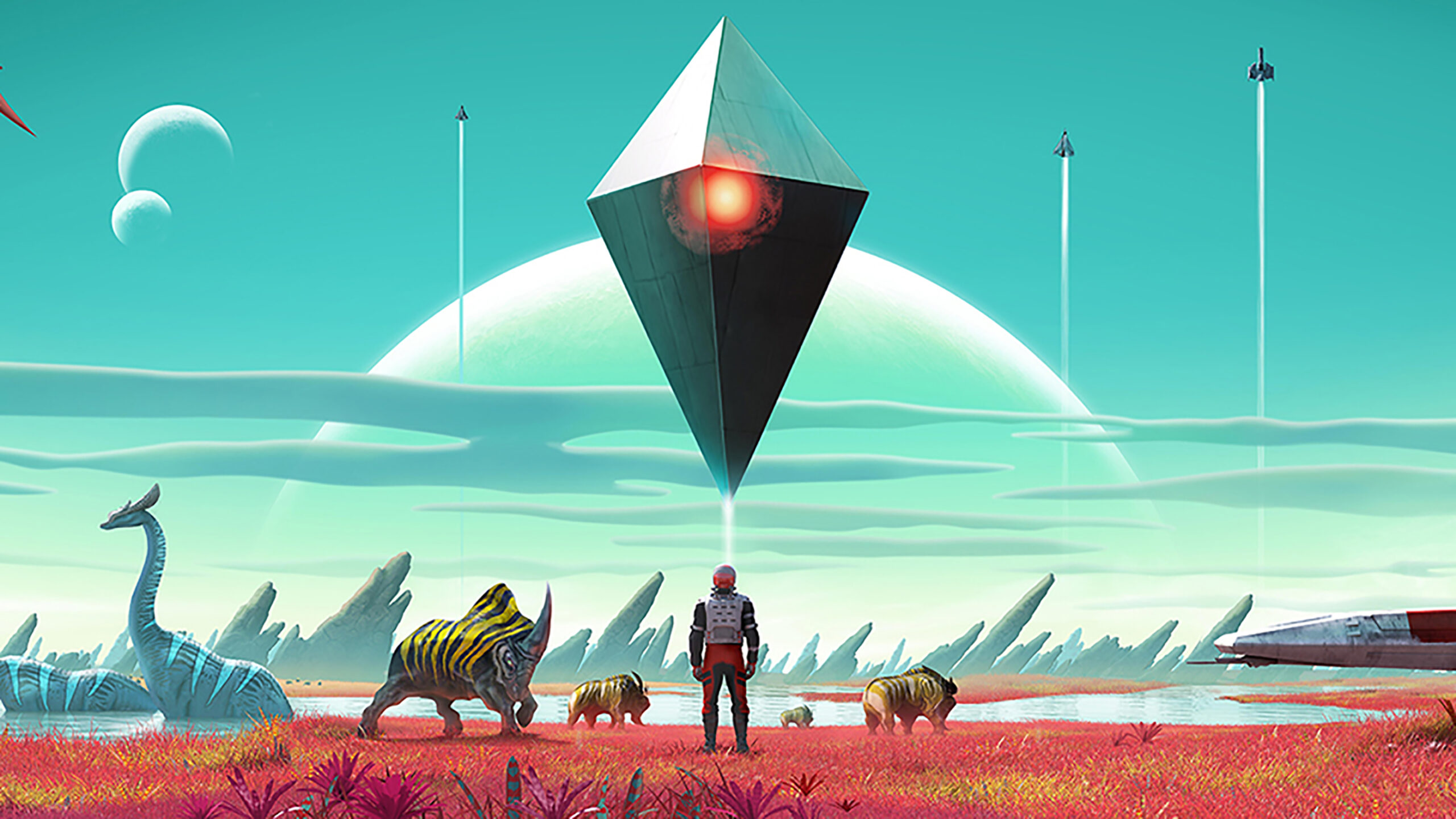
Everyone dreams of being an astronaut; Sean Murray made a game that lets you play one. This summer, the 36-year-old’s company, Hello Games, released one of the most ambitious video games in recent history: No Man’s Sky. The gorgeous sci-fi adventure allows players to explore more than 18 quintillion planets—yes, quintillion—thanks to clever environment-generation technology. Travel to massive worlds suffused with rich colors and teeming with alien creatures—then dodge galactic cops in your spacecraft.
The Ireland-born, Australian outback–raised Murray created his first game when he was just five. “My parents always joke that this is all I ever wanted to do,” he says.
Murray founded Hello Games in 2008 with three friends after quitting his job at Criterion, a big studio that got bought by EA, an even bigger studio. Sick of slaving away on blockbusters such as the Burnout series, he wanted to flex his creative muscles. Today that’s not a unique origin story for an independent game developer, but back then, in the days before the Apple App Store, it was.
“We were some of the first people to do that,” he says. “In our minds, it wasn’t some path to success. It was more like, I can’t work here anymore, and I need to go do something different.”
No Man’s Sky, the third release from Hello Games, launched in August after three years of feverish buildup among gamers obsessed with the promise of endless exploration. It’s a high-water mark for video games—and like a true artist, that’s all Murray really cares about.
I am always nervous and terrified about people getting hyped about our game.
PLAYBOY spoke with Murray just before the U.S. launch of No Man’s Sky; here’s what he had to say about setting out to make an impact, dealing with fan backlash and exactly what makes Hello Games successful.
PLAYBOY: You set out to make something that you felt would have a greater impact than your earlier games.
MURRAY: Yes. This is hard to describe: You’re having this kind of midlife crisis, and you’re not actually thinking, “Oh my God, this is going to blow people away.” What you’re thinking is like, “I don’t know whether I’m a good programmer. I don’t know whether I would actually be capable of doing something like really different.” You know, it’s like challenging yourself. I wasn’t thinking, “This will be some crazy like commercial success” or “This will be some big hit with people.” I was thinking, “I want to do something really cool that I’m excited about,” you know? And that was what drove it.
We actually, when three of us, the three others joined me and we like sat in that room, the pitch to everyone was like: We have just spent a few years making Joe Danger and we made some money from that, and we have to take that money and get it out of us—like do something crazy and burn through this and not worry about ever having commercial success or whatever. Let’s just do something that we really enjoy for the next year and see what we get to.
PLAYBOY: I don’t know how often you go on the subreddit—hopefully not that often because those people are crazy. I think anything that builds to this level, it’s inevitable that there is going to be some backlash, and No Man’s Sky is no exception. How do you guys deal with that aspect of it?
MURRAY: [Laughs] Yeah, it’s a tough one. There’s a thing in video games, I think more than any medium, where this is excitement, and excitement’s really good, but for some reason, for some people, that turns into hype, which is a kind of an unrealistic, intangible level of excitement kind of thing where it’s unattainable. I am always nervous and terrified about people getting hyped about our game. I definitely have always tried to just show great gameplay, stand on stage at E3 and just play the game and be reasonably open and honest about what the game is or what we’re doing, you know, and be open as a studio. And when the game comes out, yeah, there will inevitably be a backlash of some sort, because some people have been waiting for like three years! And it’s actually really hard to wait for anything for three years and feel like justified. You want it to be perfect, you know?
And you’ll have seen that around lots of good games. Destiny had loads of hype around it, and then it was actually when it came out it mildly disappointed people, which I really didn’t understand. But two years later, I’m still playing Destiny and all my friends are still playing Destiny. It does happen, you know, and it’s kind of an unfortunate side effect of the fact that people who like video games fucking love video games, you know?
PLAYBOY: You weather whatever comes and then the people who are still around are the ones who like it, right? So you get that positive community ultimately.
MURRAY: Right. There is that for sure, but there’s also a thing—and this is really weird. Nobody on Reddit will understand this, or on Neogaf or any of those places, right, but we do play tests every now and then where it’ll all be anonymous and it’ll be NDA’d and we will get people in to play our game. And it will just be like, 20 people at random from people who are buying games at game stores. We just pick people at random and get them in to play the game. Of those 20 people we will be lucky if one of them has heard of No Man’s Sky, and that’s happened like, time and time again.
And everyone forgets that. No one realizes that the majority of people who buy games, they don’t necessarily go on game websites, and the thing that is amazing for me is to watch these people play the game, and they play for three hours, say, and they think they’re playing what in their mind is a sort of survival sandbox game where they’re trying to repair a spaceship, and they do that, and then they get in that spaceship, and they take off from that planet. And they were never expecting that to happen. It blows their mind! [laughs] And there’s that priceless reaction where they’re turning each other around like, “What’s going on?!” We make the game for them as much as for anyone, you know?
PLAYBOY: If you were going to try to be less humble, what would you say that you guys have done to get you here?
MURRAY: We just put aside being afraid of failing, I think. At every point, when we had to make a decision, we would talk about that decision and somebody would point out something being risky or having not been done before or being problematic, and it’s become almost a joke within the group: As soon as somebody points that out, that is the thing we’re going to go and do. As soon as somebody says, “We can’t possibly get it ready for that date,” it’s like, “Oh no. Well, you’ve said it now. The challenge has been laid down and now we have to do that.” [laughs]
And I know that sounds cheesy, but that is–we had already achieved like I would say mild success [with Joe Danger], and it just felt kind of empty and kind of like a failure. And we were like, I would rather kind of be an actual proper failure or properly do something different than how this feels right now. I don’t want this to be our normality.
PLAYBOY: You didn’t think you’d peaked.
MURRAY: Yeah, like I thought—I can tell you what I thought. When I was a kid, what made me want to get into games was reading about a guy called John Carmack, who worked at id, who’d done Quake and stuff like that. And I like, I saw him as like a great programmer, right? And it would have been my dream to work in games, but I hadn’t thought I’d be good enough to do that; I thought it was only for like, for gods like John Carmack, you know? I didn’t even apply for jobs for ages. And then I did, and I got a job, and I felt like an impostor. “I’m not good enough to work here,” or whatever. And then as I did, I felt like I fit in OK kind of thing. But I just felt like, “I don’t feel like I’ve done anything.” I’d worked on a bunch of games and they’ve done alright and stuff like that, but it didn’t feel like I’d done anything really impactful or really worthwhile. You reach that point where you question whether you were ever going to do anything like that, you know?
PLAYBOY: So what is the next goal?
MURRAY: I know this sounds weird again, but we’d have made this game because we have been—and this is the thing most people don’t realize, because we’ve self-funded it. I think most people would assume that because No Man’s Sky is a thing that most people know about, I guess, or that some, within the gaming industry people know about, you would assume that Hello Games is already in some way “well off” or well-funded or has grown. We haven’t! We’re still really small, we’re self-funded, and we’re really constrained.
There’s so many things that have been positive that have come from that, because we’ve had to make really clever decisions, but there’s so many things where you’re like [sighing] you know, I wish we could have done this, this or this to a way higher standard. And there is a shot, if the community doesn’t go too crazy when it comes out, that hopefully we’re going to be able to work with them and talk to them, and everyone’s going to keep their heads and we’re going to continue to update the game and make it approach the higher standard that I’d really like.
But like, aside from that, what’s going on in the back of my head is if we weren’t on this shoestring budget, if we weren’t this tiny, tiny super constrained team, if we just had a little bit more, just let me show you what we could do. Every other studio with like 400 people, and just like, 12 or 15 of us. For every one of us, they have our whole team size again. And like if we only had half of that, if we had a quarter, an eighth, there’s so many cool things we could have done.
PLAYBOY: Do you have a call to action for fans or players or anyone reading this? What would you say to people? What can they do?
MURRAY: We all just play and buy the same kind of triple-A first-person shooter every year or whatever, and that’s cool, you know, that should exist for sure. But there’s so much more that games can be than that, and there’s so much more to get excited about. And right now publishers think that that is all that people want, and they think that the average player is actually like probably not the most refined and intelligent and well-rounded person. But I actually think, when I get to game shows, there’s people from wide backgrounds who are really interesting. And them getting excited about things that are a bit different—that is the most powerful thing in the games industry.
PLAYBOY: Yeah, more of that. More No Man’s Sky.
MURRAY: [Laughs] No Man’s Sky 2, here we come.
PLAYBOY’s 2016 Renegades: The men and women in this series will change how you think about business, music, porn, comedy, gaming and more. They’ve risked it all—even their lives—to do what they love, showing us what can be accomplished if we break the rules. Meet the Renegades: Paul Beatty, Ali Wong, Laura Jane Grace, Sean Murray, Noor Tagouri, Stoya and Jason Dill.