Your bag is empty.
An all too plausible future-shock scenario, featuring the shrinking, struggling Democratic field
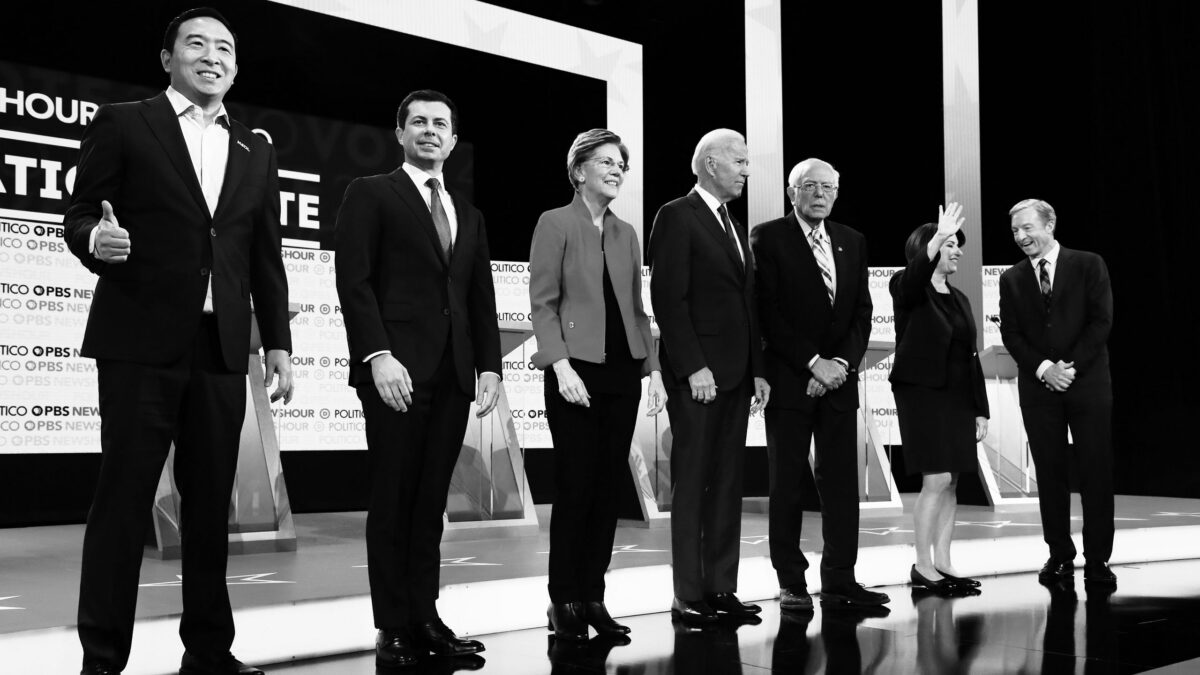
Last December, at the year’s final Democratic debate, a ray of hope finally shone down on the candidates trying to defeat Donald Trump this November.
Just a week before Christmas, a relatively small group of Democratics showed up at the Loyola Marymount campus in Los Angeles, and for the first time all year none of them bellyflopped.
They did, of course, take shots at each other. Mayor Pete Buttigieg found himself on the receiving end of a lot of criticism about a wine-cave fundraiser. The best one-liner of the evening came from Andrew Yang. “If you get too many men alone and leave us alone for a while, we kind of become morons,” he said as he condemned politics for its misogyny.
Bernie Sanders bemoaned income disparity—“worse than any time since the 1920s”—and our “existential crisis” as we try to take on the billionaire class.
Amy Klobuchar attacked Trump for standing “with dictators over innocents.”
Vice President Joe Biden assured voters that things will return to normal after the 2020 election.
Elizabeth Warren, while backtracking on her universal healthcare plans, spoke eloquently about the “hollowed out” state of the nation’s middle class.
Democrats still fail to grasp the forces that swept Trump into office in 2016 and may keep him there for a second term.
And Yang, acknowledging he was the only person of color on the debate stage, encouraged opportunities for everyone in the democratic process and said he looked forward to his friend Cory Booker rejoining him in the debates.
For a brief moment, Hollywood was the home of hope for Democrats who wish to unseat Trump.
The other debates were not so hopeful.
Shortly after Kamala Harris announced, in early December, she was ending her bid, a brief sigh could be heard among those at President Donald Trump’s re-election campaign. No one there ever thought she was a serious contender to challenge the president, but she was the type of candidate some in Trump’s campaign feared. She is a woman of color, and she could kick Trump’s ass on the debate stage.
Her bold nature, however, failed to catch on with Democratic voters, as did some of her themes of unity. Meanwhile, there have been endless moments of hand-wringing and nailbiting in and outside of the Democratic party.
Have the Democrats abandoned minorities and women? What do voters want? And the obvious: How can they defeat Trump?
The fear is palpable and growing among Democrats. The country is staring at the very real possibility that Trump could go down in history as the first man to be impeached and re-elected. It has everything to do with the fact Democrats still fail to grasp the forces that swept him into office in 2016 and may keep him there for a second term.
THE SPIN ROOM
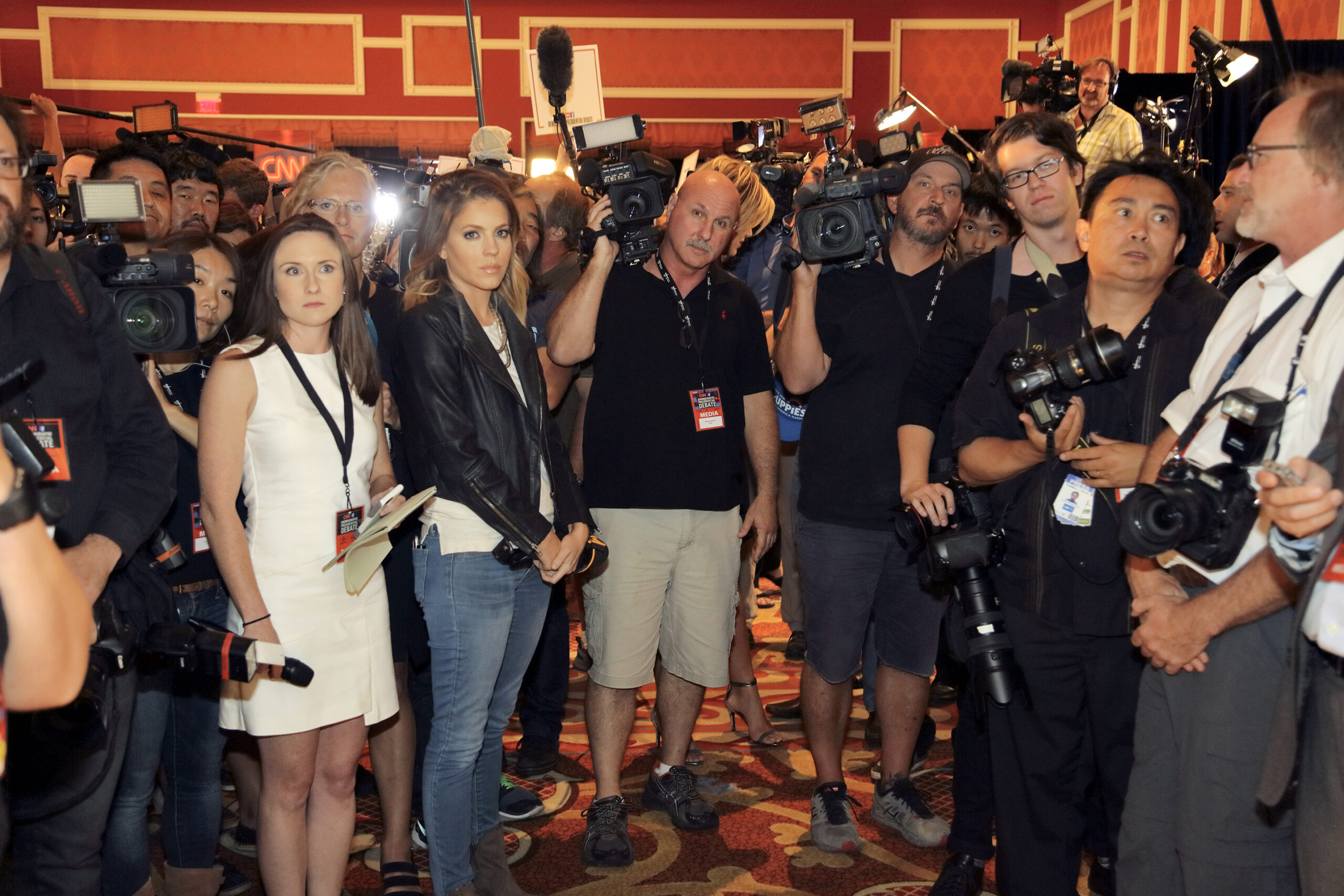
After each debate, in a crowded hall full of television cameras, reporters, sweat, the smell of stale coffee and a lot of hubris, the candidates and their representatives meet with the press. With large placards held by volunteers announcing who is walking through the crowd or offering themselves as proxies, the so-called spin room is the place for fast action and few facts.
Most of the candidates who show up glide through them from television camera to television camera, appearing on a variety of networks in quick succession to push out their talking points, claim victory or engage in demagoguery of what they hope is appropriate proportions.
Following the October 15 Democratic debate in Columbus, Ohio, DNC chairman Tom Perez strolled through the spin room speaking with reporters and trumpeting the Democratic cause to some television hosts. A young reporter walked over and asked Perez a question about the Democrats “veering too far left.”
Perez literally spat. “Why aren’t you asking the Republicans why they are too far right?” He then went through a litany of crimes he believes the GOP has committed in abandoning the American voting populace.
I just smiled at Perez. I said, “You remind me of Donald Trump.” Perez frowned at me, sputtered and walked away.
Truth is Perez could be absolutely right about the GOP, but he’s absolutely wrong to chastise anyone about it. The young reporter was covering the Democratic debate and had a valid question that suggested a valid point: The Democrats are their own worst enemy. Beto O’Rourke and others have endorsed Civil War reparations, sworn to confiscate guns and vowed to tax churches.
Elizabeth Warren introduced Medicare for all and then walked it back when it ran into a shitstorm of opposition. Marianne Williamson brought a holistic-guru vibe that turned early debates into bad stand-up comedy, while Andrew Yang has made a name for himself by not wearing a tie. John Delaney has been mourned as the missing man in action: He has been on the campaign trail longer than anyone but is as well-known among voters as a first-day employee at your neighborhood fast-food restaurant.
“The Democrats are out of touch and don’t have any ideas that the majority of voters find favorable,” Marc Lotter, the Director of Strategic Communications for the Trump re-election team, told me in Houston after the debate last September. “I think they have empty promises and do not understand why Donald Trump got elected in 2016 and they’re going to repeat their mistakes in 2020. And we’re happy to take on whoever their challenger is. They can say what they want, but the economy is strong and people respond to that.”
Jobs reports released in December back up that assertion. Larry Kudlow, the president’s Director of the National Economic Council was giddy as he told reporters at the White House in the first week of December about a robust 266,000 jobs being added to the American workforce. “As I say and the way I look at it, America is working,” he said. “America is working—and not only is America working, America is getting paid after taxes.”
The latest job reports and the Democratic candidates who challenge him are showing everyone why he might have a point. Trump shoots himself in the foot daily. The Democrats aim for more vital areas.
GOOD INTENTIONS
After the Houston debate concluded I asked O’Rourke if he thought the Democrats could beat Trump based on Civil War reparations and gun confiscation. “I want to do what’s right,” he responded. Funny, I said, I thought he wanted to be president. He frowned.
As hilariously obtuse as O’Rourke’s statement was, it was more telling that he didn’t get it—and that’s why he’s no longer in the race. Neither is Steve Bullock, Tim Ryan, Bill de Blasio, John Hickenlooper, Eric Swalwell or, of course, Harris. Now the Democrats are worried about the diversity of their candidates, but they don’t seem too concerned about their viability. The actions of most of the Democratic candidates and the party Perez represents makes one wonder if they live in a tangential universe where good intentions don’t pave the highway to the nether regions.
Lotter said the problem is most Democrats are “hypocrites.” “They talk about inclusion, but Kamala Harris insults most men with pronoun usage when she said she would only use ‘she, her and hers’.” Whether you agree or disagree with Lotter, a lot of political observers say Harris’s word choices would not have endeared her to many swing voters.
At the same time, those who stand out are those getting the least play on the debate stage. Andrew Yang has risen in esteem for advocating a $1,000 a month payout for every adult in the country and for correctly identifying the cause of misery for most low-wage workers: It isn’t that illegal immigrants are taking the jobs; it’s automation.
I asked each Democratic candidate if they thought they could beat Trump on a far-left platform. Andrew Yang was one of the few who at least tried to answer the question. “He has to be held accountable for what he’s done and we have to show why we’re better for the American people,” Yang said. The answer did not address either guns or the Civil War, but it served at least as a viable goal for Democrats.
Yang scored laughs and points at the Atlanta debate in November when asked about the first thing he’d say to Russian President Vladimir Putin. “Sorry I beat your boy,” he said with the deadpan delivery of a veteran comic.
But his support team is disorganized and lacks the acumen befitting of a top-tier candidate. He is not alone: The support staff for most of the candidates is not of the same caliber of Bill Clinton’s campaign or Barack Obama’s.
Then there’s Amy Klobuchar. She showed up at an afterparty in Columbus, all smiles, and left quickly when asked about her plans to defeat Trump. “I wouldn’t let him get away with anything on stage,” is all she said.
WHAT’S THE PLAN?
When it comes to the spin room, Joe Biden, who loves to travel by private plane, usually sends his acolytes to preach his sermon. Elizabeth Warren and Bernie Sanders have also on occasion failed to show up after the debates, settling for proxies.
So the spin room after the debates has turned into a place where those like Yang—who sat through the first 20 minutes of the Atlanta debate without saying a word—get a chance to make their case.
It’s a rough-and-tumble crowd that is seen as unfavorable for the top-tier candidates—or perhaps beneath them—though the spin room is tame compared to the White House. Biden should know this, and yet he doesn’t appear.
“He’d just actually be overwhelmed,” a Julián Castro representative said with glee. “But who are we to judge?”
In Houston, Castro’s people were eager to defend him for going negative on his opponents but had little to offer constructively on the race. Most of the “spin” in the spin room involves issues the Democrats already own. Health care? Man, they got that down in spades—except for Elizabeth Warren, whom Pete Buttigieg called on the carpet in Columbus last October for lacking a viable way to pay for her Medicare for all plan.
At the after-party in Columbus, the Buttigieg people were among the more level-headed folks pitching their candidate. Noting Mayor Pete’s young age and lack of experience and even mentioning Trump’s height advantage over him, they nonetheless spoke eloquently about the need for Democrats to quit attacking each other and start battling Donald Trump.
The party does not agree. “There’s time for that after the convention,” Tom Perez has told me on more than one occasion. (Perez’s most notable contribution to politics was as an ineffective county council member in Montgomery County, Maryland—known as “The People’s Republic of Montgomery County” by those who are not fans of the progressive politics there.)
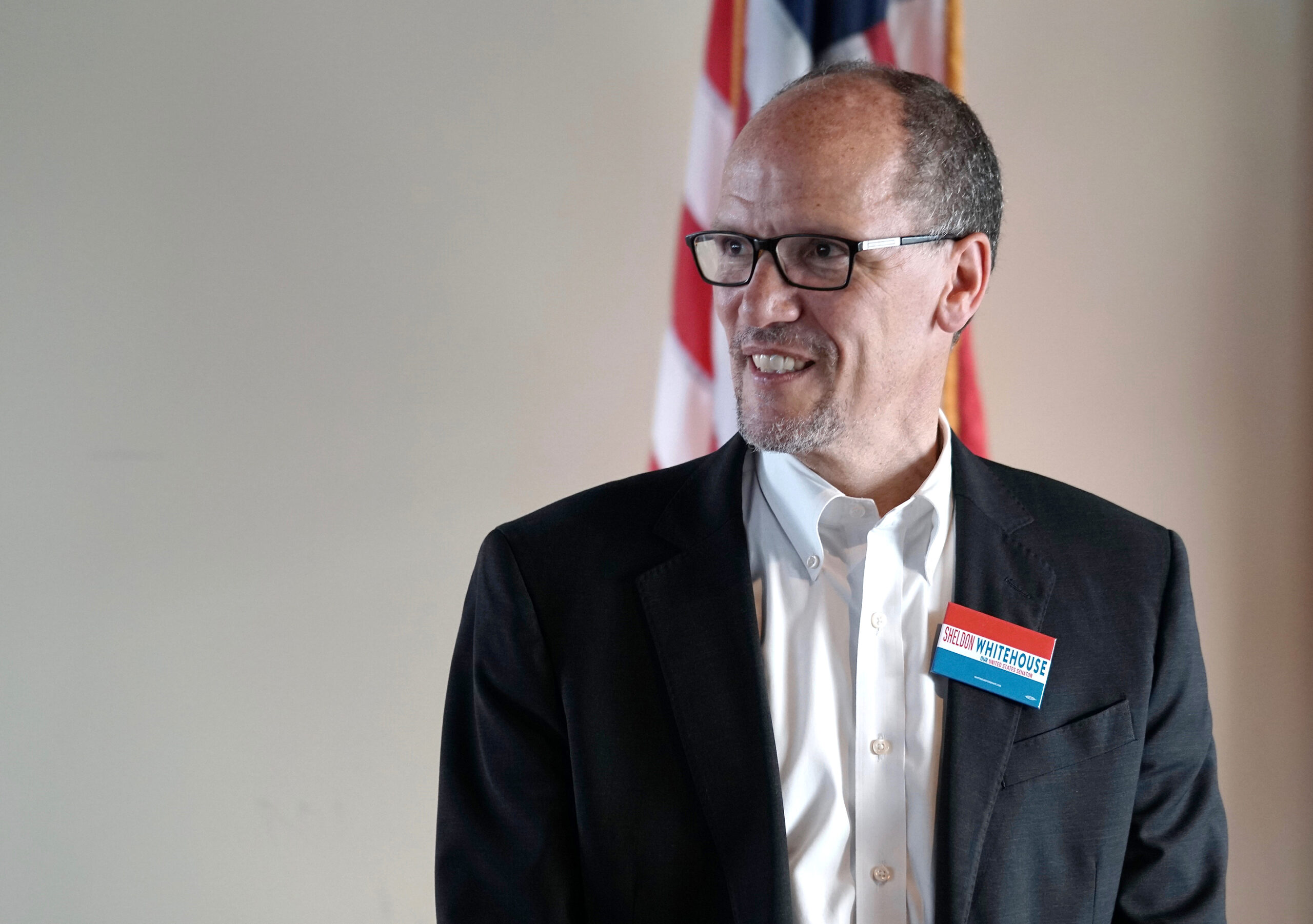
Perez jetted through the afterparty in Houston like a man on a mission. I practically had to run to keep up with him as he headed to his hotel room. He wasn’t of a mind to talk.
“You are going to have a lot of work to do to beat the Republicans next year,” I said.
“That’s why I’m here. That’s the plan,” he replied.
“Well, what’s the plan?” I asked. He didn’t say and he moved quickly, refusing to answer any additional questions.
So far, the plan appears to include putting Tulsi Gabbard on the stage. The Trump campaign congratulated the Hawaiian congresswoman after Harris dropped out of the race and Gabbard drew the ire of former First Lady Hillary Clinton, who accused her of being a Russian stooge. Perez and the Democrats put on another fringe character in the first two debates: Williamson, Oprah’s favorite guru author. Maybe they’re just comic relief, but many Democrats do not like them and several have questioned Perez and his ability to lead the DNC.
Bernie Sanders is the other questionable addition on the stage for moderate Democrats. While he aligns more with the politics of Perez’s fellow Montgomery County residents, he has been accused of dragging the Democrats far off-center. He has already suffered one heart attack but still shows more energy than Joe Biden. Sanders constantly reminds us that he “wrote the damn bill” and is unabashed in his progressive stance. But Sanders is also a septuagenarian, as are Elizabeth Warren and Joe Biden. The presidency tends to wear down the best of men. Sanders scares some Democrats not only for his leftist leanings, but because he may not survive a first term.
THE FOURTH INNING
All together the Democrats have a hard time pushing back against Trump when the president says, “Whether you love me or hate me, you have got to vote for me.” It’s the centrists and conservative Democrats he’s talking to. It worked in 2016, and the Democrats keep giving Trump fuel to make the same case in 2020.
The Democrats will tell you that healthcare is the biggest issue going into the 2020 election. But even they don’t believe it. “The biggest issue is Donald Trump,” the same Harris campaigner told me. “We don’t know how to beat him. I think Kamala could if she had stayed in the race.”
Elizabeth Warren is personally engaging. I shared a flight in coach with her on the way back from Columbus. While Biden flies around in a private jet, spending so much money he’s going to have to tap into the Super PACs he doesn’t like in order to keep his candidacy afloat, Warren didn’t even have an entourage with her on the puddle-jumper from Columbus to D.C.
Both parties have ignored the center. Those people who by and large don’t want a Civil War, don’t want to fight with one another.
Easily approachable after we got off the flight, she seemed upbeat. And while she still couldn’t explain how she intended to pay for her healthcare plan or many other policy choices, she was at least personable. “I think our message is far more inclusive than the president’s,” she said with a smile. “We have to reach everyone with it.” It remains to be seen how Warren can reach everyone with her message when she has publicly refused to engage with Fox television.
Biden? He seems befuddled in the debates, disinterested in mingling with those who will ask him questions should he become president and totally disengaged from the process he believes should merely anoint him the next Commander in Chief. The Democrats have noticed it, but how do they address their political nausea?
Enter Michael Bloomberg.
“It’s like we’re struggling in the fourth inning and the relief pitcher we put in the game has an ERA of 25,” a member of the Harris campaign told me over drinks. “I don’t think we get it.”
LIVE AND LET LIVE
Most of the Democratic hopefuls labor under the belief that saying “I’m not Donald Trump” is enough to get them elected to office. They all seem content to fight with each other over issues guaranteed to bore or antagonize the electorate.
The Democratic Party isn’t dominated by the ultra-liberals, though they are campaigning that way—just as the GOP isn’t dominated by the ultra-right, though those candidates seem to have captured that party’s soul. Both parties have ignored the center. Those people who by and large don’t want a Civil War, don’t want to fight with one another. They may have different personal opinions of when life begins or what sexual practices are acceptable but are more than willing to live and let live. These people are desperately looking to vote for someone who isn’t a crusader.
Trump is dissolving the decorum of the country. His divisive nature runs counter to the old maxim “I disapprove of what you say, but I will defend to death your right to say it.” But the Democrats who refuse to go on Fox News, who fixate on pronouns and the reproductive rights of transgender women who cannot get pregnant, are not embracing the center either. In some cases they are normalizing some of Trump’s worst behaviors and making them their own: yelling at people who ask them uncomfortable questions and calling the efforts of reporters “fake news.”
Trump may lie about everything else, but the moment a gun owner hears someone is coming after their weapons, the moment a church goer hears that churches should be taxed, those voters who believe the strongest and vote the most will flee the Democrats and cling to Trump—no matter how many articles of the Constitution the Donald has shredded.
THE FRONT RUNNER
The Uber driver in Atlanta tasked with picking me up at the airport and delivering me to my hotel asked if it was okay if she listened to the impeachment hearings while she drove. I smiled.
“Of course,” I said. She was an African American woman under 30. A single mother with two children.
“Are you a Trump fan?” I asked.
“Ha!” She laughed. “I hate him.”
“Which of the Democrats do you like?” I asked.
She paused and sighed. “I don’t know. They all sound the same. I like Kamala but a Black woman can’t win,” she said. “I think Biden could beat Trump.”
“Why?” I probed further.
“Everybody seems to think so,” she said with a shrug.
That, in a nutshell, is the Democratic quandary. Biden got saddled with the “front runner” moniker early and no one seems to know why. Few, other than those running against him, dispute it. His entire race is based on “been there, done that, bought the T-shirt.” Even the president is convinced Biden will be his likely opponent, and Trump risked his presidency to play Richard Nixon-style dirty tricks on him.
Still, not one vote has been cast. There have been no caucuses in Iowa. There have only been the debates, and those have proven to be sufficiently tepid that large numbers of Democratic voters are having second thoughts about the laconic Biden. His appeal is reflected in the Uber driver’s statement that everybody just thinks Biden can beat Trump.
Will the Democrats settle for that?
Biden showed fight in Iowa when he called a voter a “damn liar“—a viral moment that indicated he’s not out of it yet, but those moments have been few and far between. Democrats fear that in a one-on-one debate with Trump, Biden would falter. Trump effectively rewrote the rules on such encounters in 2016 as he bullied, browbeat and insulted other members of the GOP to get the nomination—and then did the same to Hillary Clinton and won the presidency.
All the nation needs is someone who aspires to sanity, someone who embraces decent manners, someone who at least tries to represent all of us.
In short, Trump blew away most political conventions and expectations in 2016 by firmly establishing that the Constitution means nothing as long as you can scream the loudest and get on television whenever you want.
The Democrats didn’t learn then and haven’t learned yet how to combat Trump. They remain firmly in their lane of traditional politics while Trump careens across the political highway, making promises he rarely keeps, angering allies who laugh at him behind his back and all the while keeping his faithful happy with economic glad-tidings.
Rahm Emanuel, who worked for Clinton and now works as an analyst for ABC News said he thinks the Democratic candidate base isn’t strong. “We can do better, I hope,” he told me prior to the Houston debate. “But we are looking at some lightweights.”
A Harris supporter put it this way: “Watching the Democratic debates, I get the feeling we’re looking at a lot of potential cabinet members debating. I think they’d all be real good in somebody’s administration as senior administration officials, but I don’t think any of them are impressive as a presidential candidate.”
Across the stage during last year’s debates, every candidate had a moment to shine. But there have been no standouts. There is, of course, still time. Bill Clinton didn’t emerge as a front runner until after Super Tuesday. Obama at this point was also behind the leaders. John Kennedy emerged over a grueling campaign of attrition and didn’t make his mark until he bested Nixon in a landmark debate.
But all of those candidates had a charisma that eludes today’s Democrats. Where is the candidate who will say, “I intend to represent all of the United States, regardless of race, gender, color or creed or whether they’re into rock n’ roll, disco or rap.”
The closest we’ve had to that moment is Andrew Yang saying, “Sorry I beat your boy.”
That might be enough, because Trump continues to lower the bar on a daily basis. When the President of the United States spends 15 minutes meeting with the press pool in the White House talking about the need to flush 10-15 times in order to get rid of a bowel movement, as Trump did on December 6, there really is no place to go but up.
“Each day I think it can’t get any weirder here, and each day I’m wrong,” more than one reporter covering Trump has opined. As he threatened war with Iran and killed general Qasem Soleimani because of a supposed “imminent” threat against the United States, it became increasingly clear in the first week of 2020 that a majority of voters may believe Soleimani was a threat, but they also view our own president as a threat.
All the nation needs is someone who aspires to sanity, someone who embraces decent manners, someone who at least tries to represent all of us.
It shouldn’t be too much to ask. But so far no one has delivered.