Your bag is empty.
With the midterms drawing near, one of America’s most influential thinkers echoes FDR’s maxim that the real safeguard of democracy is education
I’m writing these words almost exactly 50 years after I sat for my first *Playboy Interview.* It took place at the Washington Hilton hotel; below us, Connecticut Avenue was full with cars fleeing the fiery protests immediately following the slaying of Martin Luther King Jr. in Memphis. The civil rights movement produced historic levels of activism and voter engagement, and many political observers believe the upcoming midterm elections will spark a new round of both. The obstacles to political action in the current political moment are significant but not insurmountable.
Over the past five decades we’ve seen ever-expanding control by global corporations over governments, technology, media, capital and labor. Changes have occurred in these areas that few would have anticipated, but the huge number of cynical nonvoters or poorly informed active ones has not significantly declined. The turnout of the voting-age population has been below 60 percent since 1968. And voters today, beset by even more issues, are relatively less informed than they were back then, despite the vast resources of the internet, live coverage of Congress by C-SPAN and instant free access to voting records.
Voter turnout in America is the lowest in the Western world. In some countries, such as Australia, voting is a duty. The United States is one of the few democracies in which voter registration is not automatic. To make matters worse, gerrymandering by both major parties is widespread, allowing politicians to pick their voters.
It’s easy to demonstrate, starting with a weaker, corporatized Congress, that lawmakers are now more indentured to vested interests and less reflective of the people’s necessities and need for justice than 50 years ago. The corporate state’s attack on the poor, on labor, on consumer and environmental justice keeps expanding as companies export jobs, avoid taxes and profitably invade our privacy. Even state judicial elections are being corrupted with money: A report by the American Constitution Society titled “Justice at Risk” found a “significant relationship between business-group contributions to state supreme court justices and the voting of those justices in cases involving business matters. The more campaign contributions from business interests justices receive, the more likely they are to vote for business litigants appearing before them in court.”
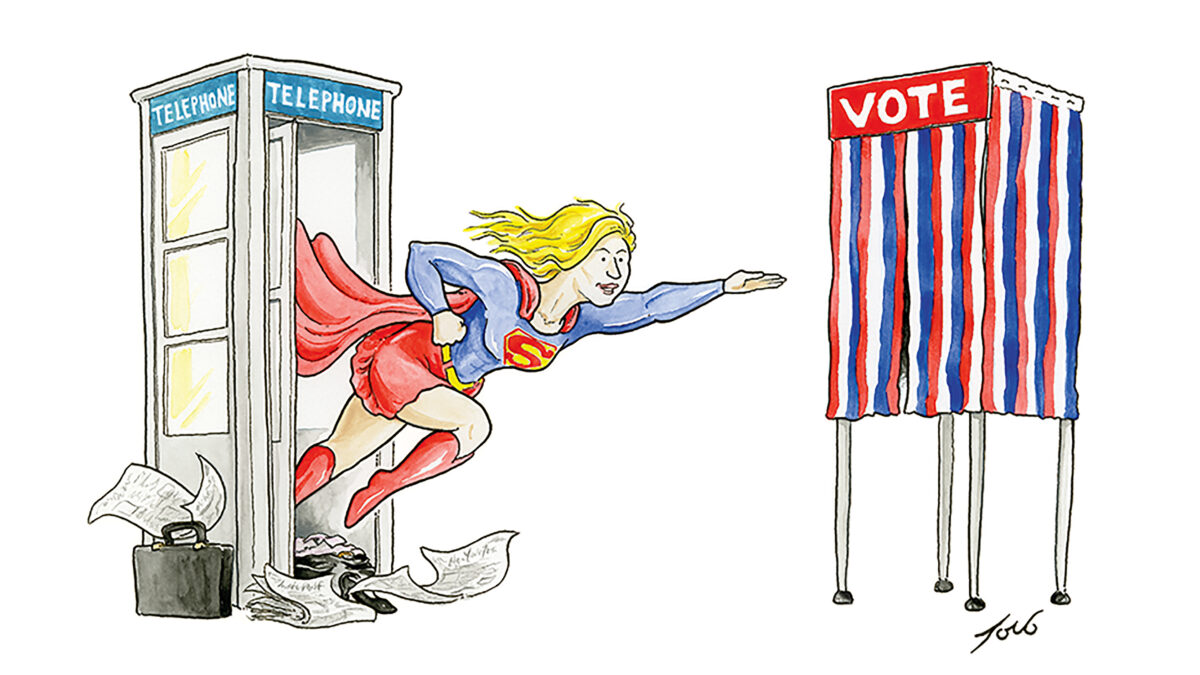
What about training yourself to become a super-voter—a voter who can’t be outsmarted by the cleverest of smooth-talking politicians? You can start by recognizing a fundamental fact: The Constitution starts with “We the People,” not “We the Congress” or “We the Corporations.” As a republic, we delegate power to elected representatives to govern, but ultimately we are the sovereign power. We can take this power back fast. Start by showing up—which is half of democracy. Show up to vote, to run referenda, to attend town meetings, rallies, marches and, sometimes, to present citizen petitions summoning your lawmakers to your own meetings to address your agenda. Organizers from Indivisible, a progressive nonprofit, have developed a variety of tools to help citizens hold members of Congress accountable. Its “Missing Members of Congress Action Plan” provides useful suggestions for motivating elected representatives to talk with the citizenry.
Avoid being a single-issue advocate, which politicians know how to handle. Instead present several popular redirections, from electoral reforms to improvements for workers, consumers and the environment, upgraded infrastructure and a smarter military and foreign policy. Politicians will realize you’ve done your homework. They’ll sense that you aren’t going away and that you’re likely to have broad public support.
Hand your elected officials a voter self-help guide that lists where you stand in contrast to where the candidates stand or have avoided the issues. This juxtaposes your positions with theirs in a concise, personal manner. It will be difficult for them to sloganize their way out of addressing your concerns. They know that asking knowledgeable, tough questions is itself power, especially when you can publicize your positions on social media.
One percent or less of the voters in a congressional district can be the deciding factor in a serious push for changes backed by a majority opinion.
When they talk of starting wars, such as the undeclared criminal war of aggression against Iraq, you can ask, “What’s your legal authority to do this under our Constitution and laws?” Many of these military actions are not legal—and both parties are guilty. As Yale law professor Bruce Ackerman wrote in The New York Times, “The legal machinations Mr. Obama has used to justify war without Congressional consent set a troubling precedent that could allow future administrations to wage war at their convenience—free of legislative checks and balances.” Truth be known, politicians are most fearful of questions from 10-year-olds, such as “Why are you taking money from polluters?” or “Why do you have health insurance and we don’t?” Students from Marjory Stoneman Douglas High School in Parkland, Florida have made politicians answer tough questions about gun control. Learn from them.
You have time to be a smart voter. You need only 10 to 20 hours of study between Labor Day and the midterms to absorb the necessary facts to choose candidates who will do right and not betray you—or you can write in your own candidate as a protest vote. And if you ever doubt your power, consider this: As I describe in my book Breaking Through Power, one percent or less of the voters in a congressional district can be the deciding factor in a serious push for changes backed by a majority opinion; that’s true regardless of the corporate lobbies.
We live in a country that has far more problems than we deserve and far more solutions than we apply. It’s time to hold up standards that will shift power back to “We the People.”