Your bag is empty.

“Fake news,” tweet storms and information silos—the media landscape is a disaster. Here are three key steps Biden can take to restore the fourth estate
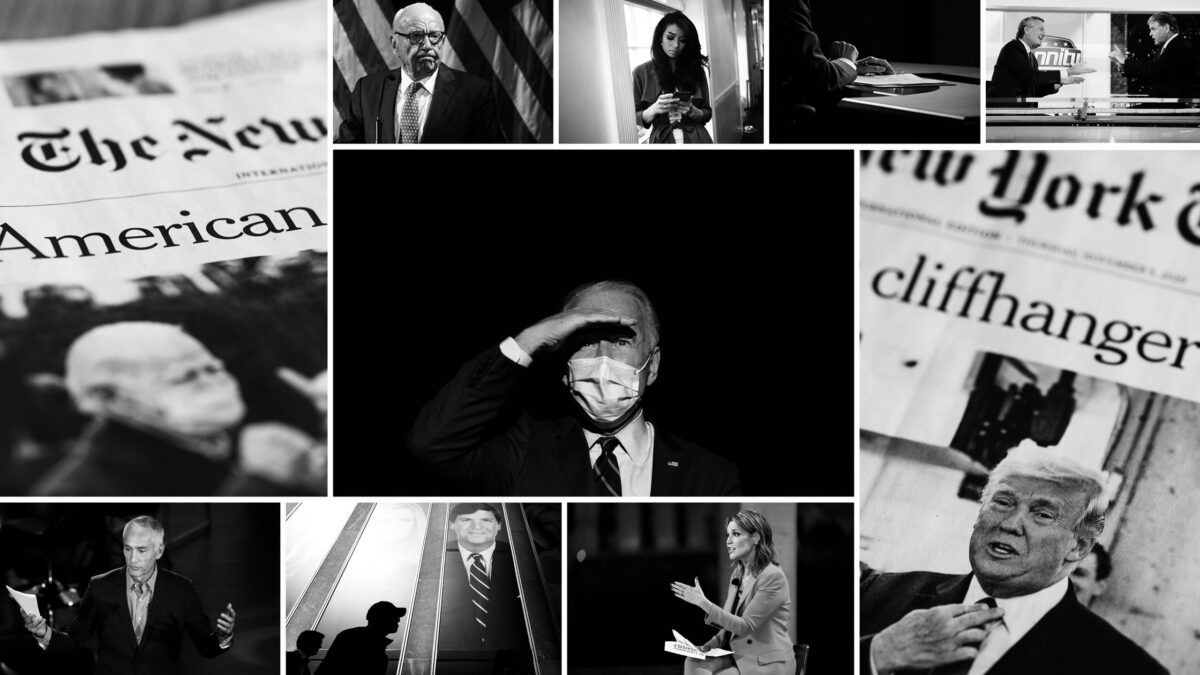
Let the apologies begin.
As President Donald Trump continues his destructive and seditious attempts to claim an election he lost, many journalists who have covered the president during his ill-fated term are seeking forgiveness for their participation in Trump’s rise from a reality-show host to a wannabe fascist dictator.
Last Friday, Jorge Ramos, the Univision anchor and reporter Trump had removed from a 2015 press conference, took the press corps to task in a New York Times opinion piece: “We journalists should have been tougher on Mr. Trump, questioning his every lie and insult. We should not have let him get away with his racism and xenophobia. We should never again allow someone to create an alternative reality in order to seize the presidency.”
Ramos is correct, but some of us have been questioning Trump all along. And because I did my job, I’ve had my life threatened, my press pass yanked (though I beat Trump in court three times to keep it) and my access to Trump curtailed after confronting his lies and telling my audience about them. I apologize for nothing.
Trump is a liar, and I’ve said so from the start—as have several other reporters in the White House briefing room. They did their jobs no matter the odds or consequences.
But plenty of reporters and several media companies stroked Trump’s ego and emboldened him from the beginning. Some saw him as a circus act; some saw him as a meal ticket. Trump didn’t care. He just wanted the attention and loved to label us the enemy, even as he made himself available to us several times a day. As Margaret Sullivan wrote in the *Washington Post* on Sunday, “From Trump’s point of view, this toxic cynicism amounts to mission accomplished. The entire point of his disparagement—as when he called journalists ‘scum’ or ‘the enemy of the people’—was preemptive self-protection.” Sullivan cites CBS’s Lesley Stahl, who says Trump told her, shortly before the 2016 election, “I do it to discredit you all and demean you all, so when you write negative stories about me, no one will believe you.”
The first thing Biden must do? Reintroduce the fairness doctrine.
When it comes to the White House’s relationship to truth, President-elect Joe Biden thus is left with a hefty cleanup. Sullivan believes the incoming president should “send a loud, powerful message” by appointing “a high-profile journalist with a record of defending press rights to a new role: special presidential envoy for press freedom. This person would report to the secretary of state and carry the president’s imprimatur to speak out about violations around the world.”
No matter how Biden chooses to address the problem, he must. You can argue that President Barack Obama’s problems dealing with the press and his use of the Espionage Act to silence whistleblowers (eight times, more than any other president) helped set the stage for Trump. Biden’s history as Obama’s vice president casts doubt on his own ability to truly support a free press. If Biden is serious about helping the fourth estate, he will have to deal with a wide variety of issues, including assisting community journalism and small newspapers and putting an end to governmental interference in the trade.
Biden should support a national shield law so reporters won’t face jail time for protecting confidential sources. On numerous occasions a bipartisan bill to create such a law was introduced in the House, with its most recent incarnation co-sponsored by Republican Jim Jordan of Ohio and Democrat Jamie Raskin of Maryland. Members of Congress on the opposite sides of the political aisle can occasionally work together for the common good.
Our new president must also look at breaking up media monopolies. Just a handful of companies today are responsible for more than 90 percent of what you see, read or hear.
But the first thing Biden must do? Reintroduce the fairness doctrine, an FCC policy introduced in 1949 that required broadcasters to present controversial issues of public import and to do so in a manner that was—in the FCC’s view—honest, equitable and balanced. In 1987 President Ronald Reagan vetoed a bill that would have turned the doctrine into law, and the FCC terminated the policy. As Reagan and his supporters saw it, by removing a perceived limit, the move would help the cause of free speech.
It has done the exact opposite.
One lesson we’ve learned from the Trump administration is that we’re all stuck in our own information silos. You are free to speak—but best to do so where your ideas are already welcome. Fox News caters to one segment of society; MSNBC caters to another, and so it goes with ABC, CBS, CNN, Newsmax, OANN and a host of other major and minor players across the vast media spectrum.
Many people—millions of people—consume their news from a single source and rarely if ever hear or see anything that could challenge their preconceived notions. This creates a disconnect from reality, perhaps unsurprising in an era characterized by the Kellyanne Conway term “alternative facts.” People prefer to stay safely inside their own philosophical cul-de-sacs.
Why do screams of “election fraud” and “election hoax” get so much attention when the facts clearly show there has been no fraud, no hoax? Because these complaints receive constant reinforcement from channels that sell swill and lies to an eager audience. The advertisers make money. The media companies make money. The rabble is happy, and the truth matters not. Let’s face it, Americans are simply too lazy to change the channel. Thus we’re stuck in silos.
A new fairness doctrine would break down the silos we live in and make sure everyone sees, hears or reads about differing points of view, even if they are too lazy to turn a channel.
The original doctrine required broadcasters to devote airtime not only to controversial matters of public interest but to contrasting viewpoints on those matters (though there was no equal time rule). Stations had wide latitude as to how to do this, whether via editorials, reported news segments, public affairs shows or other formats.
Without the doctrine to keep content balanced, station owners would feature only people who agreed with their opinions, said Justice Byron White in a Supreme Court case in 1969. But in 1984 the high court ruled in a 5-4 decision that expanding sources of communication rendered the fairness doctrine unnecessary. Some critics said the doctrine had the net effect of reducing rather than enhancing speech, an argument that grew more popular as the internet gained relevance.
Mark S. Fowler, the FCC chairman who under Ronald Reagan abandoned limits on media ownership, thus helping to make siloed informational systems powerful and more available, argued that the fairness doctrine hurt the public interest and violated free speech rights. In 1987, under Chairman Dennis R. Patrick, the FCC abolished the doctrine by a 4-0 vote.
The moment the FCC struck down the requirement, the polarization of news and politics in the United States began.
Thirty-three years later we see what hell the decision has wrought. We have retreated into our own tribes, rejecting the opinions of those who think differently.
Reporters can apologize all they want for their complicity in this horror show. Many should. I, for one, will not.
Trump is a craven liar. Reagan’s FCC made Trump’s manipulation of the masses not only possible but inevitable. The rejection of the fairness doctrine created an environment in which, years later, Trump could thrive on his preferred media platforms, ranting and raving without much in the way of consequences. Why would those who exclusively watch, read or listen to those media platforms ever question the president’s lies?
Reporters can apologize all they want for their complicity in this horror show. Many should. I, for one, will not. As I said on Stephanie Miller’s radio show this week, “After calling the press fake news and the enemy of the people, if you did not fire back, if you did not stand up to the bully, you were complicit in what he did, and I will never forgive that.”
Apologies and articles dissecting the media’s problems won’t cut it. We know what the problems are; any reporter in the field can tell you. The media companies who jockey for access to the White House and crave advertising dollars are far more complicit than individual journalists, who can be (and are) easily replaced.
President-elect Biden must do something about the serious issues facing the media today. Rancor and manipulation are par for the course; that has to change. Access journalism is for hacks. Failure to call out a lie when it’s told is an act of cowardice. While journalism is populated with hacks and cowards, it is also populated with those who try to do the right thing.
It would behoove the rest of us to encourage the fierce, fearless and free-thinking journalism necessary to overcome the nihilistic, antagonistic and delusional chaos Trump leaves behind. And Biden will be in a position to do more than just encourage it. He can go a long way to make it happen.
Much of the damage Trump caused could still be undone if he would but face the music, concede the election and apologize for his behavior.
That will never happen.