Your bag is empty.
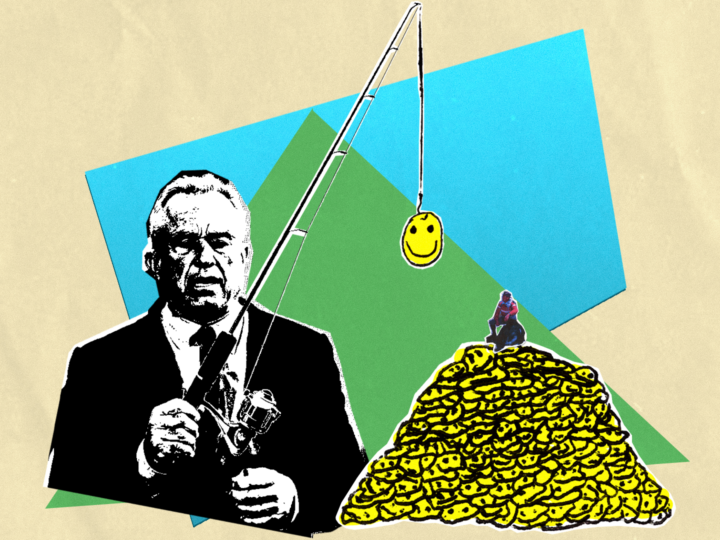
In 2004, Sergey Brin and Larry Page laid out a very different—very wholesome—vision of the internet. What changed?
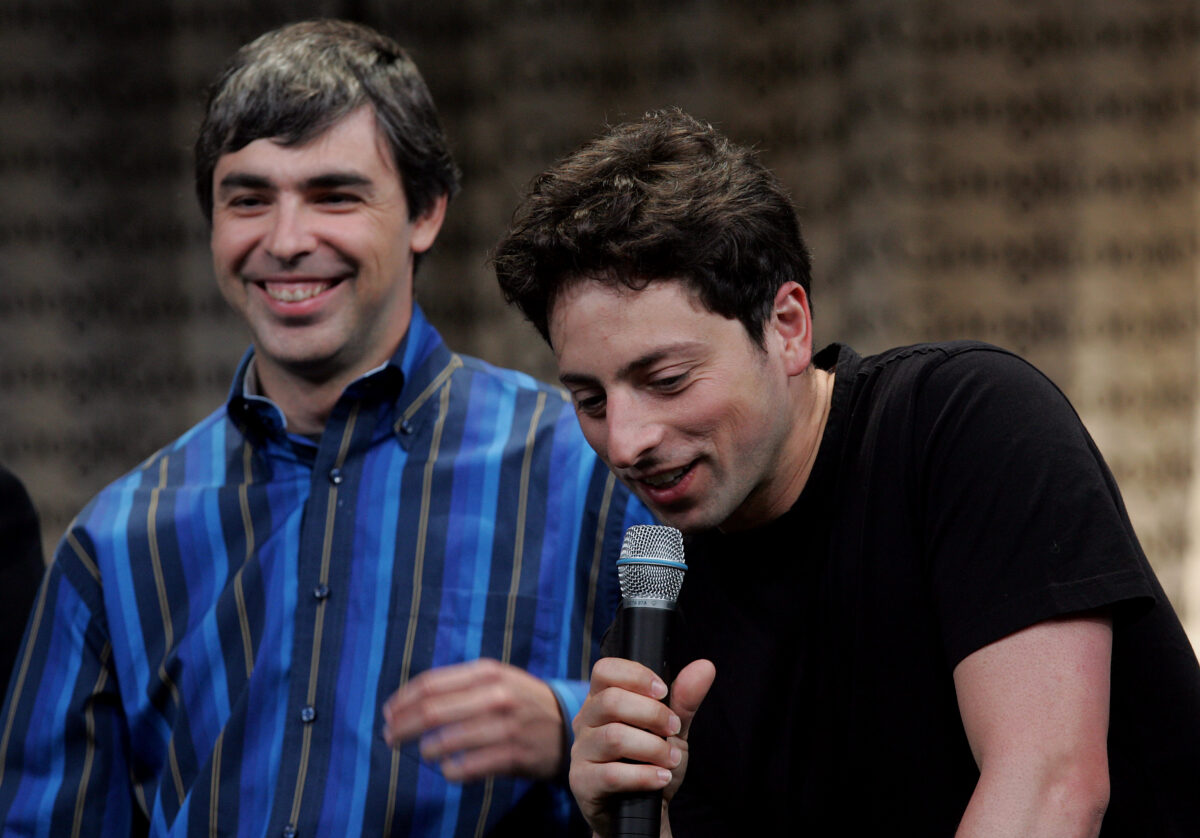
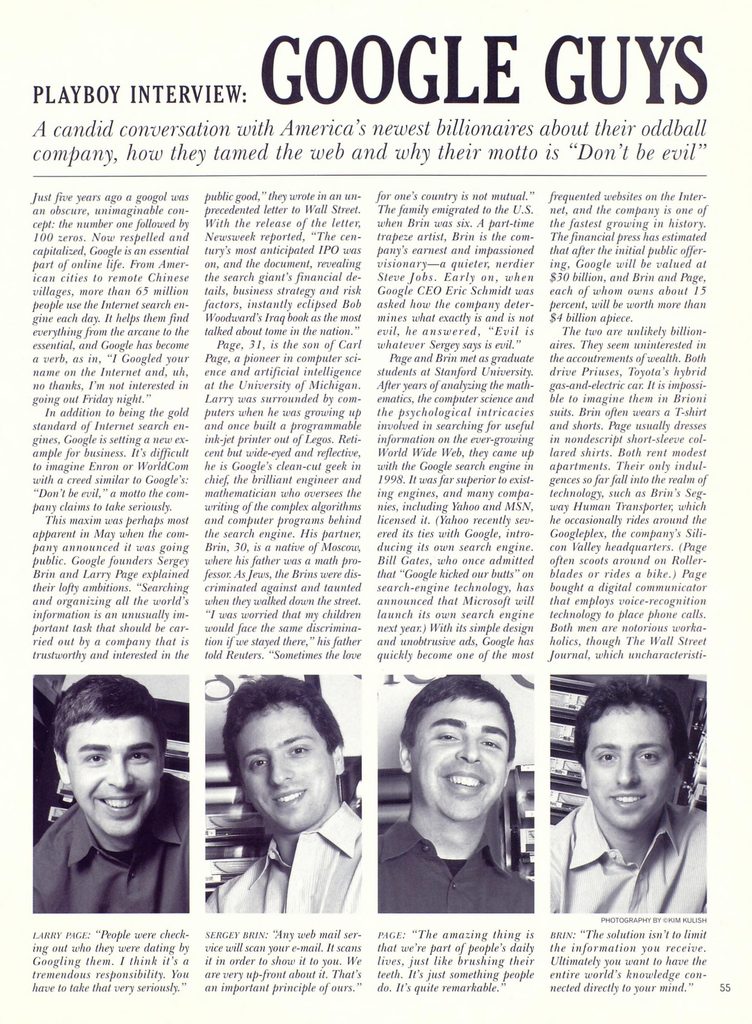
In 2004, Playboy editor David Sheff visited Sergey Brin and Larry Page, the then 31-year-old tech co-founders, at the Googleplex headquarters in Mountain View, California. At the time, the leading ethos of Google was fairly simple: Don’t be evil.
“We have tried to define precisely what it means to be a force for good—always to do the right, ethical thing,” Brin said. “Ultimately, ‘Don’t be evil’ seems the easiest way to summarize it.”
That meant a few things: They were choosy about advertisers, had a social-good grant program, and a free email service (perhaps you’ve heard of it) that they promised would never “hold your emails hostage” if you wanted to leave. In the conversation, Google’s founders outline a vision that isn’t necessarily about making a web behemoth, but about connecting everyone to all the information they could ever need – arguably, that sounds like a force for good. And it was that idea that Page said made Google different from other search engines:
“Most portals show their own content above content elsewhere on the web. We feel that’s a conflict of interest, analogous to taking money for search results. Their search engine doesn’t necessarily provide the best results; it provides the portal’s results. Google conscientiously tries to stay away from that. We want to get you out of Google and to the right place as fast as possible. It’s a very different model.”
Anyone who has recently Googled knows that what Page described is no longer the company’s reality. For almost every query, the AI Overview appears, accompanied by selective bolded phrasing and a fade-in blue highlight that ensures you know exactly where to look. Whether you search “Quick dinner recipes” or “How to get an abortion,” the information is presented in the same way, and is often thorough enough that you never have to leave Google’s page – or even scroll down.
This new function, though, is inherently different from what the search engine’s founders imagined. “If I were seriously interested in something important to me, I wouldn’t just click on the first search result, read it and take it as God’s word,” Brin said in that 2004 interview. Now, the AI Overview aggregates the biggest points related to your search even before the first result.
Some other key differences: Google’s thesis as information providers has flipped; they aren’t just aggregators anymore. “Google is now in the business of providing content,” says Angèle Christin, associate professor of communication and sociology at Stanford University. Casey Newton, the founder of Platformer, a publication about technology and democracy, reminds us why they were able to do this: “Eventually Google grew so large that it sort of swallowed the web, and the economic terms of the web are largely dictated by Google.”
Since the introduction of AI Overviews, websites have seen about a 30 percent drop in traffic from Google, a number that varied from 22 percent to 60 percent depending on the website’s size. And the loss of clicks is not the only consequence of the AI Overview. “Google tries to take no editorial position whatsoever, and so it often does elevate material that is patently false or offensive,” says Newton. An analysis by the A.I. start-up Oumi found that around 90 percent of Google’s AI overviews are accurate, but more than half of those accurate answers link to sources that don’t fully support them. New York University adjunct professor and media theorist Ruby Thelot described Google’s definition of accuracy: “They don’t call it true. They call it groundedness.”
Misinformation isn’t the only issue. In August 2026, when you searched Google for “I am alone with a Pakistani,” the AI Overview would ask the searcher if they were in danger. But, if you told Google you were alone with a British person, the AI Overview would suggest you offer them a cup of tea. Google has since resolved this.
The AI age has certainly changed Google’s core mission from what its founders laid out for Playboy 22 years ago, but part of this new experience is close to what Brin imagined in 2004: “Ultimately you want to have the entire world’s knowledge connected directly to your mind.”
Newton notes that Google didn’t really have a choice in adopting the AI game, even if it didn’t want to (which is, to be clear, unlikely). “For all the criticisms I have of Google, they do not really have an alternative,” Newton said. “As soon as ChatGPT was public, it was inevitable that they were going to go in this direction.”
In 2004, Page said, “We want to get you out of Google and to the right place as fast as possible.” 22 years later, Newton puts the reversal bluntly. “If they can answer your question without sending you away, why would they?” He adds, “…I expect a Google person might say, we found a better route to the place we always wanted to go, which was just to get you the answer. And we happened to be able to do it on terms that are overwhelmingly economically favorable to us.”
Google still acts as the connective tissue of the web, offering people information access connected (basically) to their mind. But it’s no longer the brief pitstop its founders laid out. Instead, it’s the end and the beginning, the place where the information lives. These days, nearly 68% of Google searches end on the results page.
Oh, another key difference: In 2018, Google removed the phrase “Don’t be evil” from its corporate code of conduct.