Your bag is empty.
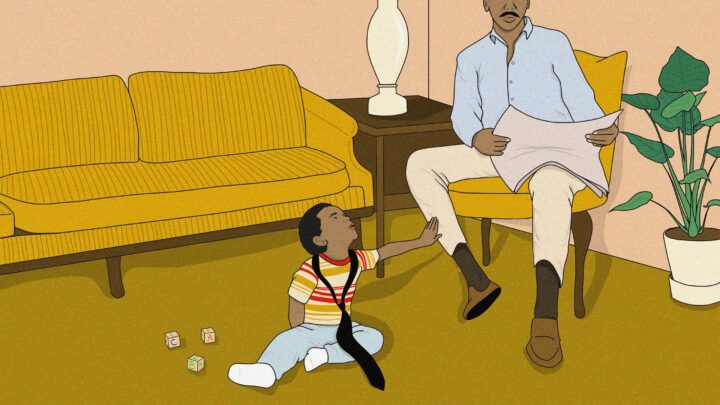
An obscure theory has captivated attention from men seeking to regain their hold on the workplace.

This is The Manthropologist, a column by Charlie Sosnick about the Internet and the male mind.
Last week, Wall Street Journal opinion editor Mary Julia Koch posted a video about young men abandoning the workforce. The video offered possible explanations for why American women now hold 176,000 more payroll jobs than men, citing the replacement of manufacturing with healthcare, Great Recession trauma, corporate diversity initiatives, and screen-induced isolation. She offered two solutions: a “Women in STEM”-type effort to get men into healthcare and education, and vocational training for the trades.
Koch was immediately dogpiled by what we might call “The Twitter Right.” She was an unfortunate messenger for this issue: She works at a newspaper, which to some is at best a “fake” “laptop” job and at worst makes her an enemy of the people. She graduated from Harvard in 2023, so she presumably did not have that much trouble getting a job. She is a young, attractive woman, and they are often not treated well on the Internet. Oh, and her father is David Koch, the multi-billionaire libertarian industrialist and Republican megadonor. One can see how she had an expanded surface area for criticism in this particular discussion.
I personally don’t disagree with what Koch said or wrote, which was an uncontroversial summary of plausible explanations for this now-trendy topic. (The one-minute video ran alongside a more detailed “Free Expression” op-ed.) I also don’t think her personal background precludes her from weighing in on it. Separate the column from the columnist, if you will. But I think the backlash is worth a closer look, because it helps tell us why so many men feel disaffected.
The thorny, confusing, anybody-got-any-ideas? part of this debate is not about the job numbers, but the resulting psycho-societal shift. The sense that young men are hopeless, aimless, lost. The malaise. Koch quotes other cultural explanations: Richard Reeves thinks men feel culturally redundant because of breadwinning women, while Scott Galloway thinks we need to promote an “aspirational masculinity.”
But Koch’s critics have a different theory: They can’t get a job because the job was given to a woman by another woman. The most common response blamed diversity and inclusion efforts, which were only briefly mentioned in the video and absent from the article. The men who aren’t working, at least the ones who responded to this tweet, believe they are victims of biased hiring practices. They even have a word for this phenomenon: they have been longhoused.
“The Longhouse” refers to a supposed pre-Aryan European dwelling, in which entire communities lived in one huge structure and their behavior was held to safe, acceptable standards by the women in charge. (Whether people actually lived like this is not based on science.) The term was coined by the Internet personality Bronze Age Pervert in his 2018 e-book, Bronze Age Mindset, a landmark text for the online far right. He used the longhouse to describe a world in which “young men [are] dominated and broken by the old and sclerotic, by the matriarchs,” where “the real problem becomes what to do with the young males.” Jonathan Keeperman, aka Lom3z, another important writer in that world, called the longhouse a “regime of maternal surveillance” and “a feminine way of social management.”
This idea is what made Koch’s video such a lightning rod. In her, critics saw an avatar of the longhouse, the player the game seems rigged for. Here is the smiling, university-educated young woman with upper-crust habitus who somehow glides frictionlessly through office politics and work happy hours. The Gen Z Boss With a Mini.
I don’t think the longhouse truthers are correct about how the world works. I think their solutions—outright misogyny, crusades against DEI and affirmative action, closed borders—are even worse. But, they have stumbled upon an unfortunate truth: Gender integration changed work, and some men are completely lost as a result.
Many Americans have little experience maintaining functional, platonic relationships with the opposite sex. According to one survey by the American Enterprise Institute, 37% of men and 47% of women report not having a close friend of another gender. The most likely place for this intergender friendship shortage to be improved—college—now enrolls dramatically fewer men, as Koch points out.
The result is that many men and women have not practiced dealing with each other until they are made to share a room for 40+ hours per week. And in the workplace, miscommunications and interpersonal difficulties can have professional and financial consequences. Without other models for platonic coexistence, men might resort to seeing their female coworkers like mothers and teachers. Thus, women’s needs and demands at work are recast as admonishments from a “sclerotic” “matriarch”—not the inevitable, ordinary frustrations of trying to get along with others, as men and women have had to do forever.