Your bag is empty.

“It’s impossible to create an orgasmic life with a guy who folds when confronted by authorities trespassing on his convictions and threatening his authority inside his own family."
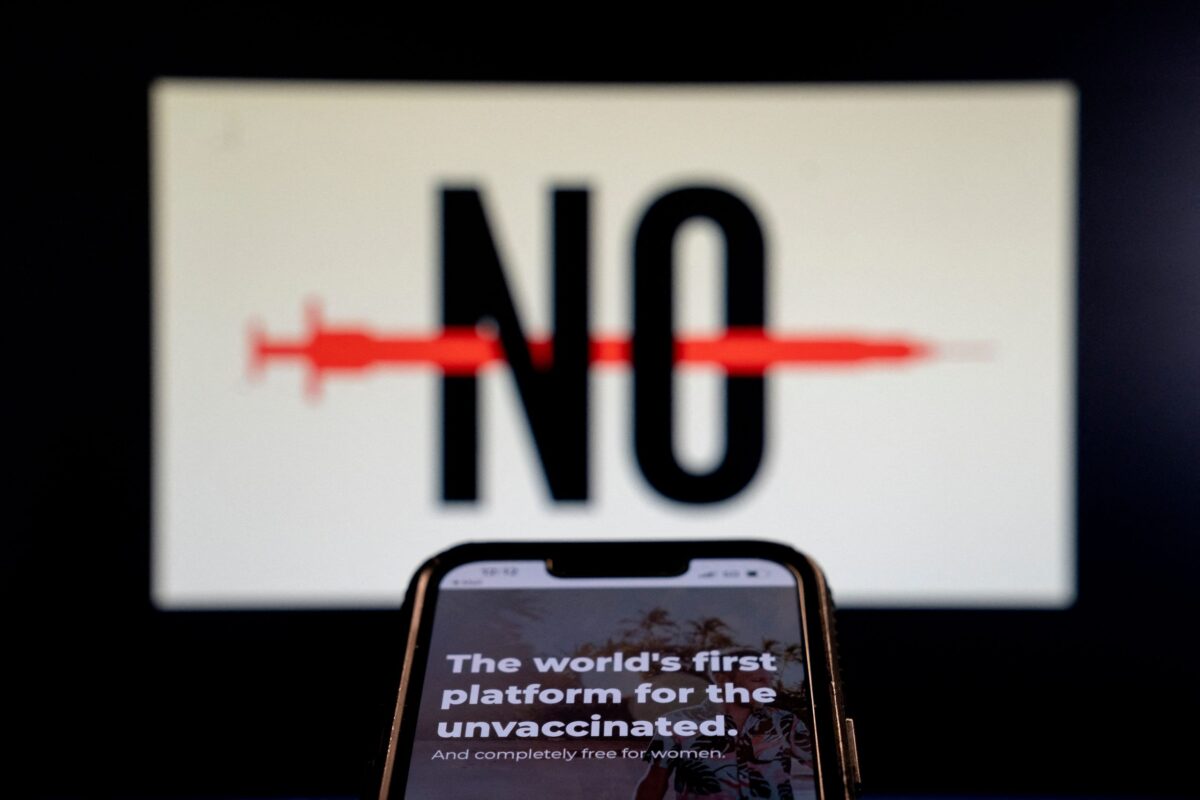
By May of 2021, 37-year-old Scott Armstrong had lost his job, his family, and all of his friends for one reason: He refused to get the COVID-19 vaccine.
Isolated in Oregon, he found himself spending more time on social media, where the algorithm served him content that reinforced his anti-vaccination stance. He was particularly invested in content made by Shelby Hosana, who’d recently founded Unjected — a dating and community platform for anti-vaxxers.
The two hit it off as friends. Armstrong volunteered his skills to help Unjected launch a podcast; Unjected’s user base grew. Hosana came up with the idea for a “URL to IRL” event series that brought the Unjected community together in cities across the country.
By the time Unjected showed up in my own news feed in Spring of 2026, the entire city of Denver, where I live, was talking about them. The public was outraged at a local beer garden for hosting the Unjected mixer, and in response, the beer garden canceled the event. Unjected found a new venue; the event was back on. Hosana moved to sue the beer garden, pro se, for discrimination.
Unjected isn’t the only dating platform for the unvaccinated. There’s the similarly named Unjabbed, and the unfortunately named Pureblood.Dating. The frenzy of the pandemic is over—vaccine requirements have relaxed, and few people are asking one another whether they’ve been vaccinated before hanging out or hooking up. So why are these unvaccinated singles so stuck on the question?
According to public health historian and Auburn University professor Zachary W. Schulz, PhD, a distrust in vaccines began long before COVID-19 upended our lives. “Americans as a society have long debated the balance between individual liberty and collective responsibility in public health,” Shulz says.
He points to a 1905 supreme court case titled Jacobson vs. Massachusetts, where a man (Jacobson) refused the smallpox vaccine despite his state’s mandate. The court ruled against Jacobson and upheld a Massachusetts state government statute to impose a $5 fine against those who refused the vaccine. In the case of communicable disease outbreak, public safety overruled personal choice.
Although this ruling was in the interest of public health, it created friction with American citizens who believed they were at liberty to make such a choice without government interference. In the century that followed, a series of public health disasters further eroded public faith in state and federal health initiatives, giving rise to what Schulz calls “a long American ethos of not trusting the government.”
For instance, the Cutter incident was a 1955 manufacturing error in the polio vaccine that failed to deactivate the live polio virus, causing 40,000 cases of the disease in children — including 200 incidents of paralysis and 10 deaths. “That shook public confidence and led to higher federal oversight,” Schulz says. Similarly, the Tuskegee experiment—a 40-year long study in which researchers, without informed consent, used Black men as test cases for untreated syphilis. Even when syphilis treatment was available, some of the men in the study were not offered it. This, alongside other widespread instances of medical racism, instilled a longstanding distrust of medicine in the Black community.
“COVID didn’t invent vaccine hesitancy,” Shulz says. “It really magnified the fault lines that were developing for decades.”
That, combined with the social isolation of the pandemic (which can breed conspiratorial thinking) and a government that promoted anti-science rhetoric around the illness, created the perfect storm.
Research shows that shared values in questioning authority can help foster belonging and social security—something that might become especially important for a person like Armstrong, whose vaccine skepticism cost him most of his previous community.
“If someone has repeatedly experienced criticism, ridicule, or rejection because of their beliefs, joining a dating platform where those beliefs are normalized provides immediate acceptance,” says psychologist Lauren Mahoney, PsyD. “Most people are drawn toward communities where they feel seen rather than communities where they expect to defend themselves.”
It then becomes easier to understand why Armstrong trusted Hosana a whole lot more than any professional advice when he found her videos during the COVID-19 pandemic, even though he’d only ever met her virtually.
“Finding other groups of people that thought like that, questioned the government and questioned the establishment the way I did, was very attractive to me,” Armstrong says.
Soon after the vaccine was rolled out, Hosana says she found a group of unvaccinated women online who believed they experienced menstrual changes after having sex with their vaccinated husbands.
The idea that the COVID-19 vaccine can “shed” through physical contact is debunked, primarily because none of the COVID-19 vaccines approved in the United States employ live viruses. In Hosana’s mind, though, sex could “infect” a person with the vaccine, which she took as evidence that it altered one’s DNA. In a world where the vaccine was being strongly encouraged, and in some cases mandated, she believed unvaccinated people deserved a safe, trusted platform on which to meet and form relationships.
“Beyond just like the opinion of not wanting to sleep with vaccinated people, there was also a lot of us that had, you know, health side effects after having sexual relations [with vaccinated people],” Hosana says.
The misinformation about vaccine shedding was further reinforced by a misunderstanding of key language in Pfizer’s clinical trial of the COVID-19 vaccine, which urged people to use contraception to avoid getting pregnant during the study. This wasn’t because the vaccine caused birth defects, altered DNA, or rendered people infertile as part of a “depopulation agenda.” Rather, Pfizer was following standard protocol for trial-phase vaccines and drugs, which are not tested on pregnant women, children, or other vulnerable groups until they’re first proven safe in healthy adults.
The vaccination-through-sex debate is a perfect example of how online communities like Unjected organize and amplify the distrust that’s long simmered in the American psyche, Schulz explains. “Before social media, people with fringe health beliefs were geographically isolated. The internet has changed the geography of trust.”
Today, a single shred of misinformation can spiral into a conviction if it bounces around the right digital echo chamber. Soon, that belief becomes a deeply personal value — like shared religious faith — that can lay the foundation for romance.
“Long-term relationships require partners to agree on far more than medical decisions,” Dr. Mahoney says. “They require shared assumptions about trust, parenting, risk, authority, science, community, and how decisions should be made. Vaccine beliefs have become a shorthand for an entire worldview.”
Hosana sees this dynamic play out in couples that meet on Unjected all the time.
“People tend to be so aligned that they really match up really well and get together quite quickly,” she says. “[We’ve created] dozens of marriages, I’ve lost count of how many actual relationships, and I think we’re up to like, 15 babies.”
For example, Michigan-based health coach Jennifer Mayo, who met her current partner, Dennis, on Unjected, says the two connected over the shared value of health freedom. As historian and American University professor Lewis A. Grossman writes, health freedom is a libertarian belief that “people have a right to choose their preferred treatments without government interference.”
For Mayo, it wasn’t just that Dennis shared this belief in health freedom, but also his willingness to act upon it. Dennis’ refusal to get the COVID-19 vaccine, despite it putting his tenured public school teaching job of two decades at risk, was a major turn-on.
“It’s impossible to create an orgasmic life with a guy who folds when confronted by authorities trespassing on his convictions and threatening his authority inside his own family,” Mayo says. “At a primal level, no woman wants to fuck a man who trades conviction for comfort when it matters [most] much less build a life or start a family with him.”
Mayo lives about a two-hour drive from Dennis, who teaches in the Chicago area, but the distance hasn’t been a problem in their 20-month relationship.
“I think if [you] can find somebody who you really connect with and you share values with, that there’s more motivation to make a long distance relationship work,” Mayo says.
Despite that the vaccine became a political firebrand, Mayo aligns with Armstrong and Hosana in saying these beliefs are not political.
“Political pigeonholing happens with people who question the vaccine,” says Armstrong. “It’s very important to point out that we have no love for Donald Trump. The thing that keeps us all in common is that we don’t trust the government and we do not trust the pharmaceutical industry.”
Hosana considers herself and Unjected apolitical; she doesn’t vote. “At the end of the day, it doesn’t matter if you’re a Republican or a Democrat, you should have the choice of whatever you want to put in your body,” she says.
Does this mean that being an anti-vaxxer in search of love is less about American politics, and more about American identity? If so, maybe the problem isn’t how a person votes (or not), but that they see vaccination as a purely personal decision.
“Yes, there are reactions; that does happen with any drug or any vaccination, and that is a tragedy at the level of the individual, for sure,” Schulz says. “But if we’re emphasizing that tragedy, we ignore the wider benefit to overall groups. The point of having a wider immune population isn’t to protect us, the individual. It’s to protect each other.”