Your bag is empty.

If any comic-book lover thinks SFSX is a far-fetched dystopia, they haven’t been paying attention
As millions of us enter a second week of quarantine, one can’t help but feel a renewed appreciation for the arts and the salve they can bring in uncertain times. Whether we’re streaming, gaming or reading, we all need a taste of normalcy, old escapism—or, better yet, a healthy dose of subversive eroticism.
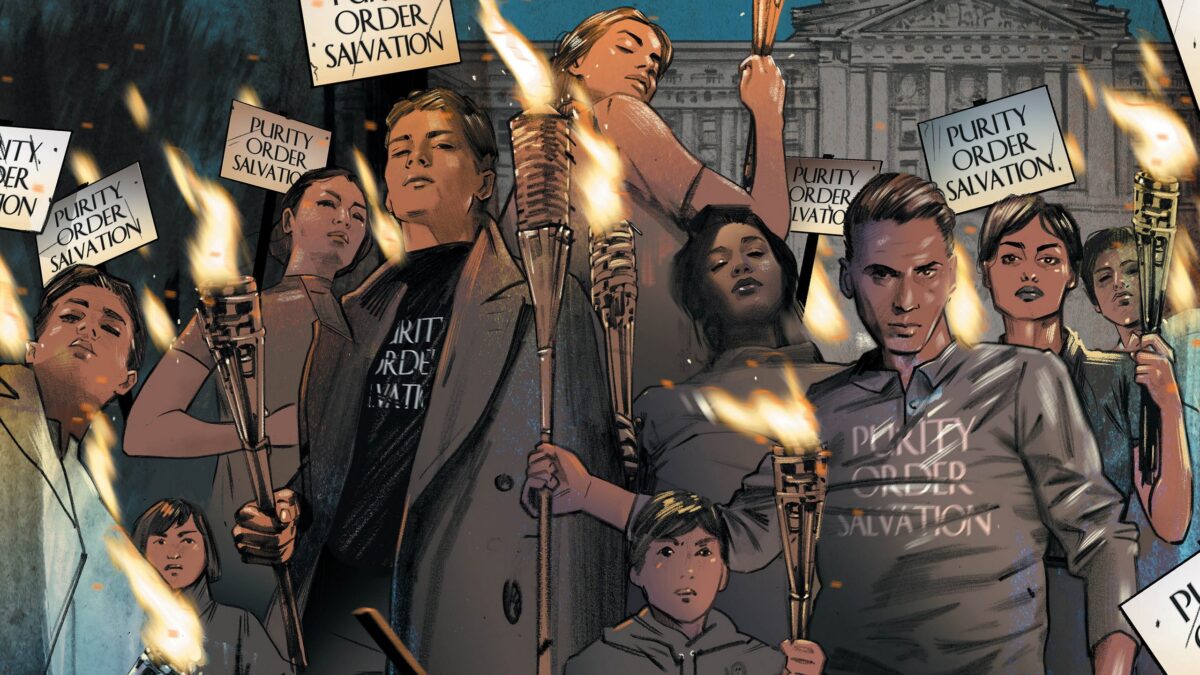
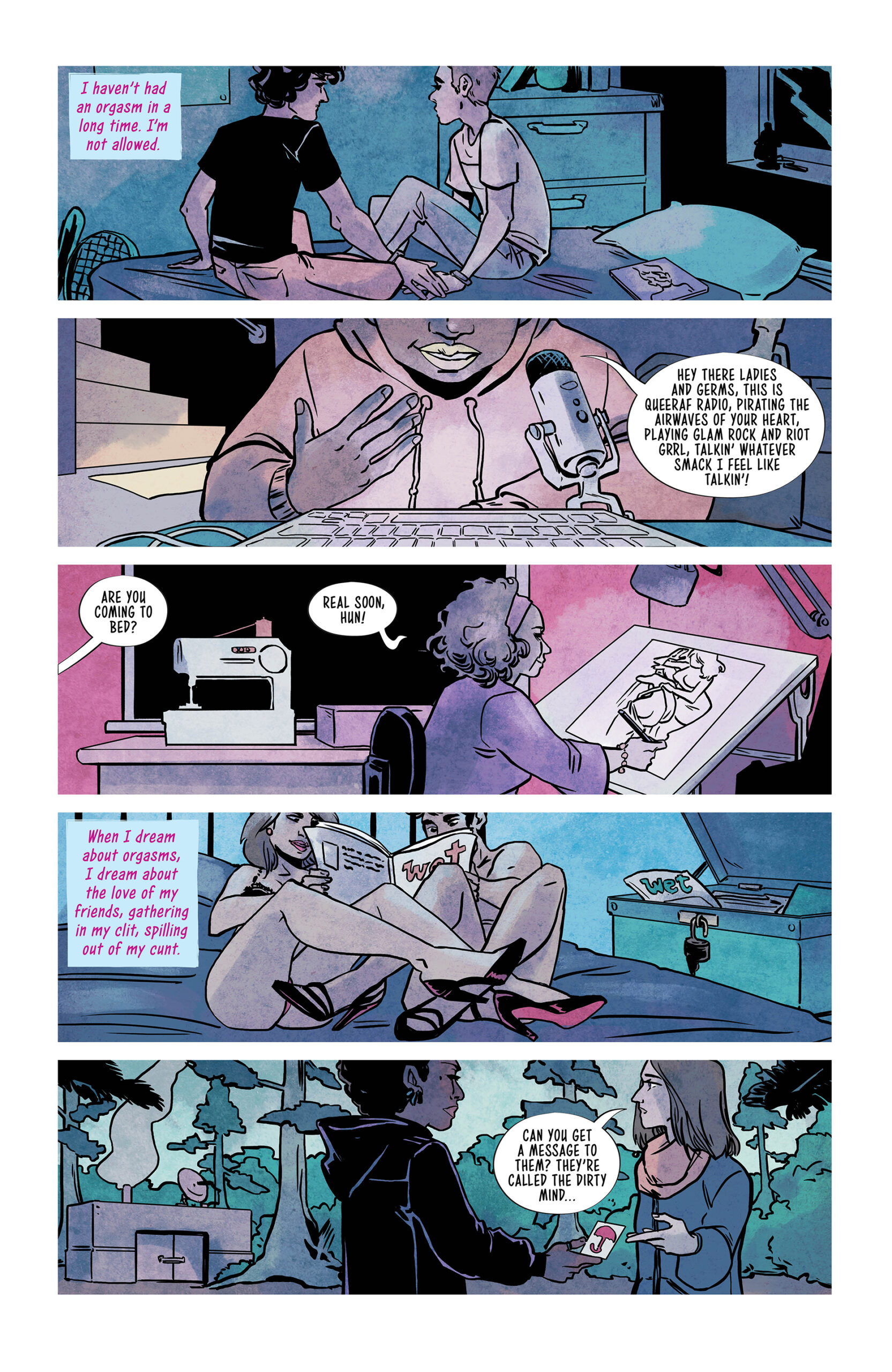
That’s why PLAYBOY is proud to shine a light on one of the contributors to our Spring Issue: comic-book writer, sex-worker advocate, kink educator and all-around badass Tina Horn. Horn collaborates with a number of artists to create the SFSX (Safe Sex) comic book series, which has resonated with a broad cross-section of marginalized communities since its first issue appeared last fall. The series takes place in a world not too removed from our own—a world where women’s sexuality is weaponized against them, where the supremacy of the state over personal freedoms is a foregone conclusion and where sex work has been pushed even further into the shadows.
SFSX feels especially relevant because it hits that hair-raising, uncanny valley between a future that seems too absurd to be real and a present in which people with uteruses are one SCOTUS decision away from losing bodily autonomy. It asks us: What does society look like when sexuality is policed and monitored with the full weight of a fascist dragnet?
Horn’s heroes don’t shoot spiderwebs out of their hands or leap over skyscrapers in a single bound, but they are out to save humanity just the same. The protagonist is Avory, a bisexual woman in her 30s who’s an erstwhile pornographer and member of an underground collective called the Dirty Mind. Across the comic’s dramatis personae, the sex worker, the pornographer and the unabashed orgasm seeker, in all their beauty and complexity, are on full display.
With the indeterminate time we’ll be spending indoors (#FlattenTheCurve, y’all!), we hope the following conversation will inspire you to check out the SFSX installment in our latest issue—in which two of Horn’s characters give an informative and very explicit lesson on talking dirty.
PLAYBOY: Although it’s relatively new, SFSX has become a fan favorite. What has been most gratifying about creating art that means so much to so many?
HORN: The most rewarding thing has been [appealing to] people who are not used to seeing themselves represented in stories or mass entertainment, whatever the medium. By that I mean queer folks, kinky folks and sex workers of all kinds. I’m somebody for whom all those identities overlap, and I know—from having community and also from being a cultural critic—the way mass media gets us wrong.
I’m not presuming that I got everything right for everyone, but I know I got it right for me, and I did my best to get it right for folks I don’t necessarily specifically represent in terms of my own identity. I’m cisgender, so I really tried to listen to discourse from trans folks about how they’re tired of being represented and what they want to see more of. I’ve done a lot of sex work, but I’ve never been a stripper, so I really try to pay attention to the ways that strippers are tired of seeing themselves represented in stories.
PLAYBOY: Who is SFSX ultimately for? It seems you made it for people in these communities but also want to educate people outside them—“civilians,” as you call them.
HORN: SFSX is definitely for queer people and kinky people and sex workers and folks who are not used to seeing themselves as the heroes of stories or to seeing nuanced portraits of themselves. It’s for us by us, but it is definitely also for a general audience. Anybody who likes action-adventure stories might like SFSX. Anybody who is interested in dystopian sci-fi might like SFSX. Anybody who is interested in a social thriller that’s for adults and therefore has sexuality as a part of the lives of the characters might enjoy SFSX, and I also think it’s for comic book fans.
I am not just somebody who came from the world of nonfiction about sexuality and then tried my hand at writing a comic. I am somebody who has been a lifelong fan of sci-fi and horror and crime thrillers and all kinds of juicy, exciting, fun, imaginative, weird kinds of fiction. I know what I want to see more of in those dramas, so I wanted to make the book one that I would be the number one fan of—a book that I would be obsessed with.
PLAYBOY: How can “civilians” help normalize sex work?
HORN: Sex work isn’t normal. It’s very weird, and I think sex workers want to stay weird, for the most part. I certainly do, so I think it’s less about normalizing it and more about listening to sex workers when we talk about what we need. Sex workers are used to other people speaking for us, whether it’s fiction creators who have absolutely no experience in sex work using our real lives as a metaphor for something in their story, or journalists, academic writers, lawyers, policymakers or social workers trying to speak for us in a patronizing way and presuming to know what we want in terms of services, rights or working conditions.
It’s really quite simple: If you’re going to be making policy or writing stories about sex workers, you need to foreground the subjectivity of real-life sex workers. The thing that blows my mind about all this is we are storytellers. That’s what we do, and because of all the struggles we’ve had, we know exactly what we need and what we want, and we’re used to articulating it. We’re the perfect loudmouths to be our own advocates, and the fact that people don’t allow us to be says to me that they are scared of what would happen if we had microphones and power. Anytime people with power are scared of a group, that’s usually a sign that the group actually stands to be a threat to an oppressive status quo.
PLAYBOY: You’ve been vocal against FOSTA-SESTA, a piece of anti–sex work legislation that was passed in 2018. Could you speak to the threat it represents to sex workers and the impact it has had?
HORN: I would say, since this is for PLAYBOY readers, that what is really relevant to me about the fallout of FOSTA-SESTA is that when laws like this target and censor sex workers, they have a chilling effect on freedom of speech for civilians. When sex workers are censored online or in any public space, that freezes the ability of the general public, of an average person, to express anything related to sexuality online or in those public spaces.
What is considered sexual expression also changes based on how much privilege someone has or whether they are considered transgressive. If people with power perceive two pictures of two women in a mini dress, and one of them is trans and the other is not trans, the transwoman in a mini dress is more obscene, so she doesn’t get to express herself online. She’s censored. That’s how normativity gets constructed.
It’s not really even about normalizing these things; it’s about saying, “Is heteronormativity the only kind of relationship that is deserving of rights?” Even homonormativity: As long as queer people behave in a normal-looking way, they’re allowed to have rights. As long as queer people get married, or appear respectable, they’re allowed to have rights. That’s not actually how rights should work. We shouldn’t have to conform to other people’s understanding of morality or respectability or even aesthetics in order to be deserving of rights.
PLAYBOY: The world you depict is uniquely dystopian. How far do you think we are from the brutal reality you show in SFSX?
HORN: Even though it’s technically canon that SFSX takes place in the day-after-tomorrow, not-too-distant future, it’s almost as if it takes place in an alternate dimension: It’s taking place now but shifting slightly to another version of now. The things that are happening in SFSX are already happening to people. It’s maybe slightly more absurd or slightly more extreme, but it’s already happening.
As long as queer people get married, or appear respectable, they’re allowed to have rights. That’s not actually how rights should work. We shouldn’t have to conform to other people’s understanding of morality.
PLAYBOY: In SFSX, co-opted and corporatized feminism seems to have been weaponized and drawn out to an ugly conclusion. What message are you trying to send by making second-wave feminists the bad guys of this story? Does the villain Judy Boreman have a real-life contemporary?
HORN: She is definitely based on a whole generation of second-wave feminism. It’s always shocking to me that people don’t recognize how vast feminism is. I have been on panels with other feminists, and we categorically disagree about topics that are very important to us, like pornography, sex work and whether or not high heels and lipstick are essentially oppressive to women.
Judy Boreman doesn’t think it’s possible for any kind of sexual art or expression to be anything other than pandering to the patriarchy. Judy Boreman doesn’t believe that sex work is real or a choice that people might be making to survive and therefore deserving of rights.
This second-wave feminist is given power by a religious right organization, and when she’s given that fascist power she’s like, “Burn all the porn; outlaw high heels. Send police to arrest the heads of these underground cultures. Let’s put them through conversion therapy. Let’s reform them.” She believes if we just snuff out high heels and porn and queer leather dyke sex-work organizations, then women will be equal to men.
PLAYBOY: What’s so subversive about comic books as a medium? Why tell this story through a comic book as opposed to a play, movie or book?
HORN: The frisson that happens between language and imagery in sequential narrative—which is the fancy academic term for comic books—creates a sense of empathy and identification between the reader and the characters. Comic book writers and artists have to find a way to collaborate in their different modes of storytelling, and that’s something comics readers get a lot out of.
I also just feel like comics take us out of the realm of realism. There’s a reason comics are such a good medium for fantasy worlds, whether it’s superheroes or dragons and unicorns, and why comics are such a good medium for SFSX—which is a science fiction world that has a strong social-thriller component—or frankly why comics are such a good medium for erotica. For whatever mysterious reason, comics are really beautiful for all that.
PLAYBOY: What does Avory, the protagonist, represent to you? Why did you decide to tell the story through her eyes?
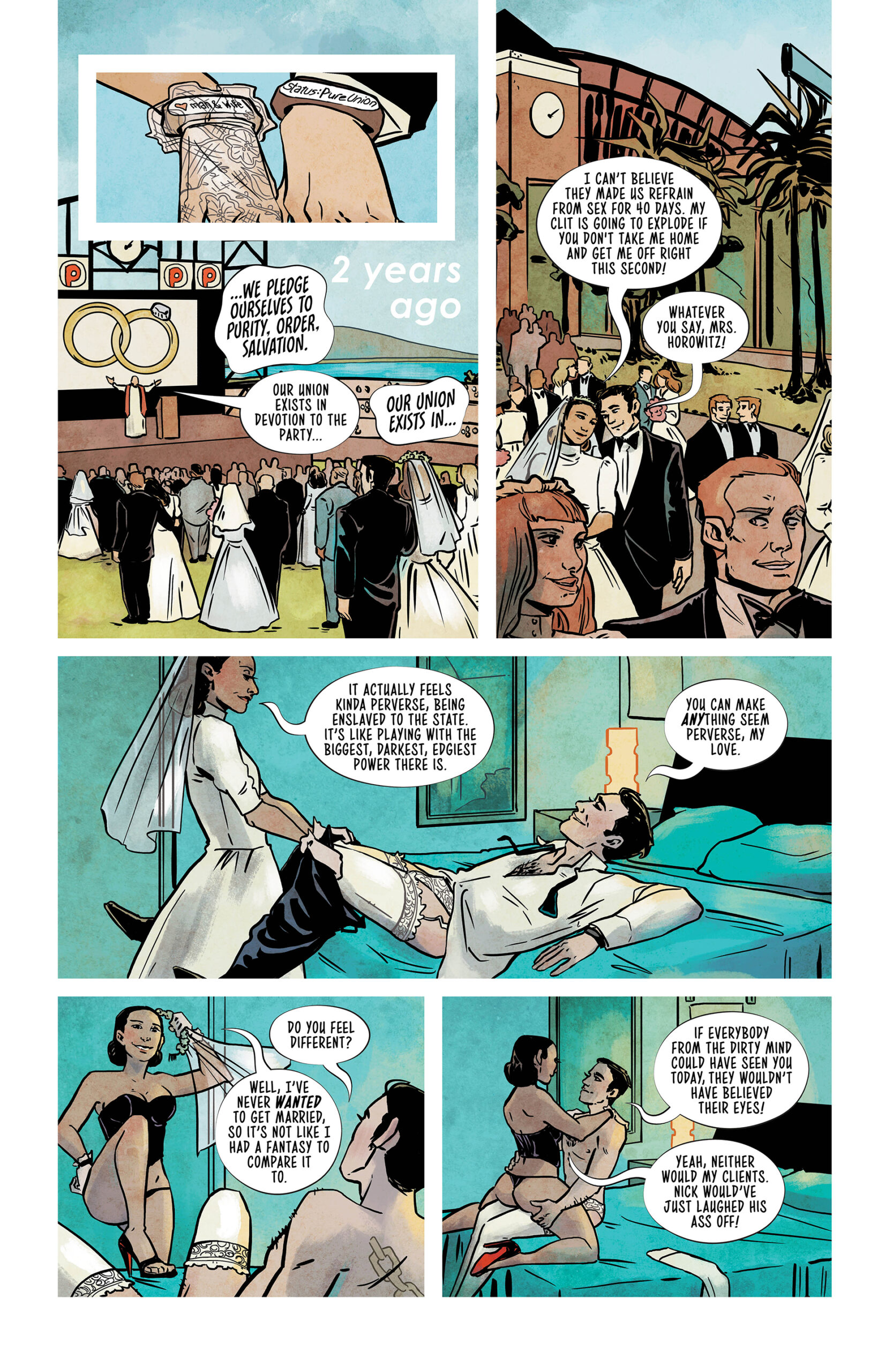
HORN: She has some elements of me, but she’s not just a stand-in. I wanted to make our point-of-view character someone who had done something selfish in the name of being safe. She took advantage of a privilege that was available to her as a queer bisexual woman who fell in love with a cisgender man who happened to have a stable government job. In an impulsive moment of fearing arrest and torture from the state, they bail on their friends.
The lesson she learns is that if you screw other people over or abandon your friends or violate the trust of your friends in order to feel safe, you are not making yourself safer. You are not protecting yourself from stigma; you are actually doing the work of the oppressor for them. The more we perpetuate horizontal violence against one another, the man is just going to keep winning.
Avory is not able to assimilate, because she’s just too much of who she is. That’s what makes her a hero: Even when she’s trying to live this shameful assimilationist life, she can’t help but be a weirdo. And ultimately she learns to use her own power to fight the power instead of conform to the power.