Your bag is empty.

A former minister immerses himself in the American Atheists convention, bearing witness to the nonbeliever movement as it rises from the ashes of 2016
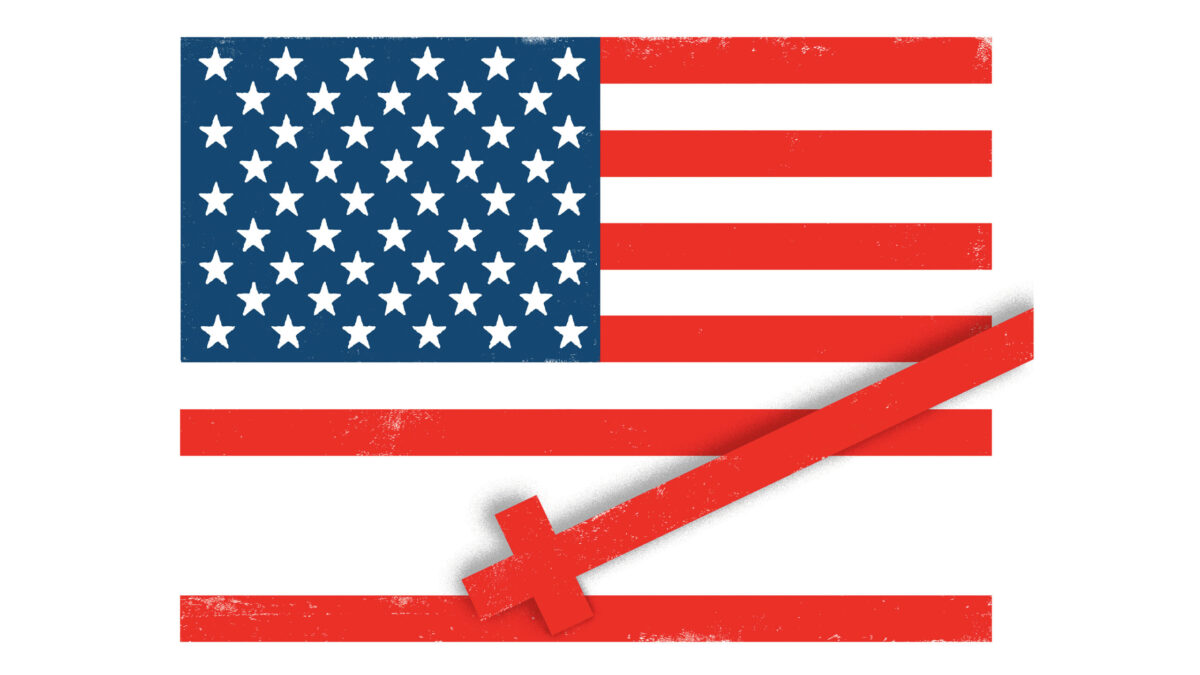
Touching down at Will Rogers airport in Oklahoma City, I request a ride; within minutes a young woman named Sandra pulls up to take me to my hotel. Contemporary Christian music plays quietly from her radio, a cross hangs from the rearview and a Bible peeks out from the door pocket at my feet. I recognize Sandra, though not personally. Sandra is me several years ago, back when I was on a mission to save a world doomed to hell by any means necessary. Planting seeds, we called it.
What she doesn’t know, and what I don’t bother to tell her, is that I was ordained as a minister in the Southern Baptist Convention. Sandra might have admired me back when I was attending dinner parties with Judge Roy Moore and riding on Herman Cain’s bus. Now she probably wouldn’t be a fan. About six years ago, after a long stretch of mounting self-hate and force-fed guilt, I became an atheist. Today, Sandra’s passenger is in town to attend the 2018 American Atheists National Convention.
I was raised to believe that Madalyn Murray O’Hair, founder of American Atheists and subject of the recent Netflix docudrama The Most Hated Woman in America, was a drug-addled, devil-worshipping sex maniac. So I honestly have no idea what to expect at this convention except maybe drug-addled, sex-crazed devil-worshipping. Just a few years ago I might have been in the street, protesting such an event, and now I’m a registered attendee.
What a time to be alive.
I’m here, in part, to see how the atheist movement, the vanguard of the roughly 27 percent of Americans who identify as nonreligious, has changed since the election of Donald Trump. Does the president’s overwhelming support from evangelical Christian voters stand to threaten the rights of nonbelievers and religious liberty itself? White evangelicals, according to the Pew Research Center, gave Trump 81 percent of their vote, at least three percent more than they gave any of the previous three Republican presidential nominees.
With his track record of rough language and sexual bravado and apparent zeal for most of the deadly sins, Trump does not immediately come across as the man for dedicated Christians. (He called the Bible his favorite book in a 2015 interview and then declined to identify a single verse.) Barack Obama was a professing Christian long before he entered the White House, and yet evangelicals by and large despised him. George W. Bush, a man of deep faith who shares the evangelical vision of a Second Coming, garnered nearly the same base as Trump. If you disregard the possibility of this support having anything to do with sexism, racism, homophobia and xenophobia, it would take quite a bit of mental gymnastics to make sense of the current situation.
In a noisy banquet room being prepared for the American Atheists’ awards dinner, I meet up with Alison Gill, the group’s legal and policy director, and staff attorney Geoffrey Blackwell to get a better understanding of what they’ve seen in the past two years. Gill tells me that, on the bright side, “there has been a real resurging interest in the electoral process and government.” Many activists, advocates and philanthropists want to be more involved than before; she cites a “new wave of people” who are interested in running for office.
Gill also admits, “At the federal level we’ve just seen a wave of negative changes that really impede the separation of government and religion, a far greater assault than we could have first suspected.”
Blackwell says one of the most consequential issues he is seeing is “the appointment of very questionable judges to federal judgeships.” The Obama administration struggled to fill these openings, but the current administration is working more efficiently to load them with “far-right religious conservatives who are really putting at risk a lot of the precedents that our current understanding of religious freedom depends on.” Blackwell adds that Trump could end up appointing as many as 30 percent of those critical slots.
Gill points out that so far those confirmations include Supreme Court Justice Neil Gorsuch and Seventh Circuit judge Amy Coney Barrett. Gorsuch authored the extremely conservative opinion Burwell v. Hobby Lobby Stores, Inc., and Barrett, according to Gill, “was an academic who sought to advance the role of religion in interpreting certain legal rules and bodies of law.”
So it comes as a surprise when Gill and Blackwell mention that American Atheists finds agreement among some religious organizations. It turns out the Johnson Amendment—the 1954 tax code provision that prohibits all 501(c)(3) nonprofit organizations from endorsing or opposing political candidates—has detractors on both sides. More than 100 religious organizations from around the country signed a letter to Trump last August, asking him to protect the Johnson Amendment. “Churches all over the country don’t want politics drawn into the sanctuary,” Blackwell says. With their flocks shrinking, some religious leaders are apparently concerned with Trump’s promises to repeal the amendment: “Why put churches in a position where they feel obligated to take a political position if they weren’t already doing so?” Blackwell says. He adds that on several individual issues, including how nonprofits are treated by the IRS, churches and atheists stand together—“even if we disagree on the question of whether or not there is a deity.”
Neda Bolourchi, a research associate at the Interdisciplinary Center for Innovative Theory and Empirics at Columbia University, shares Blackwell’s sentiments about finding common ground. Over e-mail she tells me that “there has been a confluence of support for the Johnson Amendment…. All of these have come together because they do not believe that religion is encumbered by this law, which has existed for over 50 years and been supported by both parties and all branches of government.” Bolourchi believes the only groups that would oppose this law are those that see 501(c)(3) organizations as easy vessels to introduce nearly untraceable “dark money” into politics. With the 2010 Citizens United decision and the financial floodgates it opened to campaign contributions, you can see a problem here: Millions of churches in America could become individual political action committees funded by virtually anonymous donors. Not only is that a problem for fair elections; it could also lead to compromised control over local religious bodies.
While much of the convention was focused on fighting what its organizers view as the current threats to the separation of church and state, an almost equal amount of time was spent examining the steps atheists must take to claim an equal place in American society. The next day I meet with David Silverman, president of American Atheists, in the speakers’ green room. Less than two weeks after the close of the convention, Silverman will be fired after a brief investigation into sexual and financial misconduct. In a statement on his Facebook page, he will write (and then delete), “I categorically deny any wrongdoing, legally or ethically.” But here at the convention, Silverman is focused on a different upheaval.
“I think what we have seen over the past couple of years is a terrible depression on behalf of most of the American Atheists movement,” he says. President Obama had an open-door policy with religious and nonreligious leaders alike, even favorably mentioning the latter in his second inaugural address: “We are a nation of Christians and Muslims, Jews and Hindus and nonbelievers.” To date, Trump has refused to meet with the nontheistic community. “We went from a very high place to a very low place,” Silverman says. “We weren’t ready for that defeat.”
The estimated number of nontheists makes them the largest voting group in the country.
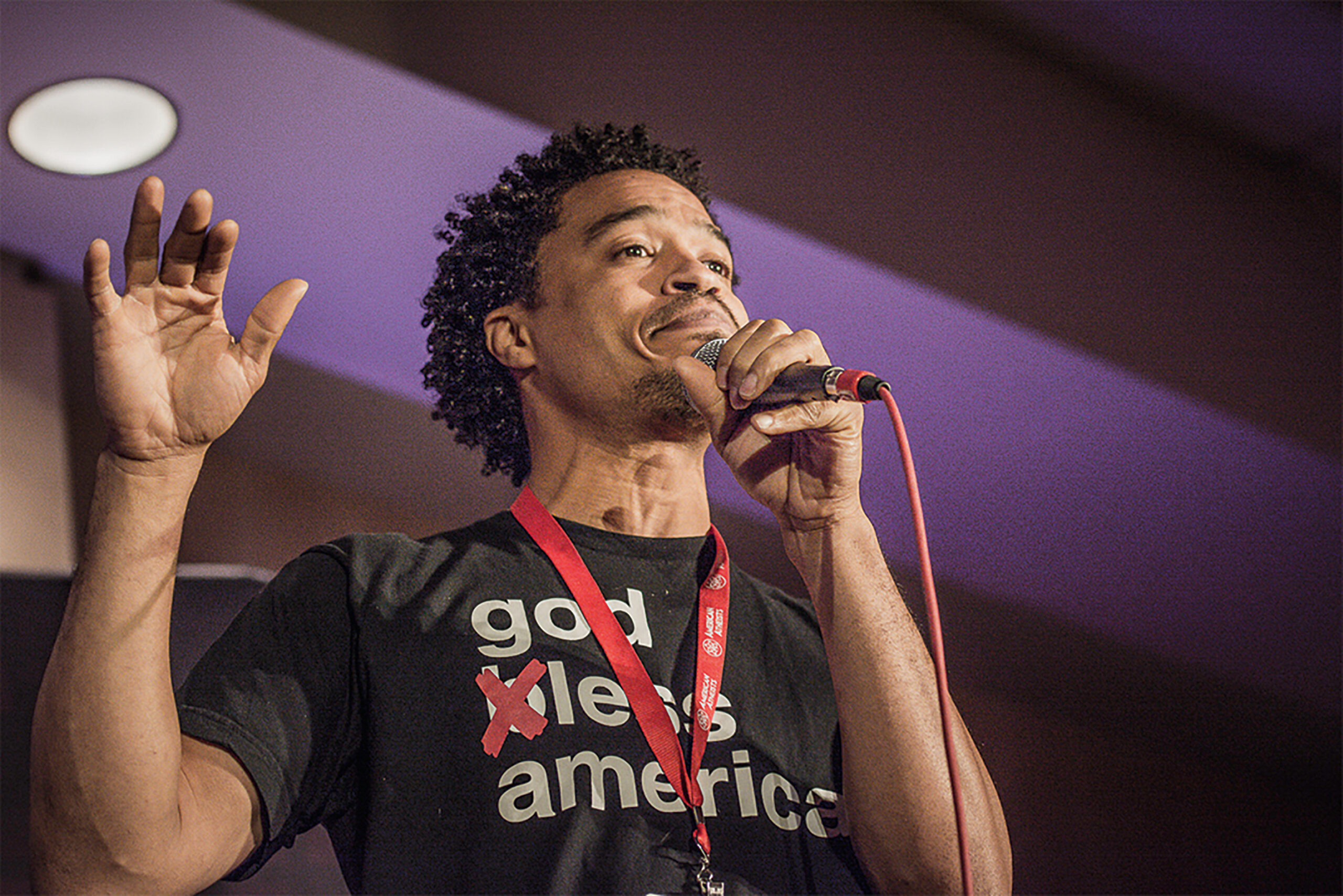
But this is a convention, not a wake, and Silverman makes a point that will echo many times throughout the weekend—a point that ironically reminds me of religious groups that faced skepticism at best and bigotry at worst before entering the American mainstream. “I think we have seen the bottom,” he says. “This convention will be used to elevate the rest of the movement. If we come out and stop hiding behind euphemisms like agnostic or humanist, if we actually call ourselves atheists, we will be able to take our place at society’s table almost immediately.”
With more than 850 attendees and a celebrity keynote speaker—House star Hugh Laurie—American Atheists appears to be taking its message on a more mainstream path than ever before. As I stand in the back of the ballroom, I can’t help noticing the attentiveness of the crowd. The room is packed but hushed. I don’t remember ever seeing a gathering this engaged for this length of time, even back in my days as a minister. The applause seems genuine, with the occasional standing ovation; none of it comes across as forced.
From the start of the convention, there has been an electricity in the air. In every corner of the hotel, I see attendees in deep conversation about everything from politics to sexuality. I find myself sharing personal information that many in my own family don’t know, and I sense no judgment. It occurs to me that I have never been this at ease with any other group of people in my life.
Multiple speakers extol the size of the country’s atheist voting bloc: The estimated number of nontheists, even on the modest end, makes them the largest voting group in the country. A 2016 Pew poll identified 20 percent of voters as white Evangelicals, while 21 percent held no religion—a whopping seven percent increase since 2008. Add that to a recent University of Kentucky study that shows as many as 26 percent of the population may be atheists, and you begin to see the potential influence of an organized nonreligious community. As Silverman suggested in our conversation, the issue among this group is not size but visibility. To harness our considerable potential, atheists must be more outspoken about our beliefs, or lack thereof.
Perhaps that emergence is already under way. Atheists are finding modest success in areas previously unthinkable: In Tennessee, Gayle Jordan, the executive director of Recovering From Religion, an organization that helps people deal with the repercussions of leaving their faith, ran for state senate, gaining around 30 percent of the vote in a deep red and highly religious district. Jordan tells me during the convention that her democratic supporters “were mostly religious people, and I ran as an out and open atheist.” Shockingly, she was also able to garner the support of many among the state’s Tea Party. Faced with the choice between “an unethical Christian Republican or an ethical Democratic atheist,” Jordan tells me it was remarkable to see the voters of her district support her. Remarkable indeed, considering the results of the 2016 presidential elections. But when you consider the right’s almost three decades of attacks on Hillary Clinton’s character, it becomes clearer how evangelical voters were able to justify voting for Trump.
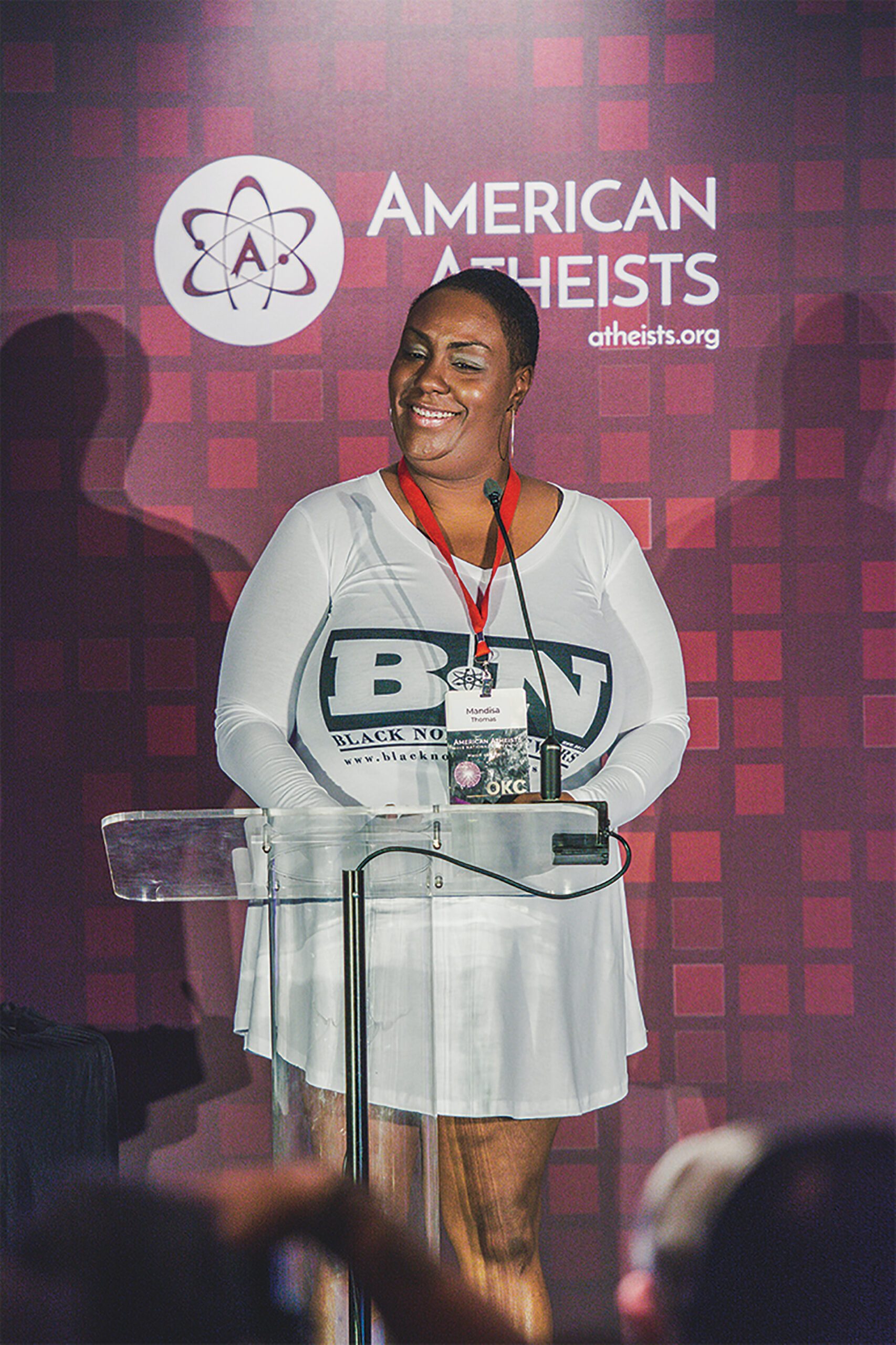
The most encouraging moment of the weekend comes when I introduce myself to Mandisa Thomas, president and founder of Black Nonbelievers, an organization dedicated to support and visibility for black atheists. Thomas, who was raised nonreligious, tells me that black nonbelievers often think they’re the only ones in what are traditionally heavily religious areas: “To say that you’re an atheist in the black community is almost like you’re trying to reject your race.” The reality, she says, is that with wildly disproportionate levels of violence, poverty and disease afflicting so many black communities, thoughts and prayers aren’t going to cut it.
“You have to say enough is enough,” she tells me. “At what point is praying or going to church going to resolve that? At what point are you going to start thinking for yourself and putting more evidence-based measures into place?”
That, in a nutshell, is what I take away from the convention: If you want things to change, you have to change them. Of course many religious organizations do great things for society, but those things often come with strings attached. Nonbelievers have the power to do good without the promise or threat of an omnipotent being.
I would like to say atheists have cornered the market on character, but Silverman’s messy departure from the organization just days after the convention serves as a reminder: No group is free of human error or frailty. Still, the work goes on. At the end of the convention—Easter Sunday, as it happens—organizers and volunteers purchase, pack and donate 30,000 meals for needy families in the area. Hundreds of atheists, including Dr. House, work shoulder to shoulder in a hotel ballroom. I leave for my ride back to the airport more encouraged than I’ve felt in years—not just in atheists but in humankind as a whole. One ideology doesn’t control the narrative for acts of kindness; it’s the responsibility of us all.
After that weekend in Oklahoma City, I feel empowered to parrot the sentiment of Hugh Laurie, who told a packed ballroom, “I stand before you a proud atheist.”
If I ever see Sandra again, I’m going to tell her.