Your bag is empty.
What do you picture in your mind’s eye when I say “Stand-up comic doing crowd work?” Is it a man in a bowling shirt asking a wine-drunk bachelorette, her plastic penis tiara hanging akimbo off her Rachel hairdo, what she does for a living?
She says “I’m a teacher.”
Bowling shirt pantomimes an air penis that he jerks off and grunts into the mic, “I’m hot for teacher!”
If it is, congrats: Your mind’s eye hasn’t been to a comedy club since 1997.
But I don’t blame your stupid mind’s eye. I blame Hannah Gadsby.
Only sorta—not really.
For the past 15 years or so I’ve watched stand-up comedy slowly eek out a market share as an art form to be taken seriously. Specials pumped out on Netflix, Comedy Central and HBO have introduced mass audiences to the great variety of stand-up comedians and the kind of art they can create simply standing onstage, talking into a mic.
Some specials even deconstructed the form: Nanette the tragi-comedy, Maria Bamford’s Special Special Special performed only to her parents, Bo Burnham’s music/comedy hybrids, Hannibal Buress’s upcoming Miami Nights special, which toys with editing in ways that make you laugh in and of themselves…
It’s really a golden age of stand-up. And yet, for some reason, there seems to be a stigma about the legitimacy of one of the form’s foundational aspects: talking to the crowd.
Maybe it’s because of these specials showcasing all this artfully written material, but the prevailing attitude seems to be that going off-script is a crutch to lean on when you run out of jokes.
Perhaps I’m being oversensitive. I mean, sure, yes, I feel defensive of crowd work because it’s a big part of my act. But damn it, I think crowd work is one of the most exciting parts of the entire stand-up experience and I resent that people think it’s somehow lazy! It’s not lazy unless you see a lazy person doing it—lying on a king size pillow, tucked into a sleeping cap mumbling “What do you do for a living” through a sleepytime tea haze.
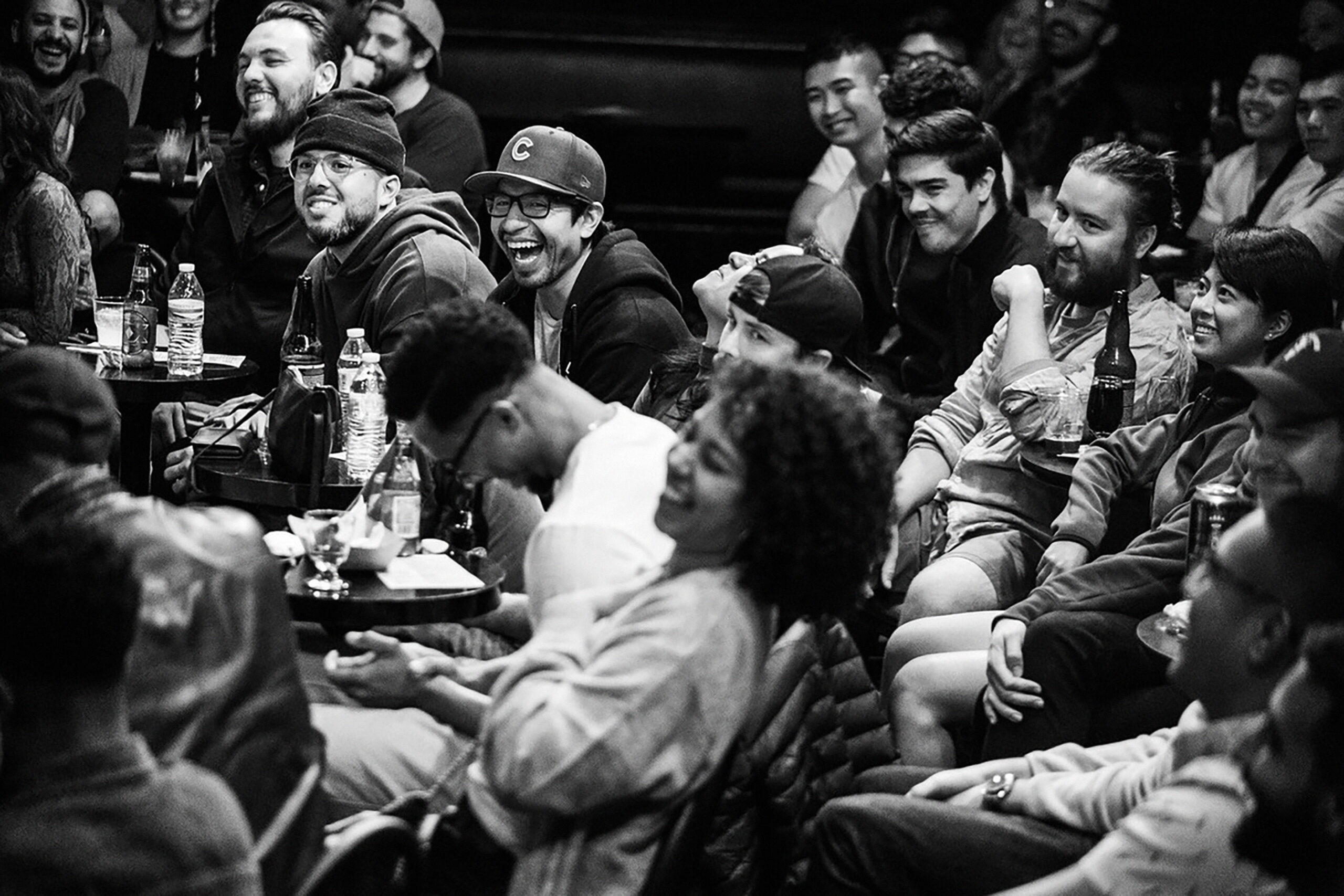
It’s a bolt of lightning—a crowd watching a performance they know was crafted exclusively for them.
It’s actually the most dangerous kind of live comedy you can do, because there’s no net. You throw a lifeline out to a stranger and hope that your brain is rapid-fire enough and their response juicy enough to create, out of thin air, a moment of comedy worth the price of admission. But when it works it’s more than that. It’s a bolt of lightning—a crowd watching a performance they know was crafted exclusively for them. That night, that crowd gets a show that no one else ever will.
There’s a story about a group of Tibetan monks who were flown out to San Francisco, commissioned by the Asian Art Museum to create a sand mandala according to their traditional practice. The Dalai Lama himself presided over the opening ceremony. For weeks, the monks painstakingly poured colored sand to create a mural of a celestial palace. Intricate images of gates and portals and heavenly creatures were hand-crafted, a grain at a time. After a month, the monks were still hard at work.
One morning, as a crowd of 200 gathered, watching the monks, a deranged woman, screaming about the CIA and Buddhist death cults, leapt over the velvet ropes, ran up to the mandala and kicked the sand in the air, destroying the thing. The onlookers, shocked and appalled by what had just happened, seized the woman, screaming with anger.
The monks, however, just calmly cocked their heads and regarded the wreckage of their work. One of them remarked, “So that’s how this was supposed to happen.”
Together that audience and I created, out of thin air, a sand mandala made of memories.
That’s how it feels when I’m performing and doing crowd work. Like the wildest thing I’d never expected to happen just blew up in my face and it’s the most exciting moment imaginable.
Don’t get me wrong. I love jokes, crafted and honed over months until they are just perfect, but the most fun I ever have onstage is when someone says something that kicks everything in the air like a plume of colored sand and we all, performer and audience alike, realize, “Hmm! So that’s how this was supposed to happen!”
With a few exceptions (delightful moments in Paula Poundstone’s specials, Todd Barry’s Crowd Work Special and Big Jay Oakerson’s Crowd Work Sessions albums) grabbing those moments of temporary magic and recording them for posterity have proven difficult.
In my new album, Crowd Surfing, I attempted to bottle a bit of that lightning by making it a semi-concept album. Rather than simply commenting on the things I saw in the room that night in Washington DC, I asked the crowd a few specific questions to elicit their wildest stories, their craziest memories. Together that audience and I created, out of thin air, a sand mandala made of memories. Well—memories, sex work, drugs, corvettes, wildlife, Jesus Christ and a beautiful tale of a man being shit upon by a lover. Like I said, I’m a master at work.
The Dalai Lama would be proud.