Your bag is empty.
Shane Bouvet once supported Obama. Now he's blessed by Trump. What changed?
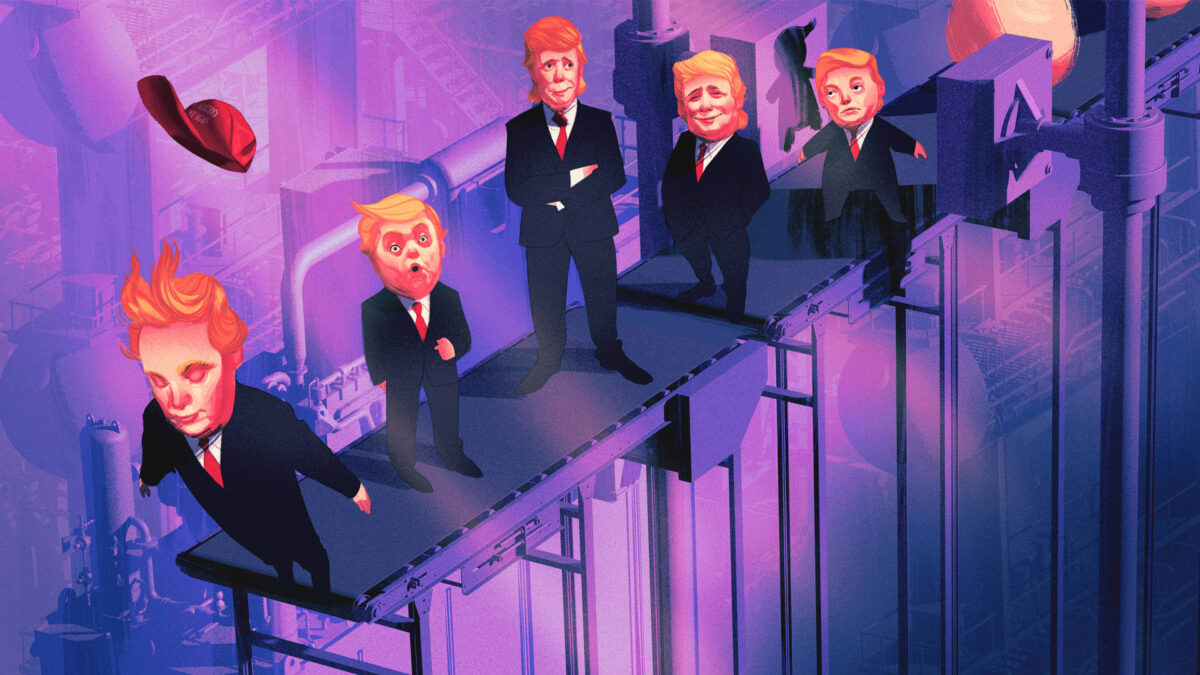
“This town is about access,” a lobbyist with a slight lisp tells me. He’s wearing motorcycle gloves and chewing on a cigar. “Right now, he’s got access to the president. That’s power.”
He is an unremarkable vision: a slightly overweight 25-year-old in a discount suit-and-tie, who’s driven by a peculiar affection for President Donald J. Trump.
My first impression is that I like him. I like him a lot, even as he wobbles toward me in the discount dress shoes you’d find on the clearance shelf at Sears. “Very poor” is how he describes his childhood, which gave him an incorruptible nose for the working class. “If I don’t smell garbage, I don’t feel at home,” he says, as if he’s giving a stump speech to a union of garbage haulers. Though he’ll never admit it, Shane Bouvet, the young man who stands beside me, is a natural populist, even a gifted fabulist. He’s the archetype of the “white working class” activist; he’s Steve Bannon’s wet dream.
Bouvet’s got a vaguely Southern accent to sell it, too, like Hank Hill lecturing his son on the va-yoo of hard work. Outside the White House, as he straightens his Trumpy tie for a meeting with Trump himself, his boughten bestie, Bouvet spends our time together romanticizing the glory days of manufacturing, when the engines roared as his grandfather dug coal within Pawnee, Illinois’ Peabody Cole Mine #10, which closed in 1994, smoking 400 jobs and most of the coal in Christian County. “I can already see manufacturing coming back,” Bouvet says, who’s part of chorus of folks who blame Obama-era environmental policies for burying the coal miner.
Trump represented an aspirational brand for boys like Bouvet; Hillary represented four more years of boarding school.
But even the most enthusiastic of coal miners can admit their industry isn’t declining because the former president enacted thousands of often meaningless environmental regulations. “Coal isn’t coming back to Stonington,” admits Ryan Marucco, the mayor of Stonington, Illinois, Bouvet’s hometown. Marucco knows the coal industry well: his grandfather was a miner. Stonington, population some 900, sits 25 miles east of Pawnee, whose populous is three times the size. “I can hear wind turbines being built,” Marucco sounds. “The future is in green energy.”
Even so, the economics and science behind coal’s downturn doesn’t matter a lick to whom Bouvet calls the “forgotten American”—blindly sentimental crusaders who viewed Barack Obama’s years in office with biblical levels of suspicion. “Obama forgot about us,” says Bouvet. On Election Day 2016, President Donald Trump took Christian County, the seat of Stonington, by 42 points. Of course, Illinois is historically a blue state, carried by its liberal beating heart, the city of Chicago and its surrounding suburbs. But journey out of its urban centers and Illinois bleeds red into the down-currents of the Mississippi River.
According to Bouvet, Trump connected with voters there because he spoke to the victims of the Great Recession in daftly direct terms. His poorly composed tweets—some might argue purposefully ungrammatical—empowered them to also “tell it like it is.” It most certainly clicked with them more than Obama’s flare for top-lofty oration or Hillary’s mechanical feminism.
The reason Bouvet is at bended knee outside the White House, however, is not his affinity for coal or Trump’s shit-posting. It’s because he’s gained rank within the Trump movement, a cottage industry that seems to have an ease of entry that doesn’t exist in our traditional party apparatus, where college degrees and trust funds have historically dictated one’s growth potential. For Bouvet, who was rejected by the Illinois Republican Party, his “in” with Trump represents opportunity to hitch a ride on the fast-moving American dream train.
“Illinois politicians told me I had no talent,” he tells me. “But God said I did. And I wanted to show the president I did.”
Nearly two years into his presidency, it has become clear that Trump’s win was based partly on him offering his soldiers a Faustian bargain and empowering them as “Made Guys” in the movement. He emancipated them to fight his war to Make America Great Again as he would advertise his intentions. The alternative was mother superior, in her Maoist pantsuit, waving a wooden ruler and scolding them for cursing, trolling and spending their paychecks on trips to the shooting range. Trump represented an aspirational brand for boys like Bouvet; Hillary represented four more years of boarding school.
“I was eating scraps during the campaign. And nobody in the Hillary campaign could compete with me. It was like God had told me my path was social media.”
“If Donald Trump had $10 dollars, he’d turn it into a millions,” Bouvet preaches.
He wasn’t always a conservative. He had previously supported Obama, but lurched right in 2016 because Trump was a “straight shooter” like his grandfather, who passed away on July 12, 2017. Bouvet saw his grandfather in Trump and began pamphleting for the candidate in the 900-person Stonington. Indeed, to truly absorb an unashamedly simple guy like Bouvet, you need to start with his roots. Stonington is a mere speck; a literal village planted with towering grain silos that act as fabricated hilltops. Its lifeblood is agriculture (not coal), with thousands of acres of corn and bean fields manned by locals who would recognize Bouvet from his days of scrubbing the floors of the local Kroger, delivering packages for FedEx or, yes, campaigning door-to-door for Trump—occasionally wearing a panda costume in the sweltering heat.
Bouvet evolved into a pro-bono salesman and mascot for the cause, spending his own money on lawn signs, hundreds of bumper stickers and a cell phone to create memes for pages like “Team Grassroots Trump.” He says he spent everything he had on the Trump campaign. “He was more important than anything else. I was eating scraps during the campaign. And nobody in the Hillary campaign could compete with me. It was like God had told me my path was social media.” Bouvet wanted to be number one; he wanted to be Trump’s actual apprentice. This is the sort of story that could never happen in the Hillary machine, where volunteer seemed handpicked based on privilege, blood and their resumes.
Indeed, Bouvet meeting Trump is a remarkable story; it is a moment that Bouvet actually says saved his father’s life. “That 10,000 dollars helped pay for his chemo.”
His sacrifice paid off. As we walk toward the gates of the White House, Bouvet yarns about the day he finally met the president, a man he first discovered on The Apprentice and one he views as the “embodiment of the American Dream.”
Trump learned of Bouvet in less romantic terms: while reading the Washington Post. The article, dated January 18, 2017, told the story of a poor Trump volunteer who couldn’t afford a suit for the inauguration. That’s when the president decided to invite Bouvet backstage at the inaugural ball. That led to a second story in the Post, on January 19th.
That evening, Trump took Bouvet’s trembling hand, squeezed it tight, repeated “You’re a celebrity” and—reportedly perplexing his aides—promised Bouvet a $10,000 check after finding out Bouvet’s father was suffering from cancer (as reported by the Post). “I started to cry,” he says. “I’d worked hard for the president, I tell you what, but I’m just small-town guy and, I dunno, man.” Bouvet says his story.
Today, he has thousands of followers on Facebook, where he crudely salutes Trump as both advocate and fanboy. One post from earlier this year reads, “Obama will go down as the worst President in history, especially foreign policy. Real News Award: Donald J Trump America’s Greatest President – Fact!”
Any criticism of Trump is seen as either a sign of disloyalty or derangement. For Bouvet, there’s nothing Donald Trump can do wrong. He’s often at a loss for words when he talks the moment Trump christened him as his second-hand apprentice, which turned him into what Politico described as a “hero in the Trump movement”—a small-town idealist who nurtured a bromance with history’s most unromantic president. Indeed, Bouvet meeting Trump is a remarkable story; it is a moment that Bouvet actually says saved his father’s life. “That $10,000 helped pay for his chemo.” Don Bouvet is an Army veteran who’s now recovering from bladder cancer. “The president saved ma’life,” Don tells me, tears filling his heavy-lidded eyes.
While Trump’s $10,000 donation turned Bouvet into a political folk hero and has forever preserved his name in D.C. newspaper ink, in Stonington, things got muddy. “People think I’m making this up. Can you believe that?” Bouvet confides in me, telling me that several local have accused him of fabricating his father’s cancer diagnosis. After we meet, he forwards me several Facebook messages from people accusing him of being a social climber and charlatan. He tells the story of a local mortgage lender who printed boxes of T-shirts with Bouvet’s face on them. “He printed thousands of them to sell at the town fair and CPAC,” says Bouvet, who eventually left his job at FedEx to work for the same mortgage lender’s company. His new boss then traded a down payment on a car for a piece of Bouvet’s celebrity; slapping a custom license plate that advertised his company on Bouvet’s car. Bouvet was hired, he claims, because of his relationship with the president—his “access.”
“I’d got to work and he’d tell me to just go home, which just felt wrong,” says Bouvet. “Then he started asking me for the president’s phone number. He was just using me to get to the president.”
With 12 months of small-town grudging behind him, and with Bouvet stuck with payments on a car he can’t afford, he made his way back to the White House. Which leads us to now. “I just want to finally thank him for what he did for me and my dad,” he says. “My dad is life, liberty, and the pursuit of happiness.” Bouvet, often speaks like he’s giving a history lesson to a troop of Cub Scouts, or reciting one of Ronald Reagan’s personal letters. “We’re at People’s House, can you believe it?” Bouvet says to his dad, as they walk down the hall toward the Oval Office.
The two are unarguably idealists with jointly beating hearts—as wrought-gold as the trimmings of Trump Tower—wrestling for a piece of the American Dream that’s become as untraceable as Big Foot. “It doesn’t look real,” Don Bouvet told his son as he sat in the Vice President’s chair, a well-timed distraction or spin-move for the president, who was dealing with the Mueller investigation and the Rob Porter scandal.
“Do you have a comment on Mr. Porter?” asked a reporter, uninterested in the Bouvets. “Well, we wish him well…” said the president, as Bouvet, with his fingers crossed together in obedience, stared with wide-eyed admiration.
“I always felt like he and I were friends,” says Bouvet.
His is a devotion that goes beyond deference for the office, or any sort of rational thinking or flag-waving patriotism. Bouvet’s love-affair with the president qualifies as next level. If you’re with Bouvet long enough, he’ll do something indescribably odd, something only a fetishist would: he’ll begin imitating Trump’s signature on anything he can grab a hold of, which he does with Trump’s favorite fine-tipped roller pen.
“Did you know that I have over 30 real autographs of President Trump? I call them my treasures.” Each autograph’s been carefully encapsulated in plastic, stamped with seals of authentication and graded through professional services like Becket. Bouvet keeps his Trump autographs inside a combination safe, like rare banknotes, part of collection he values absurdly at $100,000 and change. Bouvet’s bedroom, he tells me, is festooned with a coffee-stained casino filing, a letter outlining a Trump reality show, an MMA ticket, media credentials (all signed by Trump), 180 copies of Trump’s Rolling Stone cover from 2015 and his VIP pass to the inaugural ball. The pièce de résistance of his “Trump museum” is a personal note from the president himself: “Shane: You are a great guy—thanks for all your help.” It’s the sort of hobby that can either get you a cameo on Pawn Stars, or on a shun list, like the collector of Luftwaffe artifacts.
“I never thought I’d meet the president again,” says Bouvet back in D.C. “But I tell you what, signatures last forever. I’ll give these to my son one day.” Bouvet has partial custody of a five-year-old son, Landen, who was born out-of-wedlock when he was 20. That’s not an atypical story: In rural counties, the teen birth rate is almost nine percent higher than the national teen birth rate, according to 2016 numbers reported by the Centers of Disease Control and Prevention.
After his meeting with Trump that felt longer than it should have been, Bouvet walks out holding a sheet of paper like a schoolboy holding up his report card. “It’s personal note from the president,” he tells me. “To Shane: Great Going,” signed Donald Trump, who may be the most accessible president in modern history.
And maybe too accessible. “He gave me another $5,000 dollars,” say Bouvet.
Critics in the press say Trump’s a curmudgeon who refuses to make himself available to anyone except believers like Bouvet and the cigar-smoking lobbyist from earlier, who Trump treats with militaristic comradeship. “We see the president as a brother,” says the lobbyist. “He finally told it like it is.”
“I always felt like he and I were friends,” says Bouvet, who now worships at four different altars: family, God, country and Trump, the personal Jesus of Bouvet’s political ambitions, which he’s adjusted based on his own humble limitations under the learning tree of Trump. “I want to be president one day,” he says. “But I’m probably too short and not good looking enough.”